

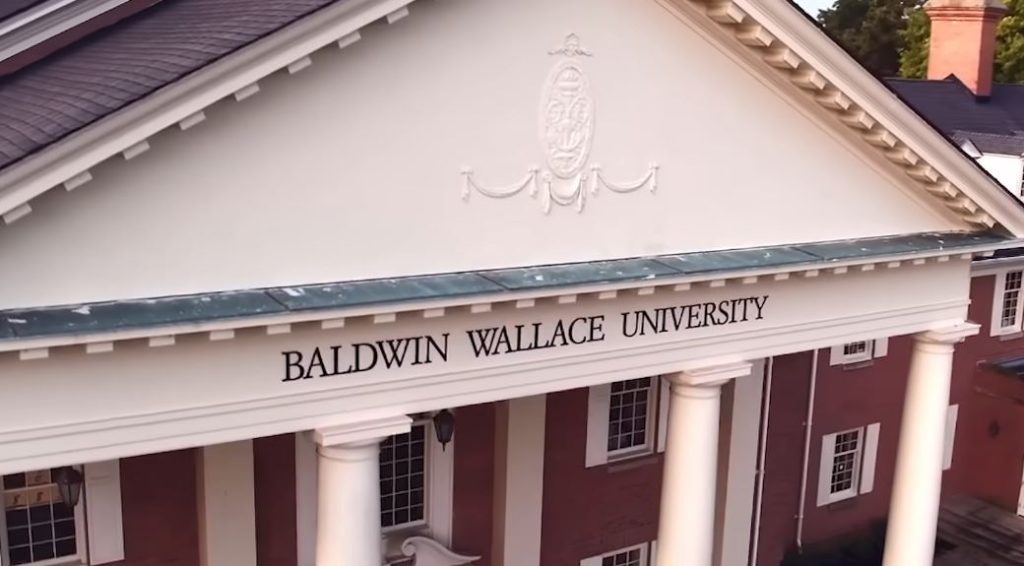
Last week, the letter was sent out quietly via email on a Friday afternoon when the campus had already begun to thin out for the season, just like these things usually do these days. The decision had already been made when Berea learned about it. Founded in 1845 in a town that used to refer to itself as the “grindstone capital of the world,” Baldwin Wallace University was cutting once more.
Seven graduate programs, nine undergraduate majors, and nineteen minors. Ten faculty positions have been eliminated. As the conclusion of a “semester-long academic optimization process,” President Lee Fisher emphasized that the school was “not stepping back.” When you put this phrase next to the list of things that are actually being phased out, it appears odd.
Among the casualties was music theory. I was struck by that particular detail. One of the few locations in the Americas with manuscripts in Bach’s own hand, this school’s Conservatory and Bach Institute are undoubtedly its greatest assets. However, it is subtly cutting back on the kind of curriculum that gives a conservatory its backbone. In an anonymous interview with Cleveland Scene, a former faculty member asked directly, “How do you call yourself a liberal arts college when you cut music theory?” Yes, it’s an emotional dispute. However, it’s not irrational.
It becomes truly confusing when you look at the numbers. According to reports, BW reported a $9.4 million surplus in fiscal 2025, a significant departure from losses of $7.1 million and $11.4 million in the two previous years. According to its own accounting, the institution is therefore making a comeback. Nevertheless, the cuts continue to occur. According to the administration’s reasoning, the ten positions that were eliminated account for less than 2.5% of the full-time workforce, a minor reduction that is in line with student demand. In theory, that math is accurate. Additionally, it ignores how a campus feels about these things—not as percentages, but as coworkers organizing their offices.
Additionally, this isn’t BW’s first round. In 2024, the university faced a projected $20 million deficit and eliminated dozens of positions. Since then, three former professors have filed a lawsuit, claiming that the layoffs were discriminatory, ageist cuts disguised as a “reduction in workforce.” Their grievance raises an important point: BW never used the official procedure that permits a school to suspend tenure protections—financial exigency. The university has decided to dismiss, citing a lack of crucial context. That will be resolved by the courts. However, it permeates everything.
As this develops, it seems as though BW is caught in the same current that is affecting small private colleges worldwide: dwindling traditional enrollment, growing expenses, and the gradual deterioration of the broad liberal arts model. Fisher, a former lieutenant governor and attorney general of Ohio who once turned around a law school with a large deficit, obviously understands how to read a balance sheet. It’s a different matter entirely whether you can use spreadsheets to get out of an identity crisis.
Nobody can quite predict what will happen to Berea. Graduates from the school are fed into local health systems, schools, and artistic organizations; as the programs get thinner, those pipelines also get thinner. Alumni are concerned that future recruitment will be more difficult rather than easier due to the cumulative trimming, with a quieter institution marketing itself to students with a plethora of options. In the upcoming weeks, administrators promise to provide more information about teach-outs and advising.
It’s difficult to avoid feeling as though something is being lost here that won’t appear in the budget for the following year. This is the agonizing math of survival, and perhaps Fisher is correct. Perhaps the resulting campus is more honest about what it can support and is leaner. Or perhaps a 180-year-old establishment is gradually losing its significance. For now, Berea waits to find out which version is accurate while the offices close and the catalog gets smaller.
