

In a short, seemingly unremarkable moment, the whole thing is revealed. You find that everyone else in the room is doing exactly what you were just doing when you look up from your phone while sitting in a café with mismatched chairs and a slow espresso machine. Nobody is talking. Indeed, no one seems to be unhappy. But in reality, nobody is there either. It’s hard to deny that this scene, which appears frequently in places like Brooklyn and Karachi, has somehow become the standard in public life.
Ignoring the evidence that supports that observation is becoming more difficult. A cross-national study that tracked adults in Norway, the UK, the US, and Australia found that increased social media use was associated with higher levels of loneliness. Those who used the platforms specifically to maintain relationships experienced the biggest impact. That final detail is the peculiar one. Those users who wanted to connect were the ones who departed feeling emptier. It appears that the tool is doing precisely the opposite of what its users believe it is doing.
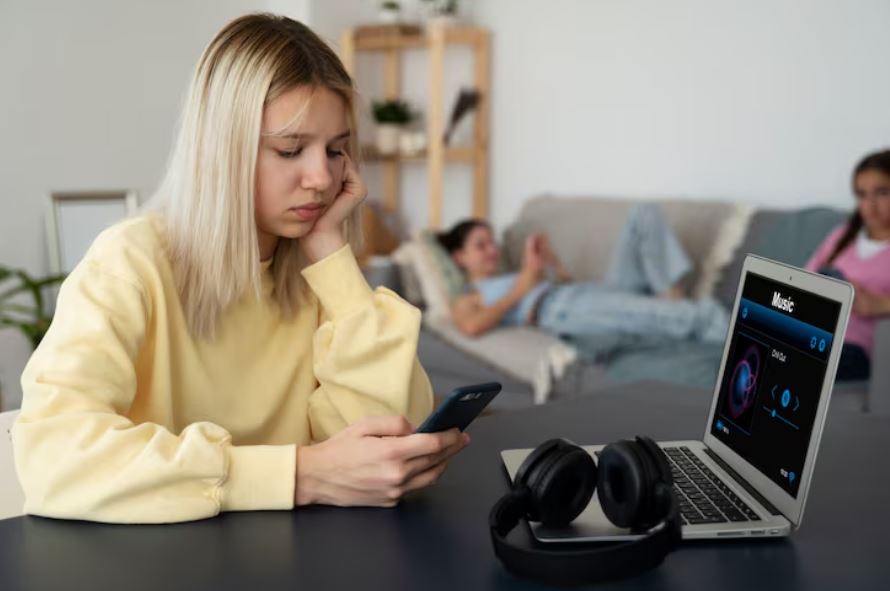
The mechanism is obvious once you start looking. User satisfaction is not taken into account by engagement algorithms, the invisible machinery that decides what you see. They are adjusted for time. Furthermore, engineers have secretly discovered that the emotional states that compromise wellbeing—such as anxiety, comparison, low-grade outrage, and the itch of an unfulfilled notification—are also the ones that retain attention the longest. It’s possible that loneliness was not the designers’ intention. But the system rewards it, and what is rewarded increases.
More subtly, researchers at King’s College London recently found that different platforms behave differently. Oddly, WhatsApp seemed to be linked to less loneliness. The opposite pattern was seen on Reddit and YouTube, where the majority of consumption is passive. The pattern indicates that people are not hollowed out by screens, which a generation of parents has been clumsily trying to explain. It has to do with the kind of screen and how it is supposed to be used.
During policy discussions, the slower, more depressing erosion beneath is ignored. Third places—dining establishments, barbershops, neighborhood parks, and the corner spots where you happened to run into people without planning—have been quietly disappearing for decades due to suburban sprawl, rising rents, and the replacement of foot traffic with feeds. Loneliness usually has no antagonist on this scale. It accumulates. The platforms did not create isolation. They profited from its acceleration.
As I watch this unfold, it seems to me that the most accurate framing is more mechanical than accusing. A system created for engagement and put into place on a global scale would unavoidably find that the human nervous system is most alert when it feels a little scared, inadequate, or alone. The underlying biology is the same, despite the cigarettes-per-day analogy being used so often that it has lost some of its impact. Cortisol doesn’t care if you understand why you’re feeling so bad.
Whether any of this has changed is still unknown. Regulators are circling. Internal research is still leaking. Examples of a minor but noticeable counter-movement that has started to suggest that people are gradually coming to their own conclusions include flip phones, walking clubs, and the sporadic resurgence of book clubs. There will be no self-correction by the algorithm. It didn’t break. In the end, that is the uncomfortable part.
