

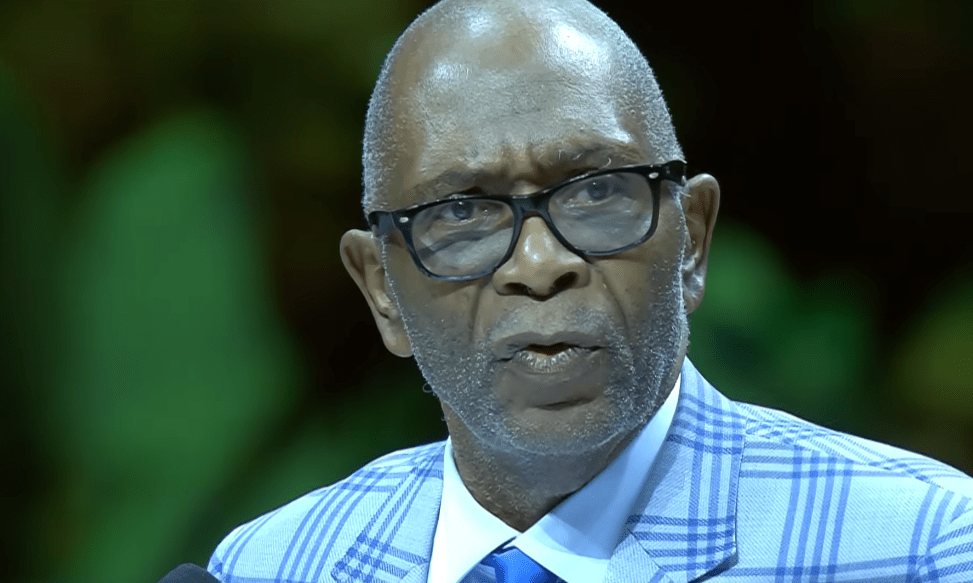
Credit: Dallas Mavericks
When the ovation subsides and the player who used to command arenas turns quiet beneath a spotlight, there’s a different type of quietness. That moment arrived for Mark Aguirre as his jersey soared into the rafters—a thoroughly earned honor—but his voice, normally calm, trembled.
In addition to becoming a champion, he also had to deal with the pressure of being seen when he wasn’t feeling well. In recent days, supporters observed the pauses, the softened posture, the glances between him and Isiah Thomas that communicated more than words could.
| Category | Details |
|---|---|
| Full Name | Mark Anthony Aguirre |
| Date of Birth | December 10, 1959 |
| Hometown | Chicago, Illinois |
| NBA Career Highlights | #1 Pick in 1981 NBA Draft, 3× All-Star, 2× NBA Champion with Pistons |
| College Career | DePaul University; 1980 Naismith College Player of the Year |
| Jersey Retirements | No. 24 retired by Dallas Mavericks and DePaul University |
| Health Concerns | Hospitalized in 2011; recent public appearances raised new concerns |
| External Source | SLAM Report: https://slamonline.com/archives/mark-aguirre-hospitalized/ |
Aguirre hasn’t publicly provided details regarding any current health concern. However, rumors have continued to circulate despite this, especially after a clearly emotional moment during his jersey retirement ceremony. Thomas, his lifelong friend and former Pistons player, rushed up to comfort him without hesitation.
Back in 2011, Aguirre collapsed during a workout in Plano, Texas, and was hospitalized in bad condition. For those who followed his career, that episode served as a silent reminder that athletes age too, even though it was no longer in the news. They simply age more noticeably than the rest of us.
What makes Aguirre’s story particularly touching is how smoothly it integrates genius with humility. He wasn’t just a high scorer—though his 24.6 points per game with Dallas surely rank as elite—he was a leader who changed when necessary, notably after joining Detroit and accepting a reduced scoring role to help the Pistons win titles.
During the ceremony, when asked what it meant to have Isiah Thomas by his side, Aguirre visibly broke down. The tears were genuine, not fake, and the crowd knew it. It was the kind of event that brings a crowd closer rather than driving it away.
I watched that film again, and what jumped out to me wasn’t just the emotion—it was the silence between statements, the way Thomas didn’t talk, but just grasped for his friend’s shoulder. That tiny gesture conveyed everything about the friendship they’ve carried since high school in Chicago.
Aguirre was recognized for his smooth mid-range jumper, his ability to operate in traffic, and his confident yet unflashy presence on the court. Now, decades later, his public appearances seem to mirror that same calm resolve. Even when he appears physically weakened, he remains grounded, focusing on thankfulness instead of attention.
It’s not uncommon for athletes to keep health problems private, and that limit deserves respect. However, the fear from fans and former teammates has become stronger, particularly considering Aguirre was previously considered as practically indestructible. He wasn’t just part of the Bad Boys era—he epitomized its grit.
When the Mavericks retired his jersey, it was more than a formality. In a way, it was a corrective. For years, Aguirre’s contributions were often overshadowed by rivalry with coaches or trade turmoil. But clarity has come with time, as it frequently does. Both on the scoreboard and in the recollections of those who witnessed him play, his influence is now remarkably evident.
Isiah Thomas has asserted openly that Detroit wouldn’t have won those titles without Aguirre. That kind of comment highlights Aguirre’s worth as a connector as well as a player, especially coming from someone who hardly ever takes compliments lightly. His combination of brilliance and selflessness is becoming more and more uncommon.
By allowing himself to be vulnerable throughout the ceremony, Aguirre reminded us of something surprisingly powerful: strength doesn’t always shout. Sometimes, it stands quietly while old teammates catch you when the emotions arrive faster than the words.
The conjecture regarding his health is sure to continue. Perhaps more significant, though, is Aguirre’s decision to be present rather than make pronouncements. Even while he is no longer the game’s sharp-cut scorer, he is still very much a part of the narrative.
In the context of aging athletes, Aguirre’s approach is particularly instructive. He isn’t clinging to youth. He isn’t disappearing either. He’s engaging where he can, recognizing the past, and letting others who care about him bear witness—even when it’s difficult.
His legacy is already safe. Mark Aguirre has already contributed more than most athletes ever do, from his supremacy at DePaul to his metamorphosis in Detroit, from high school titles to the NBA Finals. The fact that he continues to stand, to speak, to reflect—that’s an act of strength on its own.
And maybe clarification will come in the upcoming months. Or perhaps not. But any way, the admiration has already arrived, and this time, it feels permanent.
