

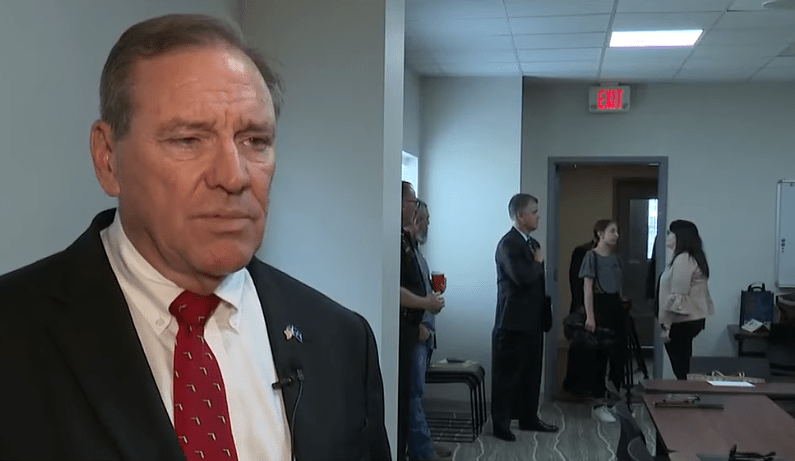
Credit: WJHG-TV NewsChannel 7 | Northwest Florida
It seemed strangely unplanned. A very private detail was revealed in a space intended for ceremonial speeches and policy announcements. At first, it was presented more as a casual remark than a headline, but it made a big impression. Former surgeon and current congressman Neal Dunn was reportedly given a terminal diagnosis.
Hearing such news from someone else rather than the person themselves can be unsettling. In this instance, it was almost casually disclosed during a press conference before anyone had a chance to consider its implications. There seems to be a subtle but noticeable shift in the room as you watch the exchange take place.
| Category | Details |
|---|---|
| Full Name | Neal Patrick Dunn |
| Age | 73 (as of 2026) |
| Profession | U.S. Congressman, Former Army Surgeon |
| State | Florida, USA |
| Political Party | Republican |
| Years in Office | Since 2017 |
| Medical Background | Practicing physician before politics |
| Recent Development | Reportedly faced a “terminal” heart condition |
| Current Status | Improved following medical intervention |
| Reference | https://www.congress.gov/member/neal-dunn/D000628 |
According to public reports, the diagnosis itself involved a severe cardiac condition. There were rumors that Dunn might only have a few months to live. The phrase used was stark and unvarnished: “Dead by June.” It’s even more startling because doctors don’t often use such direct language in public.
A description of the intervention—specialists, procedures, and a complicated operation involving extra stents—came next. Those who spoke claimed that the result had drastically changed. A situation that was once thought to be terminal changed. Maybe manageable. even optimistic.
The fact that Dunn has mostly kept quiet about the details only serves to increase the uncertainty. His office stressed that he still works and keeps a full schedule while characterizing his health as a personal matter. The fact that he showed up, attended hearings, and carried out his duties contrasts with the seriousness of the initial allegation.
Health is never just about the individual on Capitol Hill, where personal realities frequently collide with political calculations. Dunn’s predicament has ramifications that go beyond his personal welfare at a time when the House majority is extremely slim. It’s difficult to ignore how quickly the topic of concern gave way to statistics, such as votes, margins, and stability.
His health had been the subject of quiet rumors for weeks before the public revelation. Coworkers speculating in the hallways, staff members speaking softly. There was enough evidence to imply that something significant was happening, but nothing was confirmed. When the diagnosis was eventually made public, it was startling rather than entirely unexpected.
In politics, the distinction between the public interest and individual privacy has never been clear. After all, elected officials have positions of authority that may be impacted by their health. However, exposure and transparency are not the same thing. between disclosing and educating.
Whether Dunn intended for any of this to be shared in that manner is still up for debate.
The issue of recovery is another. Medical interventions can result in significant improvements, particularly in cardiac cases. Blood flow can be restored with stents. Conditions that appeared dire can be stabilized through procedures. However, the word “terminal” is powerful, and its reversal raises concerns about diagnosis, timing, and the communication of such assessments.
As you watch this play out, you get the impression that it’s not just about the health of one man. It concerns the flow of information, including who is in charge of it, how it is presented, and what happens when it crosses its intended boundaries. Even extremely private information can take on a life of its own in a time when anything can become public in a matter of seconds.
Another layer is added by Dunn’s medical background. He is aware of the subtleties underlying each clinical statement, the language of diagnosis, and the uncertainty associated with prognosis. The situation may become more complex rather than less complicated as a result of that knowledge. Because being aware does not always equate to being in charge of the story.
Official comments have been noticeably restrained in the days since the revelation. No thorough medical reports, no lengthy justifications. Just a subdued continuation of work, as though to imply that life—and politics—moves on regardless of what transpired.
That contrast is difficult to ignore. The initial disclosure’s dramatic language contrasted with the subsequent steady, nearly everyday rhythm.
There’s a feeling that the whole story might never be fully understood. And maybe that’s right. Certain things defy easy explanations.
However, the actual moment—the unanticipated disclosure, the uneasy responses, the abrupt change from private to public—lives on. It felt genuine in a way that political moments seldom do, not because it was dramatic.
And something more profound was revealed in that brief, candid conversation. The delicate line separating one’s private and public lives is rather than merely a diagnosis.
