

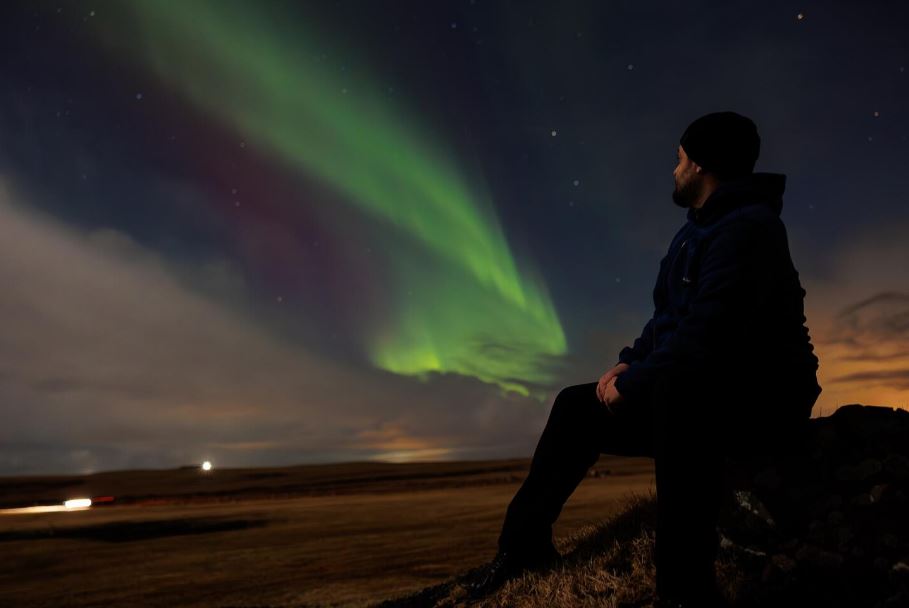
When an aurora forecast begins circulating online, a certain level of anticipation develops. Checking the weather doesn’t feel like it. It is more akin to waiting for an uncertain, almost theatrical event. A small group of people gathered in a parking lot somewhere north of Edmonton on a recent evening, their phones glowing with real-time updates from space weather dashboards and their engines idling to stay warm. Someone would glance up every few minutes, seemingly anticipating a reaction from the sky.
The most recent forecasts suggest a geomagnetic storm caused by a coronal mass ejection drifting toward Earth. The NOAA Space Weather Prediction Center’s scientists have been cautious but quietly hopeful, speculating that if all goes according to plan, conditions could reach G2 levels, possibly even G3. But that alignment is where the complexity lies. Solar particles may enter Earth with the wrong magnetic orientation, leaving only a trace.
| Category | Details |
|---|---|
| Phenomenon | Aurora Borealis (Northern Lights) |
| Governing Body | NOAA Space Weather Prediction Center |
| Key Measurement | Kp Index (geomagnetic activity scale) |
| Forecast Model | OVATION Model |
| Primary Cause | Solar wind & coronal mass ejections (CMEs) |
| Best Viewing Regions | Alaska, Canada, Scandinavia, Northern U.S. |
| Peak Viewing Time | 10 PM – 2 AM local time |
| Major Trigger | Geomagnetic storms (G1–G3 levels) |
| Limiting Factors | Cloud cover, light pollution |
| Reference Website | https://www.swpc.noaa.gov |
Aurora forecasting has always involved an odd combination of accuracy and speculation. By mapping glowing ovals around the poles that expand and contract in response to solar wind pressure, models such as OVATION can forecast activity within a 30- to 90-minute window. There is a sense of control, of science skillfully charting chaos, when one looks at those maps—green turning to red as intensity increases. However, when you go outside, the experience frequently deviates from the plan.
For instance, locals in Iowa recently discovered that they were unexpectedly close to the aurora zone. It’s not usually connected to the northern lights. Miles of flat fields are punctuated only by far-off farmhouses and silos. However, those same fields become viewing platforms on some nights when geomagnetic activity spikes. However, cloud cover arrived at the height of activity, masking what could have been an exceptional performance. There’s a subtle annoyance as you watch that happen—nature providing something remarkable, then taking it away at the last second.
The forecast is further complicated by a seasonal component. The Russell-McPherron effect can intensify geomagnetic interactions around the spring equinox, increasing the likelihood of seeing auroras. Although it doesn’t frequently make headlines, this detail has a subtle impact on outcomes. The mechanism is understood by scientists. But forecasting its precise effect on any given evening? less certain.
The actual tools are now easier to obtain. Apps that convert complicated space weather data into straightforward notifications, such as aurora trackers, send alerts when activity increases. an increase in the Kp index. a change in the Bz value. These figures are now part of a new kind of routine for many users, who check the sky for solar activity millions of miles away, along with clouds. It’s difficult to ignore how this has altered the experience, making what was once impromptu seem almost planned.
Nevertheless, the aurora’s unpredictable nature persists despite all of this technology. Forecasts for Vancouver indicated that the same geomagnetic storm might cause a display this week. However, those opportunities have probably been eliminated by an atmospheric river that brings heavy clouds and continuous rain. It serves as a reminder that even the most precise space weather forecast still depends on common factors like local cloud cover.
The aurora forecast seems to be at a unique nexus of hope and science. Although it is based on data, such as solar wind speeds, magnetic field orientation, and geomagnetic indices, it is interpreted based on human expectations. People adjust their schedules, drive hours into darker areas, and keep an eye on the horizon in order to plan trips around it. It can be profitable at times. It doesn’t always.
It seems as though the forecast has become a part of the experience as you watch this play out. It’s more than just a tool; it’s a story that builds suspense, influences choices, and sometimes disappoints. Whether modeling advancements will ever completely reduce that uncertainty remains unclear. After all, the sun doesn’t follow human timelines.
And perhaps that’s what makes it appealing. The aurora is more than just a sight to behold. It’s something to look forward to, miss, and pursue once more. Even with improved data, forecasts, and alerts, there will always be that moment when you’re standing in the dark, not knowing if anything will happen at all.
