

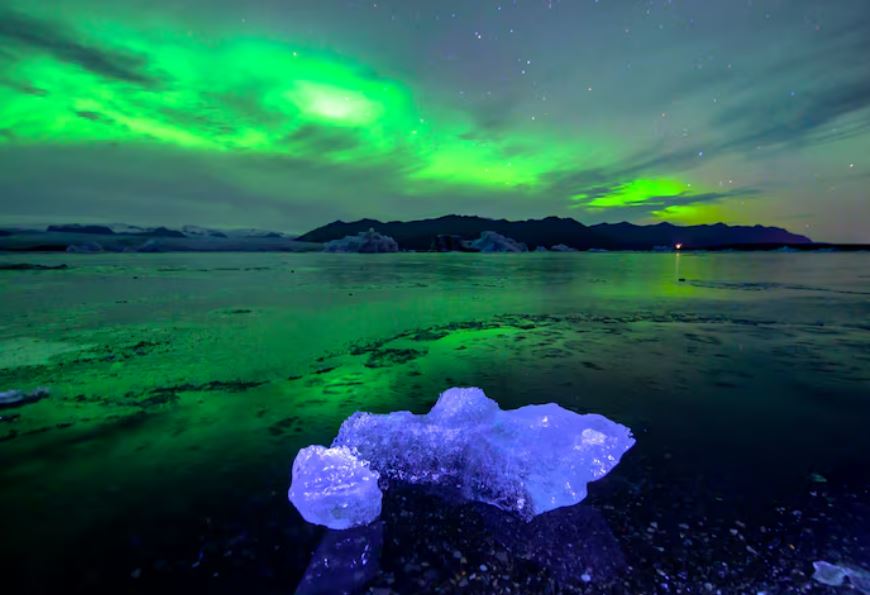
The night sky acts like a restless painter on some early spring evenings. First, faint green lines that are hardly perceptible to the unaided eye emerge. Then, occasionally, the hues intensify, with greens turning into purple and red and drifting above the horizon like slow smoke. These occurrences are rarely unexpected, and recently, scientists have issued what is known as an Aurora Borealis NOAA watch as a warning.
The NOAA Space Weather Prediction Center in Boulder, Colorado, the source of the alert, is surprisingly quiet for the celestial events it keeps an eye on. Analysts monitor magnetic fields and solar winds that flow from the Sun toward Earth inside the structure. Although it doesn’t look particularly impressive—mostly screens with graphs and numbers—the implications can occasionally extend well beyond the lab.
| Category | Details |
|---|---|
| Phenomenon | Aurora Borealis (Northern Lights) |
| Monitoring Authority | National Oceanic and Atmospheric Administration (NOAA) |
| Division | NOAA Space Weather Prediction Center |
| Location | Boulder, Colorado, United States |
| Type of Alert | Geomagnetic Storm Watch (often G1 class for minor storms) |
| Cause | Solar wind streams from coronal holes on the Sun |
| Visibility | Primarily northern latitudes; occasionally visible further south during stronger storms |
| Real-Time Forecast Tool | Aurora Viewline and 30-minute aurora forecast |
| Reference Website | https://www.swpc.noaa.gov |
A G1 geomagnetic storm watch, which is a relatively mild classification on NOAA’s scale, was recently issued by forecasters. Although it might not seem impressive, skywatchers are aware of this. Sometimes, auroras are driven farther south than usual by even small storms. Observers have been instructed to watch the northern horizon throughout the northern United States, from Alaska to states like Minnesota and Michigan. A peaceful lakeshore or rural field might turn into a front-row seat to a celestial spectacle.
A coronal hole—a region on the Sun where magnetic fields open outward, allowing solar wind to escape at high speed—is the cause of the alert. These charged particle streams hurtle through space before colliding with the Earth’s magnetosphere. The recognizable ribbons of light emerge when the particles strike gases high in the atmosphere. Although the basic mechanism has been understood by scientists for decades, it is still obstinately difficult to predict when and where the lights will appear.
One gets the impression from watching the forecasts change throughout the day that space weather is somewhat like terrestrial weather: predictable in theory but unpredictable in reality. The speed of solar winds varies. Magnetic orientations change. The Bz component is one important factor that affects how easily solar energy enters Earth’s magnetic field. Auroras frequently become more intense when the orientation tilts southward. The display may go dark before it starts when it is pointing north.
And there’s timing. Interestingly, March frequently offers better aurora opportunities than most people anticipate. The “equinox effect” is a term that astronomers occasionally use. The alignment of Earth’s magnetic field as it gets closer to the spring equinox makes it marginally easier for the solar wind to interact with the planet. Although the phenomenon was first discussed in scholarly articles decades ago, researchers continue to disagree about its practical implications.
However, in the real world, science is much more straightforward: people go outside at night and look up.
During a more intense solar storm in rural Wisconsin last fall, farmers reportedly pulled their trucks to a stop along deserted highways to observe the sky turning red over cornfields. Photographs taken that evening revealed barns illuminated by aurora light, with the hues mirrored in the grass covered in frost. Long after the scientific explanations have faded into the background, such moments remain in local memory.
Naturally, not every aurora forecast turns into a spectacle. Faint displays can be washed out by a bright moon. Clouds often cause disruptions. Additionally, the solar wind may occasionally just weaken before it reaches Earth. These forecasts are always a little uncertain, which could be one of their allurements.
The way fans follow the phenomenon has changed due to technology. These days, live solar wind data is shown in smartphone apps that update every few minutes. Standing next to frozen lakes or desert highways, amateur photographers adjust their camera tripods and refresh their screens. Colors that the human eye hardly notices in real time are captured by long exposures, usually five to ten seconds.
It’s difficult to ignore the rise in interest in auroras in recent years. The Sun itself provides some of that attention. There will be more geomagnetic disturbances, more sunspots, and stronger solar flares as the current solar cycle nears its peak. Practically speaking, that means there could be more nights when the northern sky suddenly glows.
The phenomenon is still obstinately untamed. Researchers are able to monitor solar storms as they depart the Sun. They are able to measure particle speeds and magnetic fields. Nevertheless, the sky frequently holds a few surprises despite all of the data passing through NOAA’s monitoring systems.
And maybe that’s why an Aurora Borealis NOAA watch has such a subtle appeal. It’s not a given. It’s more akin to an invitation—a hint that the universe may be getting ready for a light show somewhere, just beyond the horizon.
