

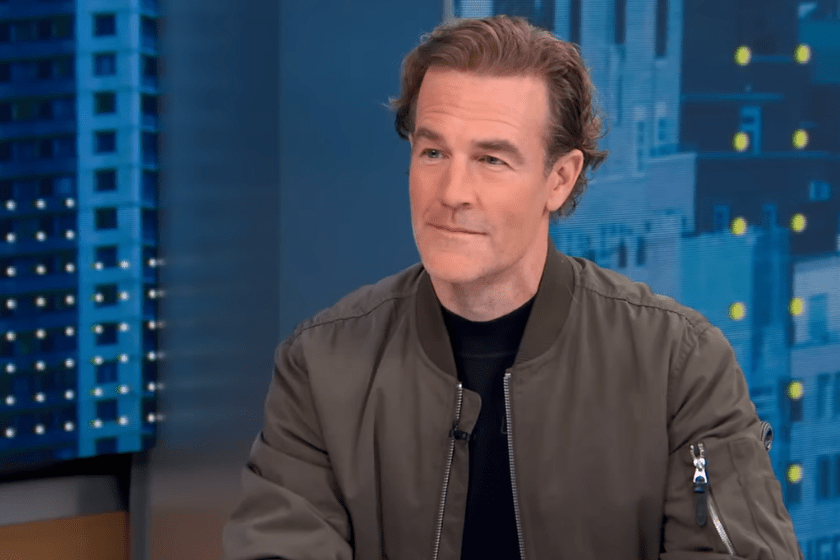
Credit: Good Morning America
For a large portion of his adult life, James Van Der Beek was connected to a fictional creek. But in 2026, discussions about his name moved from nostalgia for television to something much more nuanced: money.
The headlines moved swiftly when Van Der Beek passed away at the age of 48 following a protracted fight with colorectal cancer. His net worth ranged from $12 million to $15 million, according to some sources. $3 million was mentioned by others. Some even dropped as low as $100,000. Seeing those numbers fluctuate felt more like guesswork on top of grief than financial reporting.
| Full Name | James David Van Der Beek |
|---|---|
| Date of Birth | March 8, 1977 |
| Date of Death | February 11, 2026 |
| Age at Death | 48 |
| Profession | Actor, Producer |
| Breakthrough Role | Dawson Leery in Dawson’s Creek |
| Notable Works | Varsity Blues, CSI: Cyber, Don’t Trust the B— in Apartment 23 |
| Family | Wife Kimberly; six children |
| Estimated Net Worth (2026) | Widely reported between $100,000 and $3 million (varied sources) |
| Reference | https://en.wikipedia.org/wiki/James_Van_Der_Beek |
No clean number can convey the clarity of the truth.
As Dawson Leery on Dawson’s Creek, a program that typified late 1990s teen melodrama, Van Der Beek became well-known in 1998. The WB drama made him a household name at its height. posters. covers of magazines. Awards for Teen Choice. leftovers from a six-season run that was later streamed and syndicated. That ought to have produced long-term financial stability on paper.
And it probably did for a while.
Films like Varsity Blues, a box office hit that solidified his reputation as a young leading man, came after that breakthrough performance. Later, he deftly remade himself by parodying his image as a teen idol in Don’t Trust the B— in Apartment 23, embracing rather than resisting self-awareness. It was a clever turn that demonstrated both range and humility.
However, Hollywood revenue isn’t always a straight line. For many actors, fame peaks early. Van Der Beek continued to work steadily after Dawson’s Creek concluded in 2003, appearing in indie films, procedural dramas, reality competition shows, and guest appearances. Yes, it is dependable. Payouts comparable to blockbuster? Not so obvious.
A portion of the financial assumptions made in the years preceding 2026 were based on real estate. It was thought that he and his spouse, Kimberly, owned a multimillion-dollar home in Beverly Hills. According to later reports, they might have been renting instead. When it comes to estimating net worth, that small difference makes all the difference.
The medical battle followed.
Van Der Beek underwent years of treatment after receiving a stage 3 colorectal cancer diagnosis in 2023. Chemotherapy, hospital stays, travel, and specialists are all examples of the type of ongoing care that stealthily depletes funds, even for celebrities. His financial situation might have been drastically changed by medical expenses alone. Entertainers’ health insurance, which is frequently linked to union work thresholds, can be challenging, especially during periods of irregular employment.
He reportedly sold Dawson’s Creek and Varsity Blues memorabilia at auction three months prior to his passing in order to help pay for expenses. It seems telling to see a former teenage idol parting with items from his own mythology. Bills can occasionally be paid with nostalgia.
Then there was the ranch in Texas.
He paid about $4.8 million for a 36-acre ranch in Texas in early 2026, a few weeks before he passed away. Those who had just read reports indicating financial strain were taken aback by that figure. Purchases of real estate, however, do not always signify liquidity. Friends reportedly helped make the purchase possible, and a 20% down payment would require less than $1 million.
For his wife and six kids, the ranch might have been an investment in stability in the face of uncertainty.
A GoFundMe set up for his family shortly after his death topped $2 million. The family was “out of funds” due to medical bills, according to the campaign. It was a persistent phrase. Some questioned how a man who was a part of the 1990s’ celebrity could be vulnerable financially. However, similar tales have long been told in the entertainment sector. Residuals get smaller. Payment models are restructured by streaming deals. Long-term liquidity is not guaranteed by fame.
This is part of a larger cultural unease.
After six years on network television, viewers frequently believe that a person is inherently wealthy. For many actors, however, the reality is different. Early income spikes followed by a plateau. Balance sheets are subtly reshaped by taxes, agent fees, lifestyle expenses, and medical emergencies.
Depending on liabilities and property values, Van Der Beek’s reported net worth in 2026 probably ranged from $100,000 to $3 million in accessible assets. Perhaps based on gross career earnings rather than net holdings, the $12–15 million estimates seem optimistic. Which number best reflects his financial situation at the time of his passing is still up for debate.
It is more obvious that he was worth more than any number, both emotionally and culturally.
It seemed as though his second act—self-aware, grounded, and committed to fatherhood—had redefined him more than his teen-idol years ever had, as tributes from former co-stars and younger actors cited him as an influence. He talked candidly about family and putting time before fame. It’s possible that the change did not optimize profits. It probably made something else better.
Once a life is over, it’s difficult to ignore how often we quantify it in monetary terms. Success is shortened to net worth. However, the varying estimates in Van Der Beek’s case seem almost symbolic, serving as a reminder that Hollywood economics are rarely simple.
It may never be possible to pinpoint James Van Der Beek’s exact net worth in 2026. In the middle of being comfortable and modest. In between a ledger and a rumor.
However, the remaining image is not one of finances. It tells the story of a man who, after unintentionally becoming a teenage idol, spent the next twenty years redefining his identity, working steadily, raising six kids, and dealing with illness in a vulnerable way in public.
Ultimately, money was just one aspect of the situation.
