

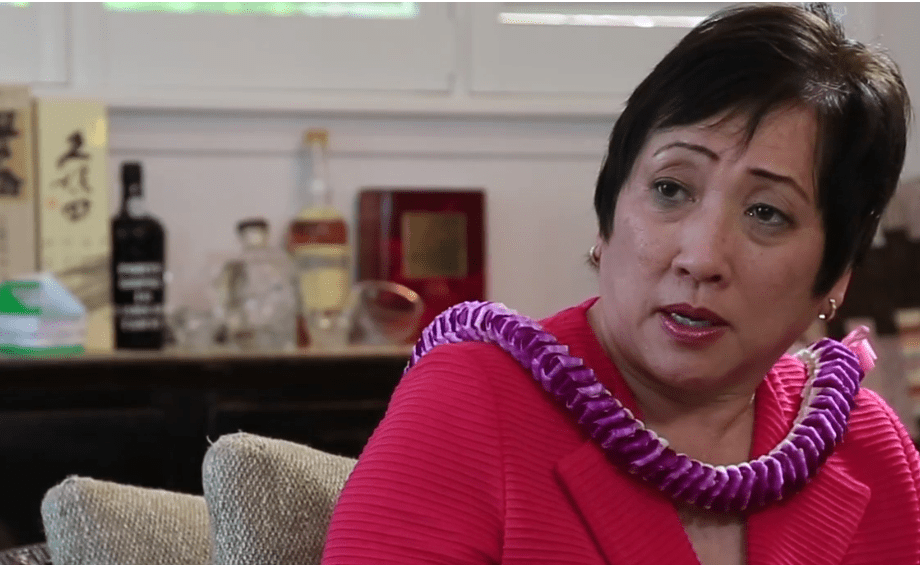
Credit: Honolulu Civil Beat
People still talk about Colleen Hanabusa as if she never left the west side of Oʻahu, where the mountains plunge sharply toward the ocean, and the Waianae coast is swept by dry trade winds.
Her family used to operate a small auto repair shop there, where neighbors would stop by to share stories and grease-stained mechanics would wipe their hands on old rags. Observing clients quarrel over politics in between oil changes may have contributed to the development of her obstinate, occasionally direct political style, which she carried all the way to Washington.
| Important Information | Details |
|---|---|
| Full Name | Colleen Wakako Hanabusa |
| Born | May 4, 1951 – Waianae, Oʻahu, Hawaii |
| Died | March 6, 2026 (Age 74) |
| Cause of Death | Cancer (after a five-month battle) |
| Profession | Attorney, Politician |
| Major Roles | U.S. Representative (2011–2015, 2016–2019); President of the Hawaii State Senate |
| Historic Achievement | First woman and first Asian American woman to serve as president of the Hawaii State Senate |
| Political Party | Democratic |
| Family | Survived by husband John Souza |
| Authentic Reference | https://www.nbcnews.com/politics/congress/former-rep-colleen-hanabusa-hawaii-senate-trailblazer-dies-74-rcna262198 |
After a silent five-month fight with cancer, Hanabusa passed away on March 6, 2026. She was seventy-four. Although the news spread swiftly through Hawaii’s political circles, the response was more akin to a slow wave sweeping across the islands than the abrupt shock that follows a scandal. Half-staff flags were ordered. Stories were told by former coworkers. Additionally, it seemed as though a particularly resilient figure in Hawaii politics had quietly left the room.
As you watch the tributes, you can’t help but notice how frequently Hanabusa is referred to as a “fighter.” In her case, the word fits in a practical, almost literal way, even though it frequently sounds like a cliché. Representing the Waianae Coast and Leeward Oʻahu, communities that frequently felt ignored by the more tourist-polished areas of the state, she was elected to the Hawaii State Senate in 1999.
In a few years, she had established herself as an internal strategist who understood the real dynamics of power in a legislature, rather than as a speaker who was good on television.
Hanabusa was the first female president of the Hawaii State Senate in 2007. That accomplishment was more significant back then than it is now. The ascent of a woman from Waianae to that position subtly altered expectations in Hawaii politics, which had long been dominated by influential individuals whose influence spanned decades. Looking back, it seems as though she had no intention of becoming a symbol. She just pushed until she got the door open.
She rarely had a clean political life. When U.S. Senator Daniel Inouye, one of Hawaii’s most influential politicians, passed away while in office in 2012, it was one of the most dramatic chapters in the state’s history. In a letter, Inouye expressed his hope that Hanabusa would take his place in the Senate. A dying statesman appointing a successor had the subdued intensity of political theater. However, Brian Schatz, a Democrat, was chosen by the governor at the time.
The contest that resulted from that decision is still remembered in Hawaii politics. In 2014, Hanabusa declared that the people should make the final decision and ran for the Senate. Less than a percentage point separated her from victory.
As I watched that race from a distance, it seemed like one of those occasions when politics gets almost unbearably personal: old networks are struggling to stay together, alliances are changing, and loyalties are put to the test.
After regaining her former seat in the U.S. House of Representatives, she made a comeback to Congress in 2016. She was already well-known on Capitol Hill by that point, moving through the marble corridors with the slightly hurried gait of someone who liked to negotiate rather than work in a television studio. Her influence was quieter than it appeared from the outside, according to colleagues. The loudest voice in the room wasn’t always hers. However, she was frequently in charge of tallying votes.
Later in her career, Hanabusa joined the board that was in charge of the long-delayed rail transit project in Honolulu and got very involved in it.
The rail line had turned into one of those public works tragedies that cities are all too familiar with: it was overbudget, behind schedule, and the subject of constant debate. Hanabusa pushed to keep federal funding and advance the project, approaching it with a sort of stubborn practicality. Despite their continued skepticism, critics appeared to recognize her perseverance.
After months of illness, which she mostly kept to herself, she passed away. According to her friends, she spent several months in the hospital before dying. Her choice to keep that conflict largely hidden from the public seems to be in line with how she conducted a large portion of her career: she was work-focused and rarely interested in dramatizing the private aspects of politics.
Small memories, the kind that are rarely included in official biographies, have been shared by people in Honolulu this week. A brief exchange in a legislative corridor. An argument about strategy broke out during a late-night policy meeting. Someone remembers how, despite her career moving to Washington, she continued to visit the Waianae coast. These tidbits point to a politician who maintained ties to the location that initially influenced her.
How history will evaluate Hanabusa’s role in Hawaiian politics is still up in the air. She was never elected governor. Inouye had hoped she would hold the Senate seat, but she never did.
The generation of younger leaders who witnessed her shattering barriers, the political battles she fought inside party circles, and the steadfast conviction that the voices from the state’s less glitzy communities should have a place at the table, however, gives the impression that her influence is found in more subdued settings.
The closing of a lengthy chapter rather than the end of a career is what many people in Hawaii are feeling right now. After all, politics rarely stops. Legislative chambers are filled with new debates, rivalries, and candidates. It seems as though the room itself remembers who used to sit there, but occasionally, when someone like Colleen Hanabusa exits the stage, the mood changes a little.
