

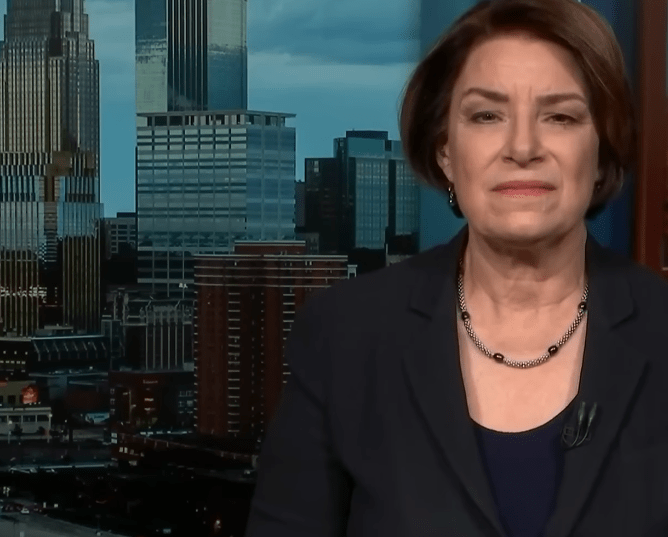
Credit: NBC News
Politics frequently gives the impression that those who live on Capitol Hill are a little higher up than the rest of the population. Hearings, TV interviews, and countless flights between home states and Washington occupy their days. schedules with infrequent pauses. Now and then, however, something interrupts that cadence to remind the public that even the most well-known political personalities experience the same uncertainties as everyone else.
That time, for Senator Amy Klobuchar, came subtly in 2021. The Democrat from Minnesota, who has been a member of the U.S. Senate since 2007 and has previously run for president, disclosed earlier that year that she had received an early-stage breast cancer diagnosis. Many people in Washington were taken aback by the news.
| Category | Details |
|---|---|
| Full Name | Amy Jean Klobuchar |
| Born | May 25, 1960 |
| Profession | U.S. Senator, Lawyer |
| Political Party | Democratic (DFL) |
| State Represented | Minnesota |
| Senate Service | Since 2007 |
| Known Health Issue | Early-stage breast cancer diagnosed in 2021 |
| Treatment | Lumpectomy and radiation therapy |
| Recent Health Update | Cancer-free, precautionary radiation in 2024 |
| Official Website | https://www.klobuchar.senate.gov |
At the time, she had persisted in attending hearings, participating in legislative debates, and negotiating the day-to-day chaos of national politics without disclosing to the public that she was dealing with a private health issue. After a routine mammogram, the diagnosis was made.
A biopsy was eventually performed after doctors found tiny white patches known as calcifications. The outcome verified stage 1A breast cancer, which indicates that the illness was detected early and had not progressed outside the breast. That stage has one of the best prognoses in terms of medicine. However, the mere mention of “cancer” tends to pause time.
Later, Klobuchar said the diagnosis was unexpected. It can feel strangely personal to watch public leaders share these private moments, particularly in a city where showing vulnerability is uncommon. Senators work for years to build a reputation for being resilient and in control. That story is upset by illness.
Her course of treatment for early-stage breast cancer was rather typical. A lumpectomy, a surgical procedure that removes the tumor while leaving the majority of the surrounding tissue intact, was carried out by the doctors. Radiation therapy, a course of treatments intended to eradicate any cancer cells that remained, came next.
Her case is unique because of how it developed in tandem with the responsibilities of public office, not because of the treatment itself.
At the time, the Senate was heavily involved in investigations into the attack on the U.S. Capitol on January 6. These investigations required lengthy hearings and close political scrutiny. According to reports, Klobuchar kept up his job during that time, even going to hearings while receiving medical care. It’s difficult to ignore how infrequently political life takes a break for private matters.
In subsequent interviews, Klobuchar underlined the importance of routine screenings—a point that physicians emphasize frequently but that people tend to ignore. As hospitals prioritized emergency care during the early months of the COVID-19 pandemic, she had postponed her own mammography, like millions of other Americans.
One of the most prevalent cancers among American women is still breast cancer. Hundreds of thousands are diagnosed annually. Many people survive, particularly if the illness is detected early. However, the figures still have some significance.
That experience may have contributed to Klobuchar’s increased advocacy for preventive healthcare.
The subject came up in both legislative proposals and speeches. She backed programs that promoted regular screenings and increased access to preventive care. Compared to the typical policy debates, there is a slight change in tone as you watch her discuss the matter.
The story was then brought back into the public eye in 2024 by a minor medical advancement. Doctors at the Mayo Clinic in Minnesota found a new calcification during an examination at a routine follow-up visit. The finding led to the removal of the spot through a minimally invasive outpatient procedure.
The senator later received precautionary radiation treatment for several days, but doctors subsequently confirmed that she was still cancer-free.
Although it can occasionally sound frightening to outsiders, the term “precaution” is fairly common in oncology. When it comes to conditions that have a history, doctors tend to favor caution over risk. When Klobuchar made the announcement, he took the opportunity to reiterate what has become practically a catchphrase: screenings save lives.
As the story progresses, it becomes clear that beneath the medical specifics lies a larger cultural layer. Several prominent politicians, both Republicans and Democrats, have publicly discussed cancer diagnoses and other health issues during the last ten years. In politics, this openness wasn’t always the norm.
For many years, leaders kept medical conditions a secret out of concern that being vulnerable could be seen as weakness. The atmosphere feels a little different today. Stories about personal health can occasionally enter the public discourse surrounding healthcare policy. The connection seems particularly clear in Klobuchar’s case.
A personal health issue involving her daughter influenced her early political activism, as she pushed for legislation that would ensure new mothers stay in hospitals longer. Years later, she is now more aware of another aspect of healthcare because of her personal medical experience.
The extent to which these individual experiences shape legislative priorities over time is still unknown. Public perceptions can change rapidly, and politics is a complex field. However, there is a discernible sincerity when listening to Klobuchar talk about cancer detection.
And maybe that’s the story’s subtle lesson. A human life continues to unfold behind every public office, campaign speech, and committee hearing; this life occasionally intersects with illness, uncertainty, and the fleeting medical moments that serve as a reminder to people worldwide of how precarious health can be.
