

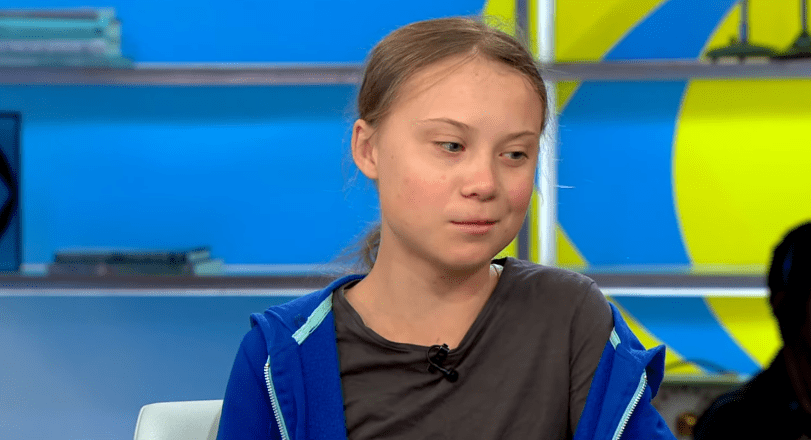
Credit: CBS Mornings
The pavement was a little slippery after the rain had stopped, and the red paint on the glass frontage had already started to fade into drab lines. It appeared to be both symbolic and obstinate, as if it were subtly demanding attention.
The police gathered in their customary loose circle. Office workers nearby slowed and then pretended not to be observing, as though showing interest was in some way unprofessional. The atmosphere was oddly subdued, almost bureaucratic.
| Key | Details |
|---|---|
| Name | Greta Thunberg |
| Bio | Swedish climate and human-rights activist |
| Background | Began striking outside Sweden’s parliament as a teenager, gradually expanding her focus to justice issues |
| Career highlights | Built Fridays for Future, addressed parliaments and the UN, supported protests tied to hunger strikes |
| Reference | https://www.bbc.com/news/articles |
Greta Thunberg entered the room with a plain placard. Inmates on hunger strike and opposition to continuing violence were mentioned in the text. The handwriting seemed leisurely. Just cardboard and ink, no theatrics, no slogans designed for algorithms.
A number of activists in prison had stopped eating in recent weeks. They demanded better treatment, bail, and a reconsideration of the authorities‘ choices regarding a banned group. A few had been admitted to the hospital. Campaigners claimed that one’s symptoms—drifting speech, waning strength—were remarkably similar to those observed in other political prisoners.
Hunger strikes have always forced someone to examine the price of remaining silent. They transform the body into a dispute. Additionally, they make institutions into mirrors. It can be extremely unsettling to see what we see reflected.
However, the official response in this case felt extremely formal. numbers of sections. Language for public order. The Terrorism Act is cautiously invoked. A sign turned into a “item.” A protest turned into a file. A van door shut. Then came the bail paperwork.
The people on the pavement, on the other hand, spoke in shorter, more tentative sentences. Paper cups of tea were passed by a woman. According to her, her friend once adhered themselves to a building, leaving behind marks that persisted for months. There was a mixture of admiration and concern in her voice.
Everything was doubled back at us by the glass towers surrounding Fenchurch Street, including cardboard signs, fluorescent jackets, and red paint. The city kept reflecting itself, almost mockingly, as though to say, “This will all be cleaned.”
Physicians cautioned that the hunger strikers might sustain long-term injuries. After making thoughtfully sympathetic remarks during their visit, some politicians withdrew into process-oriented rhetoric. Time was only going in one direction for the inmates.
Thunberg used more incisive wording. She referred to them as political prisoners. The phrase forced the discussion into the realm of morality rather than neat categories. It meant accountability, not merely supervision. It was supposed to be unsettling.
On the other hand, the police relied on legality. “Prohibited organization,” they said once more. As though that label provided all the answers. As if fear could be neatly categorized.
A security guard across the street scraped dried paint off the frame. It was a low-pitched sound. The moment was somehow grounded by that little detail. It served as a reminder that protest always leaves behind residue, whether it be civic, emotional, or physical, and that someone is tasked with cleaning it up.
The hunger strike was more than just a protest for many supporters. They considered it a last lever. They discussed systems that prevent violence, insurance underwriting, and Gaza in brief bursts. Their debates were convoluted, multi-layered, sometimes contradictory, and wholly human.
A message from inside the prison was read out loud in the middle of the day. periods of vertigo. losing consciousness. A body that seemed oddly detached. Institutions occasionally learn to wait people out, the nurse standing next to me whispered, and the thought lingered, unexpectedly heavy.
The event was then reduced to familiar rhythms by the news cycle: paint, protest, placard, arrest, and release. Storytelling condensed. Complexity was greatly decreased. The unspoken query underneath—how far should someone have to go before officials feel obligated to react—was still missing.
When I heard a man in a suit mutter that everyone was hurrying to lunch and taking things too seriously, I wondered for a moment if urgency is always invisible until it affects our own schedules.
Critics claim that Thunberg simplifies because she has grown accustomed to this rhythm: demonstration, detention, release, and repetition. Simplifying is a strategy at times. When a situation feels overrun with footnotes and disclaimers, it can be incredibly effective.
She provided directness that morning. Because they think their lives are in danger, people are refusing to eat. Officials ought to investigate. Why should be a question that communities ask. Language should not be limited to law.
In the future, the question is whether Britain views this as a turning point or lets it fade into the background as paperwork. The paint has been cleaned. The office reopened. Like a swarm of bees testing a window, the hunger is still there, and its message is still loud and clear.
