

It happened in the kind of afternoon that usually passes without incident—sunlight steady, suburban streets quiet, the hum of everyday life carrying on in neighborhoods just north of Houston. Then, suddenly, a flash. Not dramatic enough to stop everything at once, but bright enough that people looked up. And then the sound came—a deep, startling boom that seemed to arrive a second too late, as if the sky had hesitated before explaining itself.
For a moment, confusion ruled. Some thought it was construction. Others wondered about aircraft. A few reached instinctively for their phones. But what actually happened, according to NASA, was something far less ordinary: a meteor, roughly a ton in mass, had entered Earth’s atmosphere at about 35,000 miles per hour, burning, breaking apart, and scattering fragments across the Houston area.
Houston Meteor Event (March 2026)
| Category | Details |
|---|---|
| Event | Meteor explosion and fragmentation over Houston |
| Date | March 21, 2026 |
| Location | Houston (Cypress Station area) |
| Estimated Size | ~1 ton, ~3 feet in diameter |
| Speed | ~35,000 mph |
| Explosion Altitude | ~29–49 miles above Earth |
| Energy Release | Equivalent to ~26 tons of TNT |
| Impact Evidence | Fragment reportedly pierced a residential home |
| Confirming Authority | NASA |
| Reference Website | https://www.nasa.gov |
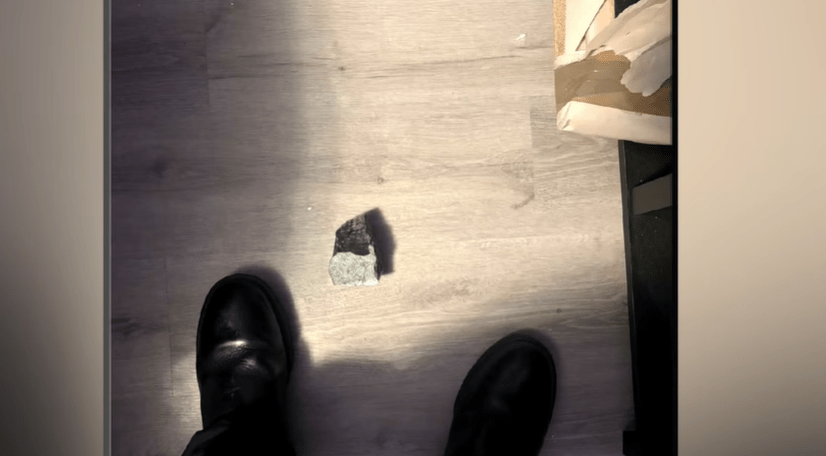
It’s possible that events like this happen more often than people realize. Most meteors disintegrate quietly, far above the ground, leaving behind little more than a streak of light. But this one didn’t fully disappear. It broke apart, yes, releasing energy comparable to 26 tons of TNT, but some fragments survived. And one of them, improbably, ended up in a home.
The house itself sits in a fairly typical neighborhood—low roofs, modest lawns, the kind of place where weekends are spent mowing grass or fixing small things. Inside, the moment must have felt surreal. A loud crash. Dust. Then a hole where there hadn’t been one before. The homeowner, startled and unsure, reportedly called emergency services. The object on the floor didn’t look familiar. It didn’t behave like anything ordinary.
There’s something unsettling about that image. Not catastrophic, not apocalyptic—just a reminder that space occasionally reaches down and interrupts life in the most unexpected ways. A rock, traveling for millions of years perhaps, ends its journey in someone’s living room. It’s hard not to pause on that.
NASA’s data helps reconstruct the path. The meteor became visible around 49 miles above a place called Stagecoach, northwest of Houston, then moved southeast, breaking apart near Cypress Station. Doppler radar even picked up falling fragments, scattering them across a defined “strewn field” between neighborhoods like Willowbrook and Northgate Crossing. It sounds precise, almost clinical. But on the ground, it felt anything but.
Watching videos that surfaced afterward—grainy clips of a bright streak in the sky—it’s clear how quickly the event unfolded. A flash, a trail, and then it was gone. The boom came later, echoing across neighborhoods, rattling windows, prompting people to step outside and look around, unsure of what they had just experienced.
There’s a cultural layer to this, too. Houston, after all, is not just any city. It’s closely tied to space exploration, home to NASA’s Johnson Space Center, a place where astronauts train and missions are managed. There’s something almost ironic about a piece of space arriving uninvited, bypassing all the controlled environments and landing in a suburban home instead.
It’s still unclear how many fragments actually reached the ground. Scientists say only a small percentage of a meteor’s mass typically survives the journey through the atmosphere. Most of it vaporizes, turning into light and heat. But even a small percentage, when starting from a ton, can leave behind pieces large enough to notice—and in rare cases, to damage property.
There’s also the question of what happens next. Meteorite hunting has already begun, quietly at first. People scanning fields, checking yards, hoping to find a piece of something that traveled across space. NASA has even released maps suggesting where fragments might have landed. But finding one isn’t easy. They don’t glow. They don’t announce themselves. They just sit there, looking like rocks—until someone looks closer.
It’s hard not to notice how quickly the story shifted from shock to curiosity. Within hours, conversations turned from “What was that?” to “Where can I find a piece?” That shift says something about how people process events like this. The initial fear fades, replaced by fascination.
Still, there’s a lingering sense of unpredictability. Meteors don’t follow schedules. They don’t respect boundaries. And while events like this are rare, they’re not impossible. Watching this unfold, there’s a quiet realization that the sky, for all its distance, is not entirely separate from life below.
In the end, the damage was limited—a hole in a roof, a shaken homeowner, a city briefly reminded of its place in a much larger system. But the story lingers. Not because of destruction, but because of its strangeness.
A rock from space. A suburban house. A moment where the ordinary and the cosmic collided, if only for a few seconds.
