

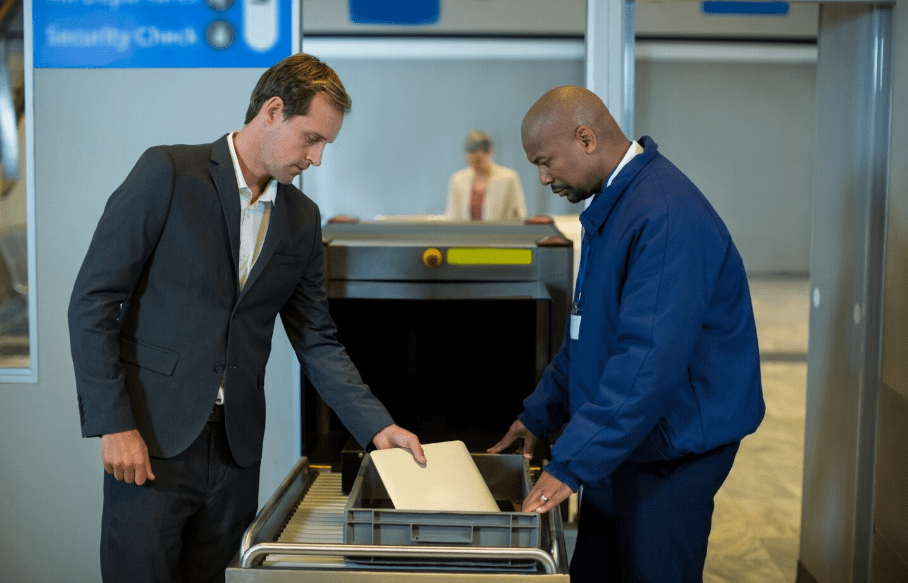
When you’re in a TSA line, there’s a moment when the airport feels more like a place to wait than a place to move. Passengers inch forward in that familiar choreography, shoes half off, laptop awkwardly balanced in one hand. Most travelers are familiar with this routine. However, lately, it seems a little slower, heavier, and less certain.
Airport security at TSA has always been a trade-off between speed and safety, alertness and ease. Created in the aftermath of September 11, 2001, the agency was designed to restore trust in air travel. And for years, it worked pretty well, despite the occasional frustration. Lines shifted. There were flights. The system worked.
TSA Airport Security
| Category | Details |
|---|---|
| Organization | Transportation Security Administration (TSA) |
| Founded | 2001 (after 9/11 attacks) |
| Parent Agency | U.S. Department of Homeland Security |
| Primary Role | Screening passengers and baggage at U.S. airports |
| Airports Covered | 450+ airports across the United States |
| Workforce | ~50,000 employees |
| Key Programs | TSA PreCheck, Secure Flight |
| Current Issue (2026) | Staffing shortages due to funding shutdown |
| Average Wait Time (Normal) | 15–30 minutes |
| Reported Delays (Recent) | Up to 2–3 hours in major airports |
| Official Website | https://www.tsa.gov |
However, there seems to be a shift in the balance when observing security checkpoints in 2026. It is now more difficult to ignore reports of lengthy wait times, which can occasionally reach two or even three hours. Travelers are arriving hours ahead of schedule in cities like Houston, Atlanta, and New Orleans in order to avoid missing flights. It’s not quite panic. It’s more akin to a subtle adjustment of expectations.
Staffing is one factor contributing to the strain that most passengers are unaware of. Tens of thousands of people work for the Transportation Security Administration, but many of them are unpaid due to recent funding problems. A few have given up. There have been calls from others. Longer lines, fewer officers controlling the flow, and closed checkpoints are the obvious outcomes.
It’s possible that what we’re currently witnessing is more indicative of a system that is overworked than of a breakdown. Airports are still operating. Flights continue to take off. However, the margins are narrower. Additionally, minor disruptions like bad weather, busy travel times, or a single closed lane can quickly spread when margins get smaller.
These days, when you stroll through a large airport, you pick up on little details. a line that winds through the open terminal area and past the stanchions. In an attempt to keep things moving, a TSA officer is repeating instructions louder than usual. Travelers look at their watches, then look at them again. There is a persistent, low-key tension that is not overt.
What’s striking is how uneven the experience has become. A traveler might pass through in twenty minutes one day. The same airport might seem like a bottleneck the next time. The true difficulty appears to be that unpredictability. Long lines are something that travelers can prepare for. Planning is more difficult when you don’t know how long the line will be.
Technology has been introduced as a buffer, if not a solution. Faster processing, fewer steps, and less friction are promised by programs like TSA PreCheck and biometric screening. And they deliver for a lot of people. However, staffing shortages still affect even these expedited lanes. Even the fastest lines slow down when there are fewer officers on duty.
The question of how airport security should feel is also more general. It has developed into a sort of ritual over time: take off shoes, empty pockets, and put things in bins. It’s almost routine, familiar. However, situations like this upend that comfort. They serve as a reminder to travelers that people, not just procedures, are what make the system work.
Politics is still influencing the situation in the background. The practical realities of airport operations have been impacted by discussions about funding, immigration policy, and the role of federal agencies. There have been suggestions to bring in additional federal employees to help with security, but it’s still unclear how successful that would be. Passenger screening requires coordination, experience, and training in addition to manpower.
The demand for air travel hasn’t decreased in the interim. It’s actually expanding. Driven by a sort of pent-up desire to move, travel, and reconnect, millions of passengers are expected to fly every day during peak seasons. There is a paradox here: people are more willing than ever to put up with inconvenience in order to get where they’re going, even as the system exhibits signs of strain.
It’s difficult to ignore that willingness. In real time, travelers are making adjustments to their schedules, registering for expedited programs, and standing in long lines. That’s resilient, but there’s also a quiet acceptance that things might not go back to how they were, at least not right away.
TSA airport security currently appears to be a system undergoing change. Not entirely steady, but not broken either. The experience surrounding screening, safety, and oversight is evolving, but the fundamentals remain the same.
There’s a sense that this is more about a new phase than a brief disruption as you stand in those lines and observe the slow, steady movement toward the scanners. One in which the journey itself now involves patience, time, and some degree of uncertainty.
