

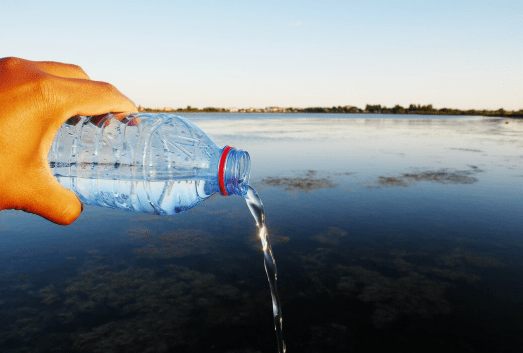
The ground has begun to sink in some areas of the Central Valley of California. The land is being pulled downward inch by inch by decades of groundwater pumping, but not dramatically—no abrupt collapses—but slowly, almost silently. Although irrigation systems continue to spray in steady arcs and farmers continue to drive their trucks across these fields, the surrounding landscape is gradually shifting. If you weren’t looking for it, you wouldn’t notice this kind of shift. Furthermore, the majority of markets aren’t searching.
Water is still priced as though it were abundant, even though it is one of the most important resources in the world economy. Accessible, affordable, and nearly taken for granted. Investors seem to treat it similarly to how earlier generations treated air: it’s vital, but you don’t put a price on it until it becomes scarce or polluted. The issue is that it might already be that time.
| Category | Details |
|---|---|
| Technology | Synthetic Food (Cellular Agriculture & Precision Fermentation) |
| Key Companies | Perfect Day, The Every Company, Upside Foods |
| Production Methods | Lab-grown cells, engineered microbes, 3D food printing |
| Key Benefit | Reduced land, water, and emissions |
| Major Concern | Energy use, biodiversity loss, consumer acceptance |
| Timeline | Scaling expected by 2030–2040 |
| Farming Impact | Shift toward hybrid and premium natural systems |
| Core Question | Will nature-based farming decline or evolve? |
| Reference Website | https://www.nature.com/articles/s43016-024-00999-0 |
In policy talks, the phrase “global water bankruptcy” has begun to surface, and it’s not merely rhetorical. Aquifers, rivers, and wetlands are examples of water systems that have been overused to the point where recovery is impractical in many areas. This isn’t a seasonal shortage or a transient drought. It is structural. ongoing. Permanent, perhaps. Balance sheets, however, do not show this.
Since the 1990s, over half of the world’s large lakes have shrunk. Some major aquifers are irreversibly declining. The majority of freshwater is used for agriculture, which is becoming more prevalent in areas where water stress is already severe. However, the potential for a fundamental shift in water availability is rarely taken into account in food prices, commodity forecasts, or corporate valuations. This could be more avoidance and less oversight.
Risks in financial markets are typically only priced when they materialize. In contrast, the scarcity of water moves slowly. It takes time for markets to plummet. They are eroded by it. A farm makes a little less. There are sometimes shortages in a factory. Expenses increase gradually. Nothing spectacular—until it is. It’s easy to ignore that slow burn.
Visibility is another problem. Water risk is deeply ingrained in supply chains and is frequently found several layers away from the finished product. Cotton grown in water-stressed areas of India may be used by a European textile company. A manufacturer of semiconductors might rely on ultra-pure water that comes from progressively more delicate systems. Although they aren’t always acknowledged, these dependencies exist. As a result, investors make choices based on insufficient information.
The extent of water use becomes more apparent when strolling through an industrial area outside of a manufacturing center. Thousands of gallons are transported per hour via pipes that run overhead. Chemical treatments, cleaning procedures, and cooling systems all depend on consistent access to water. Companies don’t emphasize it in their annual reports, but once you start noticing, it’s all over the place. It also brings up an unsettling idea. What would happen if that supply stopped being dependable?
The effects on the economy are already partially apparent. Every year, droughts disrupt transportation, energy production, and agriculture, costing the world economy hundreds of billions of dollars. Water scarcity is causing factories in some areas to temporarily close. In others, food prices are rising due to decreasing crop yields. These are indicators. However, they are still regarded as singular occurrences.
A more general mismatch is at work. Water is a private input as well as a public resource. In many places, it is priced administratively rather than based on market dynamics and is managed politically. This implies that the price that businesses pay does not accurately reflect the cost of scarcity. Water is sometimes effectively subsidized, which promotes excessive use. Urgency is not intended to be signaled by the system.
Conversely, investors typically concentrate on shorter time horizons. annual returns and quarterly profits. In contrast, water risk takes decades to manifest. A sort of blind spot is created as a result. Data does not always result in action, even when it is available. How long that gap can last is still unknown.
There are indications of change. In order to identify high-risk areas and modify operations, some businesses are starting to map their water dependencies more thoroughly. In an effort to more accurately reflect scarcity, governments are experimenting with price reforms. However, these initiatives are inconsistent and frequently sluggish. Maybe too slow.
The concept of “stranded assets” is gaining traction. Facilities constructed in areas with limited water resources may become too costly to run or maintain. Once-reliable agricultural land may become less valuable. Entire industries may encounter unforeseen limitations due to water rather than demand. This type of risk is distinct. less noticeable. more fundamental.
As this develops, it seems like water is becoming a key economic variable rather than just a background resource. Not all at once, but gradually, necessitating changes in ways that are still unpredictable. The market is still lagging behind. Perhaps it will. Perhaps it waits until it is left with no other option.
Because there isn’t a simple replacement for water, unlike other resources. It cannot be discreetly replaced at scale by any other input. When it becomes scarce, the consequences spread to industry, agriculture, energy, and even geopolitics.
