

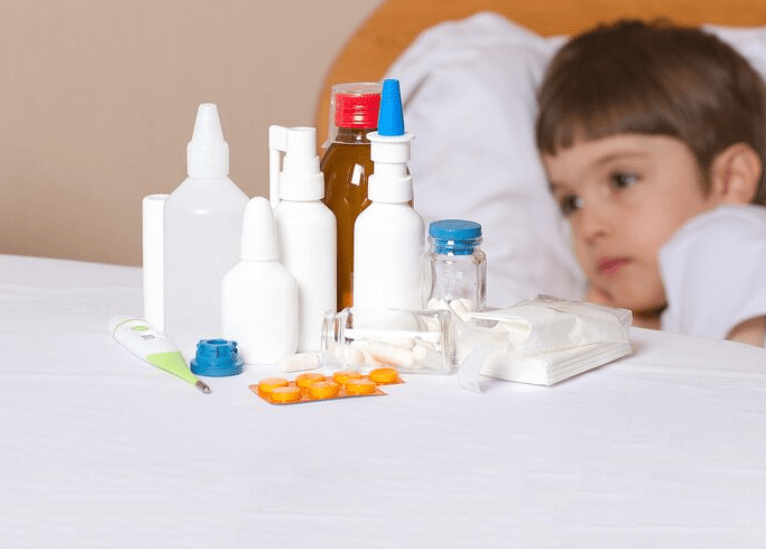
Seeing a child’s medication taken from the shelves is unnerving. It upsets a quiet trust that most parents don’t give much thought to until something goes wrong.
Nearly 90,000 bottles of children’s ibuprofen were recalled nationwide in March 2026 due to complaints that sound almost surreal: a gel-like mass and black particles that obviously didn’t belong in a medication intended to treat a feverish child. The recall, which was started by Strides Pharma and subsequently categorized as Class II by the U.S. Food and Drug Administration, is in that uncomfortable middle ground where it is neither immediately life-threatening nor harmless.
| Category | Details |
|---|---|
| Company | Strides Pharma |
| Regulator | U.S. Food and Drug Administration |
| Product | Children’s Ibuprofen Oral Suspension (100 mg/5 mL) |
| Quantity Recalled | ~89,592 bottles |
| Issue | Possible contamination (black particles, gel-like mass) |
| Recall Type | Class II Recall |
| Lot Numbers | 7261973A, 7261974A |
| Expiry Date | January 31, 2027 |
| Distribution | Nationwide (United States) |
| Reference | https://www.fda.gov |
It’s difficult to ignore how unremarkable everything still appears when strolling down a pharmacy aisle these days. The shelves are lined with colorful bottles that promise relief. Risk is not visually indicated by anything. However, there had been bottles containing foreign material sneaking into homes somewhere in that well-known setup.
The product in question was a common 100 mg children’s ibuprofen suspension that was produced for Taro Pharmaceuticals and sold all over the country. 89,592 bottles seem like a big number, but it’s also oddly abstract. The scale only becomes relatable when you picture those bottles in kitchen cabinets, nestled next to thermometers and kids’ vitamins.
At first glance, the recall’s cause seems almost unremarkable: complaints from customers. Something seemed strange to someone. Perhaps a parent is pausing, squinting, and shaking the bottle in the kitchen light. That seemingly insignificant, easily overlooked moment ultimately started a regulatory process. It seems that these recalls frequently start in homes rather than labs.
The FDA’s designation of the recall as Class II is instructive. It implies that while there may be transient or reversible health effects, major harm is unlikely. However, there is room for interpretation in that phrase. “Impossible” and “unlikely” are not the same thing. And that distinction can seem hazy to parents, particularly those who have young children.
Overall, this isn’t the first time a commonly used drug has been recalled. Similar incidents, such as contaminated cough syrups and infant formula scares, have eroded public trust over the past ten years. In times like these, the increasingly global and intricate pharmaceutical supply chain occasionally shows its weaknesses.
With its headquarters located in India, Strides Pharma functions within a global system. It’s efficient to manufacture in one country, package in another, and distribute throughout a whole country, but it also adds layers where things could go wrong. The precise method of contamination in this instance is still unknown. Was there a problem with production? A storage issue? Something that was missed during quality inspections? There are questions raised by the silence surrounding those details.
For their part, regulators seem to be gradually tightening oversight. Moving the recall into Class II status is the FDA’s response, which shows concern but not alarm. It is a delicate balance. An excessive sense of urgency can cause panic. Too little encourages complacency.
Trust in medicine is no longer passive when one considers how swiftly the story spread across news outlets, social media, and parenting forums. People examine, discuss, and inquire. There is a growing expectation that transparency will occur more quickly, clearly, and comprehensively. It is another matter entirely whether companies and regulators are meeting that expectation.
Practically speaking, the advice is simple: cease using the recalled product, verify lot numbers, and seek medical advice if necessary. Beneath that simplicity, however, is a more nuanced emotional reaction. Parents are reevaluating presumptions rather than merely verifying labels.
The quiet routines that this disturbs are difficult to ignore. When a parent has a late-night fever, they instinctively reach for the same bottle they’ve previously used. There is now a glimmer of doubt in that moment.
Nevertheless, the system does function, at least in part. The recall took place. The problem was found. The bottles are being taken out. There has been progress in comparison to earlier decades when such issues might have gone unnoticed for longer.
However, the question of what will happen next remains unanswered. Will manufacturing standards become more stringent as a result? Inspections more often? Or will it fade into the background of a fast-paced news cycle, as many recalls do?
The bottles are no longer on the shelves. However, there is still a persistent and subtle uneasiness that lingers in the area where modern medicine increasingly seems to reside—between caution and trust.
