

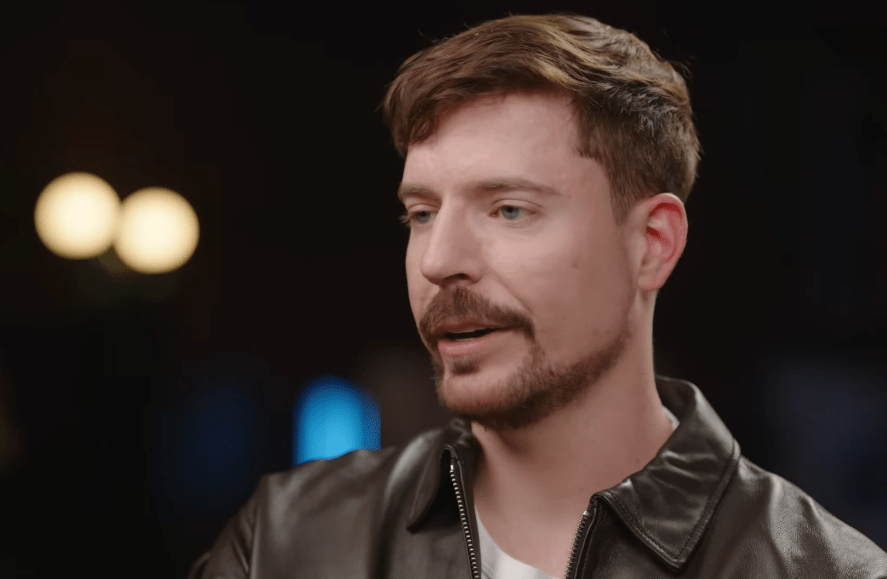
Credit: WSJ. Style
The internet was ablaze with rumors in recent days that the most popular person on YouTube, MrBeast, had declared bankruptcy. One quote, “I have negative money right now,” was the source of the rumor.
The statement seemed like a startling turn of events to people who were not familiar with his business strategy. How could someone with an estimated net worth of over $2 billion say they couldn’t even afford McDonald’s breakfast?
| Detail | Information |
|---|---|
| Full Name | Jimmy Donaldson |
| Online Name | MrBeast |
| Date of Birth | May 7, 1998 (Greenville, North Carolina) |
| Career Start | Launched YouTube channel in 2012 at age 13 |
| Known For | Philanthropic YouTube challenges, large-scale giveaways, creator-led businesses |
| Business Ventures | Beast Industries, Feastables, Beast Games, MrBeast Burger |
| Estimated Net Worth | $2.6 billion (primarily equity-based) |
| Current Status | Says he has “negative money” due to reinvesting all revenue into content and ventures |
| Reference | Finance Yahoo |
Ironically, the truth is more inspiring and far more complex. MrBeast, whose real name is Jimmy Donaldson, has never declared bankruptcy. However, he is purposefully and blatantly managing his personal finances on extremely thin margins.
He recently clarified that although his business, Beast Industries, is worth billions, he has very few liquid assets. This is due to the fact that he devotes almost all of his energy to his content.
He told the Wall Street Journal, “I estimate we’ll spend about a quarter of a billion dollars on videos this year.” Even Hollywood productions seem insignificant when compared to that amount of $250 million.
His videos are not merely YouTube uploads; they are elaborate productions, ranging from crafting survival stunts and mega-giveaways to remaking Squid Game on a seven-figure budget.
Furthermore, it costs a lot of money to keep up that pace. It is unrelenting.
He has established a multi-tenant media ecosystem that includes the snack brand Feastables, the competition series Beast Games, which offers eight-figure prizes, and the now-defunct virtual restaurant MrBeast Burger.
He owns a majority stake in Beast Industries, which is centered around them. Furthermore, even though its valuation has increased remarkably quickly, those figures reflect equity rather than cash flow.
He remarked, “People think I’m sitting on piles of cash when they see the valuation.” “However, that is not at all reflected in my personal bank account.”
To help pay for his impending nuptials, he has even gone so far as to borrow money from his mother. The picture of a billionaire businessman phoning home to request a personal loan breaks through the glitz in a way that is surprisingly realistic.
“You can have millions in valuation and still be hunting for gas money,” an early-stage founder once told me at a startup accelerator. This reminds me of that.
When you look at his financial situation, Donaldson’s assertion that “everyone watching this video has more money than me” seems ludicrous. Technically speaking, he makes a lot of money, but almost all of it is used to create the content that generates it.
And he has made that strategic decision. Instead of hoarding money, he wanted to create something much greater than himself.
MrBeast has adopted the opposite strategy, funneling everything into scale, spectacle, and community reach, in an era where artists are frequently criticized for grabbing money too quickly.
It works incredibly well. His subscriber base keeps growing. Within hours, his videos frequently receive tens of millions of views. Companies wish to collaborate. The investors are observing.
However, it is still unclear if this degree of reinvestment is sustainable.
There is a fine line between ambition and overreach. Every production must be successful, or at the very least create enough buzz to warrant the hundreds of millions of dollars spent annually on content.
His strategy is to rely on momentum. And it hasn’t failed him thus far.
However, the workload is heavy. In the same interview, he acknowledged, “I wake up, I just work.” “I don’t really think about my personal bank account because I’m so busy.”
There isn’t any pretense. He doesn’t downplay the emotional sacrifices or deny the pressure. Even his recent choice to rent a private jet to travel to see his fiancée was presented as a time-saving measure rather than an indulgence.
He clarified that round-trip commercial flights with layovers would take 19 hours. It took eight for the jet. Time seems to be more of a luxury for someone running a billion-dollar media company than money.
His admirers, many of whom respect his honesty even when it contradicts their idea of what wealth ought to look like, are aware of it.
His alleged “bankruptcy” sparks a larger discussion about what success means, especially in the creative economy.
Is net worth the only metric used to measure it? Or is it determined by the sustainability, scale, and impact of what you’re creating—even if your personal finances are momentarily empty?
Donaldson appears to favor the latter. He has a long-term vision. He is creating reach, infrastructure, and brand loyalty that many conventional media companies still find difficult to match.
And that’s especially creative in an industry where potential is frequently derailed by burnout and short-term gains.
This model’s long-term viability is not guaranteed. However, it’s working for the time being, with incredible influence and visibility.
He is not insolvent. He is reinvesting. And he’s probably just getting started if his historical trajectory is any guide.
His dedication to depth over comfort might be his greatest strength to date in a noisy digital economy.
