

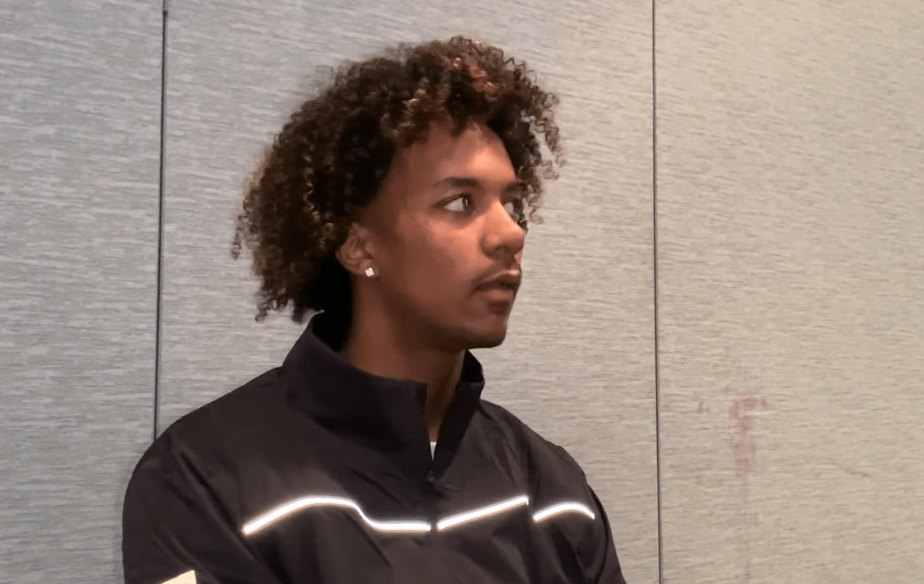
Credit: RandomZRecap
A handshake can be used to recruit certain athletes. With a promise that ended in court rather than a touchdown celebration, Jaden Rashada was recruited.
Unlike other quarterback prospects, he was unique. By the end of 2022, his NIL contract was falling apart more quickly than his defenders on a blitz, making him the face of an especially turbulent period in college athletics.
| Name | Jaden Rashada |
|---|---|
| Role | College Football Quarterback |
| Notable Teams | Arizona State (2023), Georgia Bulldogs (2024–), Former Florida signee |
| Legal Case | Lawsuit filed against Florida coach Billy Napier and boosters over unfulfilled $13.85M NIL agreement |
| Reference | ESPN: Jaden Rashada NIL Lawsuit |
A remarkably ambitious $13.85 million NIL agreement is at the heart of his lawsuit against Florida head coach Billy Napier, prominent booster Hugh Hathcock, and employee Marcus Castro-Walker. Rashada claims that only the pressure and persuasion made that deal materialize.
According to Rashada’s documents, a sequence of discussions, inducements, and changing assurances significantly intensified in the days leading up to his signing of his letter of intent. He claims that Napier personally provided a $1 million upfront guarantee. He claims that a collective supported by boosters promised an additional $500,000 right away.
That money never appeared. The agreement quickly collapsed as a result of the collective pulling out, internal confusion taking over, and Florida officials allegedly continuing to pressure Rashada to sign even though they knew the deal had already fallen through.
Rashada left in January 2023 with only $150,000 of his purported signing bonus. After leaving Florida, he went west to Arizona State. He suffered an injury that ended his first season. Then there was another change, to Georgia this time.
But the legal side never stopped.
Rashada filed an eight-count lawsuit in federal court in May 2024. Fraudulent misrepresentation, conspiracy to commit fraud, and negligent misrepresentation are some of the accusations. The court notably agreed to allow the majority of these claims to move past the dismissal stage, which is an exceptionally high standard for athletic fraud cases.
The case is extremely important just because of that.
In addition to serving as a warning, Rashada’s story is now serving as a model for how athletes may resist when negotiations fall through. Others who may have felt duped, tricked, or even cornered by booster-backed promises now have a legal path thanks to his case.
The lawsuit challenges presumptions that NIL deals are merely handshake agreements with little accountability by exposing dishonest behavior that seems to be coordinated between coaches and collectives.
I found myself reading the judge’s opinion again at one point and stopping on a single sentence that mentioned how reliable Rashada’s timeline was. That was a lingering moment. Until someone turns on the light, a lot of collegiate athletics is still negotiated in the dark, it reminded me.
Other athletes have begun to speak up since Rashada filed.
Three Florida State basketball players filed a lawsuit against their coach, claiming that they were also verbally promised NIL sums that never came to pass. They say they were left without legal protections, just like Rashada. They had no contract, no fallback, and no representation, unlike Rashada.
When that promise fell through, quarterback Matthew Sluka, who had transferred to UNLV believing he was receiving a $100,000 NIL offer, also left. He didn’t file a lawsuit. Nothing was written.
This distinction between relying on verbal promises and having a paper trail has become especially significant. It’s also a major factor in the court’s consideration of Rashada’s claims.
The judge gave the indication that athletes might no longer have to put up with being outwitted by influential organizations by highlighting the veracity of his claims and the particulars of the false statements.
Rashada is changing the definition of fairness in NIL negotiations through this legal process.
His current stint at Georgia is an opportunity to regain stability as well as a second chance on the field. Rashada is anticipated to use the 2024 season to grow and learn under coordinator Mike Bobo, as Carson Beck is set to be the starting quarterback.
In the long run, that might be especially advantageous, even though it might seem like a step back to some. Georgia has plenty of talent, and learning in a top-notch system could eventually help Rashada surpass expectations.
He will probably face competition from Ryan Puglisi and Gunner Stockton for the starting position by 2025. Resilience has been one of Rashada’s best qualities thus far, but the competition will be intense.
The loss of Rashada had an instant impact on Florida.
Coach Napier was held accountable for a 5-7 season, irate supporters, and the decline in trust brought on by high-profile errors. Particularly as Florida attempted to hold onto quarterback D.J. Lagway, their top 2024 recruit, the legal mess only made matters more difficult.
This lawsuit may be a watershed for the larger picture.
The NCAA has halted NIL-related enforcement due to mounting pressure and a federal judge’s ongoing injunction. Athletes like Rashada are filling this void by coming forward to demand change as well as to get what they feel is rightfully theirs.
Since NIL’s inception, the flurry of agreements, pledges, and private discussions has produced a chaotic environment that benefits those with authority and experience. The case of Rashada restores equilibrium.
It implies that athletes are learning how to defend their worth in the event that deals fall through, rather than just how to sign contracts.
And it’s worthwhile to keep an eye on that trend.
Rashada has already impacted the national dialogue by pursuing legal action and by simply refusing to go away after being harmed. Regardless of the outcome of this case, he has established a precedent that will undoubtedly be followed by others.
More athletes will likely demand written contracts, legal counsel, and openness from collectives and boosters in the upcoming seasons. Schools should reconsider their level of coordination with those same collectives.
And perhaps—just possibly—ask for more equitable treatment for the following generation.
