

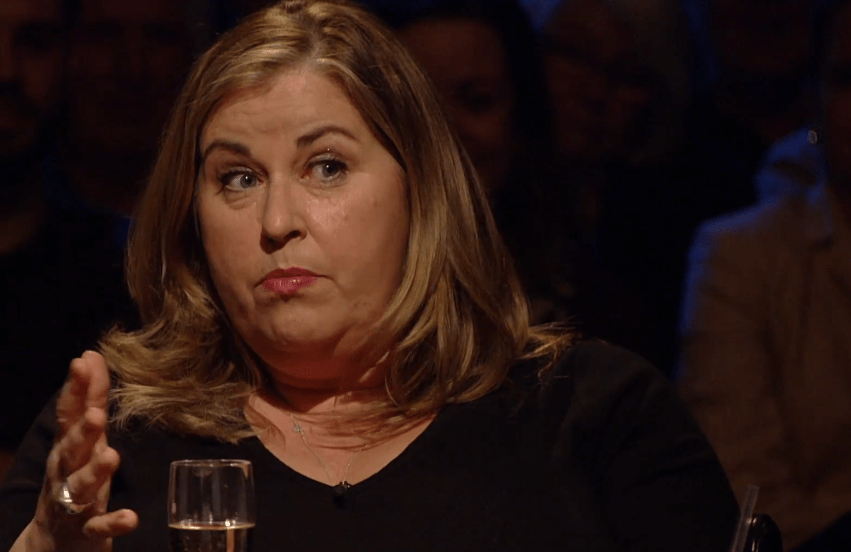
Credit: British Comedy Guide
The phrase “Liza Tarbuck’s husband” has a subtle allure. It keeps coming up in search results, is whispered about in celebrity forums, and occasionally is presented as a mystery that needs to be solved. The interesting thing, though, is that the narrative is more about the purposeful absence of a husband than it is about a husband.
Liza Tarbuck has been a well-known voice and face in British entertainment for many years. Audiences are familiar with her laugh, which is loud, unadulterated, and distinctly Liverpool in spirit. They are also familiar with the effortless warmth she brings to television sets and radio studios. Her personal life defies the neat narrative that people frequently anticipate from public figures, which they are unaware of or may find difficult to accept.
| Personal Information | Details |
|---|---|
| Full Name | Liza Tarbuck |
| Date of Birth | 21 November 1964 |
| Age | 61 (as of 2026) |
| Birthplace | Liverpool, England |
| Nationality | British |
| Profession | Actress, Comedian, Radio & TV Presenter |
| Famous For | BBC Radio 2 show, Linda Green, Watching |
| Education | Royal Academy of Dramatic Art (RADA) |
| Parent | Comedian Jimmy Tarbuck |
| Marital Status | Not married |
| Reference | https://en.wikipedia.org/wiki/Liza_Tarbuck |
The facts are fairly simple. Born in Liverpool in 1964, Liza Tarbuck was raised in a home steeped in the entertainment industry. Comedian Jimmy Tarbuck, her father, worked in the British entertainment industry for many years, from television variety shows to theater stages. According to family tales, the house was bustling, with comedians stopping by, scripts strewn all over the place, and the sound of performances always present. Still, those who’ve followed Liza’s career closely get the sense she learned early how to separate the public spectacle from private life.
Her early exposure to celebrity may have influenced her privacy instincts. She might have become wary after closely observing the mechanics of celebrity, such as the gossip columns, the presumptions, and the peculiar way strangers feel entitled to details. Tarbuck seems to have carefully crafted her career, giving audiences just enough of herself while keeping the rest firmly out of reach.
When discussions turn to relationships, that strategy is most evident. In interviews, the question “Is there a husband?” comes up almost ritualistically. A companion? Someone in the background, silently? When he does respond, it is usually in a lighthearted, humorous, and somewhat evasive manner.
The most accurate explanation is still the most straightforward one. Liza Tarbuck has never tied the knot.
That fact is more noticeable than it probably should be in a time when celebrity weddings frequently serve as media spectacles. Her generation’s performers eventually integrated their personal lives into the public narrative, including marriages, divorces, and children featured in magazine articles. Tarbuck didn’t adhere to that plan. Rather, she developed a career that alternated between radio, acting, and presenting while her private life went mostly unreported.
Naturally, there have been rumors. One tale that comes up from time to time concerns an enigmatic character known as “Bob.” Some media outlets had been speculating for years that a man with that name might be a long-term partner. However, the details are almost hazy, which is frustrating. The story was never verified by Tarbuck herself. As I watch these rumors spread, I get the impression that they reveal more about the public’s curiosity than about her real life.
Her career path continued to develop in the interim. Tarbuck received training at the Royal Academy of Dramatic Art before landing his first television parts, most famously in the comedy drama Watching on ITV. Later came Linda Green, who portrayed a sardonic working-class singer negotiating complex relationships. Perhaps it’s a little ironic that she played characters who struggled with commitment and love while her own relationship status remained so ambiguous.
In addition to acting, Tarbuck was especially at home on the radio. Her conversational style became well-known to BBC Radio 2 listeners; she was laid back, occasionally mischievous, and always sounded more at ease conversing with friends than broadcasting to millions. It has a disarming quality. After a sufficient amount of time spent listening, one begins to perceive her as a familiar presence in the room rather than a famous host.
Nevertheless, people continue to be fascinated by her personal life. Tarbuck doesn’t appear to play the celebrity game, which could be the reason. She seldom shows up at glitzy gatherings. According to interviews conducted over the years, she would much rather walk a dog or spend an evening with friends than go to an industry event. Her self-control seems almost archaic in a society that frequently rewards continuous exposure.
It’s difficult to ignore the fact that her public persona now includes this independence. Tarbuck frequently discusses happiness in terms unrelated to marriage or conventional milestones. She seems to value autonomy, which is the freedom to make her own decisions about her career, friendships, and routines without the obligations that occasionally accompany high-profile relationships.
That does not, of course, imply that romance has never existed. Tarbuck has most likely had relationships that never made headlines, just like the majority of people in their sixties. However, she has succeeded in keeping those experiences out of the public record, something that many celebrities find difficult to accomplish.
Observing the interest in “Liza Tarbuck’s husband” develop over time reveals an intriguing cultural practice. People frequently believe that a successful life must follow specific steps—career, marriage, and family—that are neatly organized like chapters in a well-known narrative. Tarbuck’s life doesn’t quite fit that description.
Rather, it appears to be a long, winding career characterized by independence, humor, and a refusal to overly explain herself. And that might be the true response to the search query. Not a covert spouse. A woman with a slightly different script, that’s all.
