

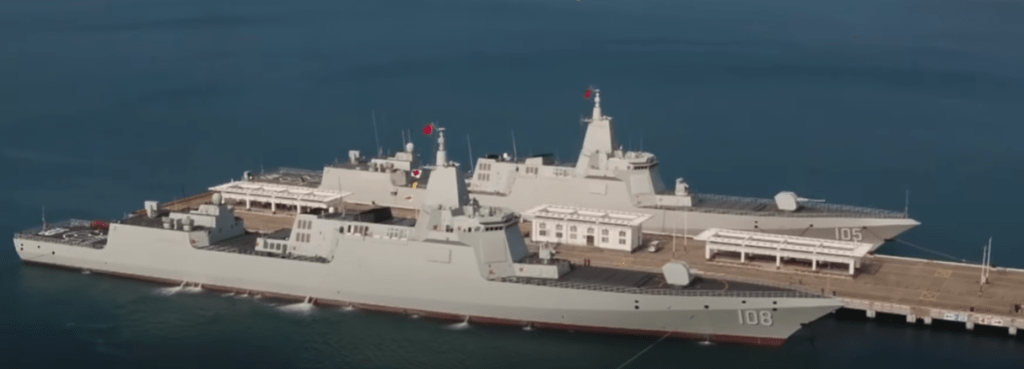
Older warships seem suddenly outdated when compared to the Type 055 destroyer. It carries the bulk of something designed for a larger era of naval ambition, even in photographs with the deck lines cleaned up for stealth and the hull painted that flat, nearly anonymous gray. With a length of about 180 meters and a full load of 12,000 to 13,000 tons, it falls into that awkward category where referring to it as a “destroyer” feels both technically and emotionally correct. NATO refers to it as the Renhai-class cruiser, which may be more accurate—or at least more accurate in terms of the impression it conveys.
This ship isn’t just big. It’s a very thoughtful one. China had ten Type 055s in service by March 2026, including the recently unveiled Dongguan and Anqing. The first of the class, Nanchang, went into service in 2020. That speed is important. Shipbuilding has a physical bluntness to it, but naval power is frequently discussed in abstract terms like tonnage, sorties, and industrial capacity. Formations shift, hulls emerge, crews train, and steel is cut. As the Type 055 program expands, it seems that China has shifted from questioning whether it could produce a true blue-water surface combatant to focusing on developing a fleet of them.
| Category | Details |
|---|---|
| Ship/Class Name | Type 055 destroyer |
| NATO Reporting Name | Renhai-class |
| Operator | People’s Liberation Army Navy (PLAN) |
| Role | Large multi-mission guided-missile surface combatant focused on area air defense, strike, and fleet escort |
| Length | About 180 meters |
| Displacement | Roughly 12,000–13,000 tons full load |
| Missile Cells | 112 vertical launch cells |
| In Service | Since 2020 |
| Current Fleet Size | 10 ships in service as of March 2026 |
| Reference Website | U.S. Naval Institute Proceedings / USNI News |
112 vertical launch cells is the headline number that everyone aims for first. Almost any navy would pay attention to that. Long-range air defense missiles, anti-ship weapons, land-attack cruise missiles, and anti-submarine munitions can all be carried by these cells, which are divided into forward and aft sections. Practically speaking, this indicates that the ship is not limited to a single role. It can threaten ships from a distance, thicken an air-defense screen, escort a carrier, and make an opponent’s calculations more difficult before the first shot is fired. It’s possible that the class’s true significance lies in its versatility rather than its raw missile count.
The sensor image, on the other hand, might be even more revealing. According to USNI’s assessment, the class is among the most powerful surface combatants on the water, and a large portion of that assessment is based on detection, tracking, and command-and-control in addition to missiles. One of the most notable characteristics of the Type 055 is its dual-band radar system, which provides the kind of situational awareness one would expect from a vessel built to safeguard valuable assets and manage a larger formation. Because of what they can shoot, warships are frequently admired. What they can see, how quickly they can process it, and whether the crew can take action before the opposing side is the more important question.
Recent footage from the Chinese state media gave that argument some nuance. Nanchang’s first live-fire surface-to-air missile test from 2021 was shown in official coverage in March 2026, with five reported hits out of five during what Chinese reporting described as a challenging air-defense scenario. A certain amount of caution should always be exercised when reading state media, particularly when it comes with a triumphant narrative. Even so, the video had a purpose. It served as a reminder to both domestic and international audiences that the ship is more than just a shipyard success story. It is transitioning into a more developed operational life.
Where these ships are headed, however, seems more significant. Dongguan and Anqing joined the Eastern Theater Command, which is most closely linked to any possible Taiwan contingency and to operations against Japan in the East China Sea, according to a USNI report this month. It’s not a subtle assignment. Setting up elite surface combatants in Asia’s most politically charged maritime theater is a different matter entirely from carrier escorts and prestige deployments. The Type 055 seems to be more than just a representation of modernity. It is being positioned where modernization is supposed to matter.
It is impossible to avoid comparisons with American ships, and they are typically a little messy. The Type 055 is frequently discussed in conjunction with the Arleigh Burke destroyers, the Ticonderoga-class cruisers, and occasionally even the problematic Zumwalt program. According to some analysts, China has distinct advantages in integrated design, growth potential, and missile capacity. Others note that Aegis ships from the United States and Japan continue to have significant advantages in terms of ballistic missile defense, doctrine, and practical alliance integration. Both perspectives may be accurate. Although hardware is important, naval warfare has never been a showroom competition. Sensors, logistics, training, geography, and nerve are all at stake.
The psychological impact that the Type 055 has already had is difficult to ignore. It is no coincidence that the ship has become a focal point in nearly every conversation concerning China’s surface fleet. It is big enough to dazzle, powerful enough to frighten planners, and numerous enough to change maps instead of just headlines. Perhaps the most crucial point is the last one. You can write off a one-time super-ship as theater. With more expected, a growing class of ten begins to resemble a structure.
And that’s most likely the true tale. While the Type 055 destroyer is impressive in and of itself, it is even more illuminating as a sign of a larger shift in Chinese naval philosophy. This ship is designed to manage air-defense networks, escort carriers into far-off waters, and make other people’s intervention appear riskier and slower, in addition to protecting coasts. It remains to be seen if it will be decisive in any future crisis. Confident forecasts are often humiliated by war. However, there’s a sense that the long-held belief that China’s navy was primarily a regional force with regional boundaries is beginning to fade as this class expands.
