

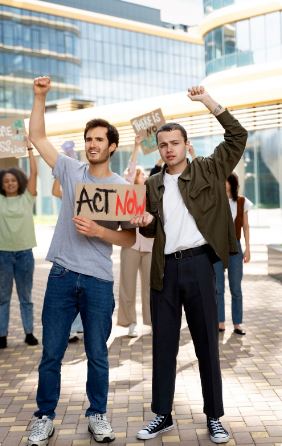
A museum café in Brighton is bustling on a soggy Saturday afternoon as children tug at their parents’ coats and elderly people order tea. The conversation, which was overheard in between Victoria sponge bites, has nothing to do with pronouns, statues, or “wokeness.” It concerns train delays, heating costs, and whether the waterfront will ever be adequately restored. However, survey after survey claims that Britain is engaged in a culture war.
The figures are startling. According to a study conducted by Ipsos and the Policy Institute at King’s College London, 84% of Britons now feel that the nation is divided. According to two-thirds, “culture wars” have divided the UK. The culture of the country is changing too quickly, according to half. These changes are significant because they point to a growing dissatisfaction with the rate and course of social change, especially among older voters.
| Category | Details |
|---|---|
| Country | United Kingdom |
| Key Research Body | Policy Institute at King’s College London |
| Polling Partner | Ipsos |
| Thinktank Referenced | More in Common |
| Latest Finding | 84% say the UK feels divided; 64% say culture wars are a serious problem |
| Reference Website | https://www.kcl.ac.uk |
However, the situation is further complicated by a different set of findings. The loudest voices are those of a relatively small minority, according to a long-standing argument by the think tank More in Common. Just 12% of voters were responsible for half of the political content on social media in previous studies. Researchers discovered that the majority of Britons favored compromise over confrontation. What appears to be a national shouting match may actually be a heightened dispute between the most politically active people.
It’s difficult to overlook the amount of energy invested in symbolic disputes when strolling through Westminster on a weeknight and passing TV crews positioned beneath streetlights. A remark regarding the label of a museum. a dispute over a speaker at the university. A headline referring to a curriculum that is “woke.” These erupt, take center stage in the news cycle, and then fade away as the next provocation takes their place. The pattern is almost ceremonial: indignation, reaction, panel discussion, repetition.
It seems like people are worn out.
According to a poll, 64% of people now believe that culture wars pose a significant threat to politics and society. Once unheard of, the term “woke” is now widely accepted and is being used more and more as an insult. However, a significant portion of the populace either shrugs or claims they are unsure of the meaning of the terms when asked if they consider themselves to be “woke” or “anti-woke.” It feels illuminating to see that gap between awareness and identification. Despite knowing the language of the war, many people are reluctant to enlist.
Whether this weariness will result in political change is still up in the air. Parties persist in experimenting with culture-based messaging, possibly because they think it will inspire their core supporters. Voters for reform in the UK, for instance, are likely to believe that the nation is too rapidly changing and is deeply divided. In the meantime, younger voters are becoming more nostalgic, which is unexpected considering that nostalgia is typically thought to be reserved for the elderly. Dislocation isn’t age-bound, as evidenced by the 20-somethings’ comments about wanting the nation “the way it used to be.”
Immigration is still a contentious issue. Accusations of bad faith frequently arise during discussions about housing, migration, and NHS capacity. One hears coded animosity, while another refers to it as a practical concern. People may continue to argue because they perceive actual pressures and a lack of forums for thoughtful discussion, rather than because they like fighting. Everyone loses when important policy debates devolve into colloquial cultural jargon.
Brexit serves as a warning. It was presented, in part, as a cultural split between tradition and openness, sovereignty and cosmopolitanism. At the time, the divide felt existential. However, recent data indicate that tensions between the Remainers and the Leavers are decreasing. The wounds are less raw, but they haven’t healed. That suggests that even severe cultural differences can eventually become less pronounced.
The media’s amplification makes things more difficult. The percentage of people who think the media exaggerates division has dropped from 77% five years ago to 66% now. People continue to believe that politicians fabricate or exaggerate culture wars as a strategy. Fewer people, however, believe that the drama is wholly manufactured. The effect of the repetition is evident. Words that were once reserved for scholarly seminars are now frequently used in tabloid headlines.
It’s difficult to reconcile the everyday tranquility with the occasionally apocalyptic tone heard online when you’re standing outside a National Trust property on a sunny autumn morning with lines for scones extending across gravel paths. Parking fees appear to be more important to the typical visitor than ideological disputes. It’s difficult to ignore how normal life feels in contrast to the noise of the digital world.
The secret might lie in that contrast. Britain does not have the same binary political structure as the United States. The electorate changes allegiances based on the issue, acting more like a kaleidoscope than a battlefield. For example, there is widespread consensus among all demographic groups regarding climate change. There is still widespread support for gender equality. Even arguments concerning Britain’s imperial past frequently show a range of opinions rather than dogmatic positions.
Do Britons no longer quarrel with one another? Not totally. Immigrants and UK-born citizens are perceived to be at odds once more. The nation’s pride has fallen below a majority. Furthermore, younger generations are voicing new concerns about cultural change in spite of their purported liberalism. Harmony is not the same as fatigue.
Fatigue, however, is important. The desire for constant conflict can be sated by exhaustion. There is a subtle sense that many people want to cool things down after seeing this play out over the past few years. Not to eliminate conflict, but to restore its manageability.
Naturally, there is a chance that weariness will lead to cynicism rather than peacemaking. Voters may choose to disengage rather than demand better if they believe that politics is merely symbolic conflict. The loudest factions would have even more space to rule as a result.
The nation is currently torn between fatigue and division; it is conscious of the noise, doubtful of its value, and uncertain of how to distance itself. Britain may be still fighting. However, it may finally be prepared to speak more quietly.
