

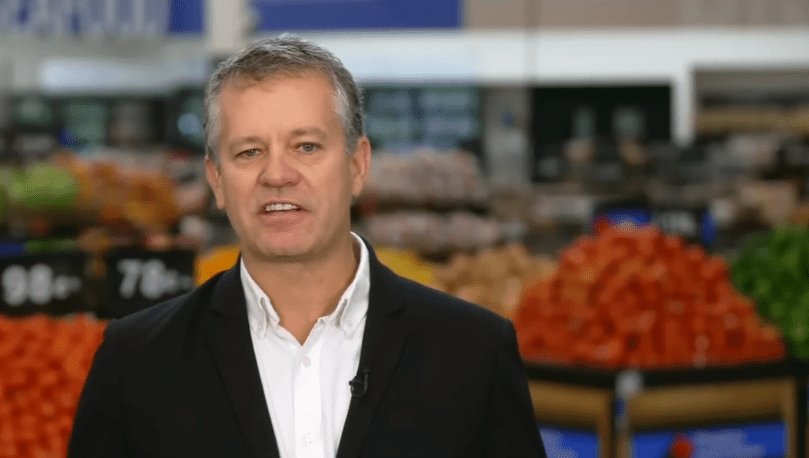
Credit: CBS Mornings
When John Furner first picked up bags of dirt in the garden area of a Walmart in Bentonville, he surely didn’t expect he’d one day be heading the entire firm. Yet, that’s precisely what’s happened, and it speaks volumes—not just about him, but about how organizations evolve.
Doug McMillon’s final day as CEO concluded with cordial farewells and a transfer that felt notably planned. As Furner stepped into the post, he brought decades of experience within Walmart’s walls and a leadership style built by proximity to real problems—not simply spreadsheets or strategy boards.
| Detail | Information |
|---|---|
| Name | John R. Furner |
| Starting Point | Hourly employee at Walmart’s garden center in Bentonville, Arkansas |
| Education | Degree in Marketing Management from the University of Arkansas |
| Key Roles | CEO of Sam’s Club (2017–2019), CEO of Walmart U.S. (2019–2026), now CEO of Walmart Inc. |
| Leadership Style | Collaborative, grounded, forward-focused |
| Major Achievements | Overhauled store manager compensation, expanded digital infrastructure, led pandemic response |
| Stores Overseen | 10,750+ globally across 19 countries |
| Employees Managed | Approximately 2.1 million worldwide |
| External Reference | Fox Business |
For many leaders, especially those joining from outside a company, the problem comes in knowing the culture. Furner doesn’t have that problem. He has built worldwide divisions, experienced the day-to-day grind of store life, and guided Sam’s Club through a digital renaissance that some rivals found difficult to match.
His time in Shenzhen with Walmart China is often overlooked, but it’s telling. Running merchandising in a market as layered and fast-moving as China required both sensitivity and speed. That’s where Furner developed his instincts—learning how actions in one aisle affect the supply chain, perception, and profit margins two continents away.
Furner not only controlled the turmoil during the epidemic when labor shortages and panic buying collided, but he also adopted Walmart’s strategy. He campaigned for safety, modernized logistics, and concentrated on keeping shelves stocked. Every retail CEO was put to the test during that time, but few came out of it as credible as he did.
What’s particularly interesting about his leadership is how it integrates business ambition with practical sensitivity. He’s one of the few Fortune 500 CEOs who can talk logistical KPIs in the same sentence as staff morale—and truly mean both. That balance has proven remarkably effective at creating trust across ranks.
Walmart’s move to raise store manager pay was a headline-grabber, but it was founded in something deeper: a respect for frontline leadership. Furner knows what it’s like to close up business late and open the doors early. By drastically boosting salary ranges and adding long-term incentives like stock grants, he showed that Walmart isn’t just scaling—it’s maturing.
He also revived bonuses for hourly workers, framing them not as handouts, but as recognition. Not only was this strategic, but it was also very human. For a company employing over two million people, that nuance matters. You don’t move a workforce that huge without emotional intelligence.
Even more is revealed by Furner’s daily routines. He carves out time to listen—morning and night—both inside and outwardly. Not through secondhand briefings, but by calling colleagues, conversing with team members, even collecting insights from store visits. It’s a hands-on method that, while time-consuming, remains highly efficient in catching friction before it becomes fire.
He has expedited Walmart’s transition into digital and AI by working directly with the tech, operations, and merchandising departments. AI-assisted pricing, warehouse automation, and drone pilots are all making their way into actual stores. And with Furner, that tech doesn’t feel like a gimmick—it’s founded in solving genuine problems for consumers and staff alike.
He typically draws on early lessons from his grandfather’s Arkansas farm—like fixing fences at dawn and selling watermelons along the highway. Those events taught him persistence, but also taught him improvisation. That mindset—resilient yet curious—colors the way he leads today.
I remember watching an interview where he attributed studying guitar with teaching him to listen more than speak. It felt honest, not rehearsed. And for a firm that operates on relationships as much as margins, such humility isn’t just charming—it’s crucial.
By harnessing internal talent and establishing feedback loops into decision-making, Furner has considerably increased Walmart’s agility. It now takes weeks to make changes that used to take quarters. Strategy has met speed—and that alignment, under his guidance, is beginning to feel durable.
Additionally, his appointment reflects a greater faith in continuity. Walmart opted for a builder instead of pursuing the next innovative disruptor. Someone who knows which beams matter and which can be changed without affecting the structure. That’s a quiet type of courage.
Still, the job ahead is massive. It takes more than just leadership to oversee 10,750 stores in 19 different countries; coordination is necessary. And with retail evolving fast, from online grocery supremacy to AI-driven personalization, Furner’s steady hand will be tested.
But if history is any guide, he won’t worry. He’ll pay attention. He’ll adjust. He will most likely visit a few stores, speak with colleagues, and then make a choice based on both information and gut feeling.
Instead of being hurled, the baton has been passed. And in an era of showy launches and short attention spans, that kind of leadership—measured, careful, grounded—feels not only refreshing, but astonishingly vital.
