

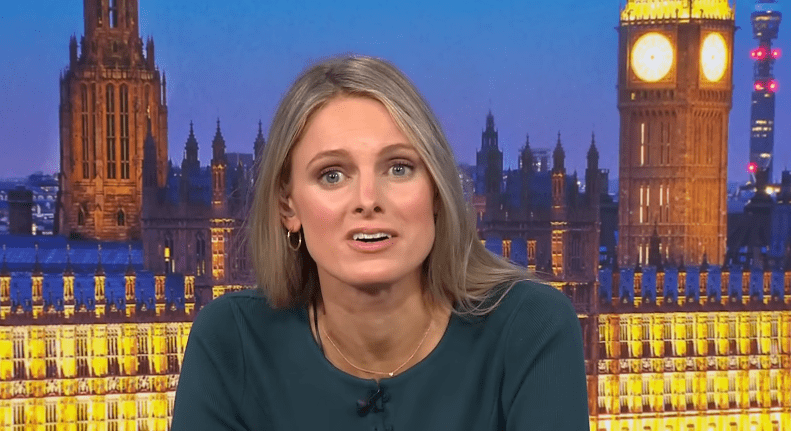
Credit: SKY News
Ali Fortescue is a trusted presence during times when British politics seem to change by the hour rather than the year because of her reputation as a political correspondent whose reporting is noticeably clearer even when events happen at a breakneck pace.
Early academic rigor at the University of Oxford shaped her career path in journalism. There, she developed habits of close reading, organized argument, and evidence-based debate that are still evident in her broadcasting style, especially when she rejects policies that come with catchphrases rather than substance.
| Detail | Information |
|---|---|
| Full Name | Ali Fortescue |
| Nationality | British |
| Profession | Political Correspondent and Presenter |
| Current Employer | Sky News |
| Previous Employer | BBC News |
| Education | University of Oxford |
| Base Location | London, United Kingdom |
| Languages Spoken | English, French, Spanish |
| Specialist Areas | UK politics, immigration, European affairs |
| Awards and Recognition | Royal Television Society commendation |
| Reference Website | https://news.sky.com/author/ali-fortescue-757 |
As a regional reporter in northern England, Fortescue honed her skills before the cameras and live locations. She covered stories that were grounded in everyday life, where trust had to be gradually gained, frequently by revisiting the same communities long after the headlines had faded.
She learned from those years that journalism works more like a swarm of bees than a single spotlight, with little observations collected over time to create a larger picture that is frequently far richer than any one dramatic moment might imply.
This strategy was demonstrated in an early investigation into abuse at a care facility in Margate, which condensed complicated evidence into firm yet compassionate reporting. This earned her praise from the Royal Television Society and established her credibility long before she gained widespread recognition.
Fortescue’s move to Sky News seemed remarkably successful; she quickly became the focal point of Westminster coverage during a time of turbulent leadership, policy reversals, and public exhaustion, all of which required reporting that was calm rather than explosive.
On the days that Boris Johnson and Liz Truss resigned, she provided live updates from Downing Street that were incredibly transparent, separating rumors from reality and enabling viewers to comprehend not only what was happening but also why it was important.
Her interview with Boris Johnson just before he left office is still widely cited, not because it was confrontational but rather because it was persistent and asked questions that didn’t shout but lingered, subtly revealing gaps that louder exchanges frequently miss.
She frequently questions senior Home Office ministers about immigration, which has become a defining theme of her reporting. She insists on facts rather than rhetoric, a strategy that has remained remarkably consistent across administrations despite shifting faces at the podium.
Her proficiency in French and Spanish, which was especially helpful when covering the French presidential election in Paris for several weeks and following Marine Le Pen’s campaign, puts European politics firmly within her purview.
Fortescue was assigned to the Baltic states during the time leading up to the conflict in Ukraine. He reported from close to the Russian border as NATO exercises took place, providing commentary that was incredibly trustworthy in tone and did not minimize risk or overstate threat.
Through formats like “PMQs Unwrapped,” a weekly breakdown that many viewers find especially helpful for comprehending parliamentary exchanges frequently obscured by procedure and partisan noise, she has established herself as a well-known analytical voice beyond frontline reporting.
Her analysis style has significantly improved over time, as evidenced by her regular breakfast television segment “Ali’s Take,” which combines live reaction with context gleaned from historical voting data, internal party dynamics, and more subdued off-camera discussions.
Fortescue’s growing role on digital platforms is a reflection of larger changes in journalism, where reporters now have to write, present, explain, and interact all at once. Fortescue handles this workload in a way that seems extremely effective rather than hectic.
She freely asks for advice and story leads on social media, which has turned out to be surprisingly cost-effective in terms of reputation. This builds audience trust while upholding professional boundaries that many public figures find difficult to establish.
Her internal reputation helps to explain why she is regularly assigned to high-pressure stories where mistakes carry a reputational cost. Her colleagues frequently characterize her working style as collaborative, prioritizing preparation over performance.
It’s inevitable to draw comparisons with colleagues like Laura Kuenssberg or Sophy Ridge, but Fortescue’s style feels unique, characterized by restraint and an avoidance of personality-driven commentary that keeps her reporting at the forefront.
This moderation is in line with the evolving expectations of viewers, who are increasingly drawn to journalism that clarifies rather than incites, a change that has drastically decreased tolerance for performative outrage in political coverage.
Her ability to speak multiple languages also suggests a wider range of international adaptability, which will be advantageous for cross-border assignments in the future, especially as external policy and security concerns increasingly impact domestic politics.
Despite being well-known, Fortescue keeps her personal life relatively private. This decision supports her reputation as a journalist whose work, not her fame, defines her, which is becoming a more uncommon position in media culture.
Her reporting’s influence on society is partially due to its tone, which shows that accountability need not be met with violence and that politeness and in-depth inquiry can coexist. These lessons are applicable outside of the broadcasting industry.
Her composure in the face of legislative chaos is often praised by viewers, who characterize it as grounding. This trait becomes crucial when public trust in institutions seems to have declined dramatically.
Fortescue’s career trajectory points to increasing influence as political cycles tighten and news breaks more quickly. This influence was developed through preparation and consistency rather than viral moments.
Her rise from local reporting to national prominence is representative of a broader industry trajectory where credibility is built up gradually through innumerable choices that are imperceptible to audiences but crucial to credibility.
By demonstrating that authority can be communicated through knowledge rather than volume, Ali Fortescue’s work also provides a model for aspiring journalists, especially women entering the field of political reporting.
Practically speaking, she has contributed to changing the standards for political correspondence by demonstrating that depth, patience, and clarity are not extras but rather requirements in intricate democratic discourse.
Her reporting conveys a sense of optimism about the function of journalism, implying that thoughtful storytelling still has the ability to enlighten rather than alienate, despite weariness and cynicism.
Ali Fortescue is still regarded as a person whose impact is steadily increasing due to his remarkably resilient professionalism, persuasive analysis, and unwavering conviction that meticulous reporting is still crucial to the general public’s comprehension.
