

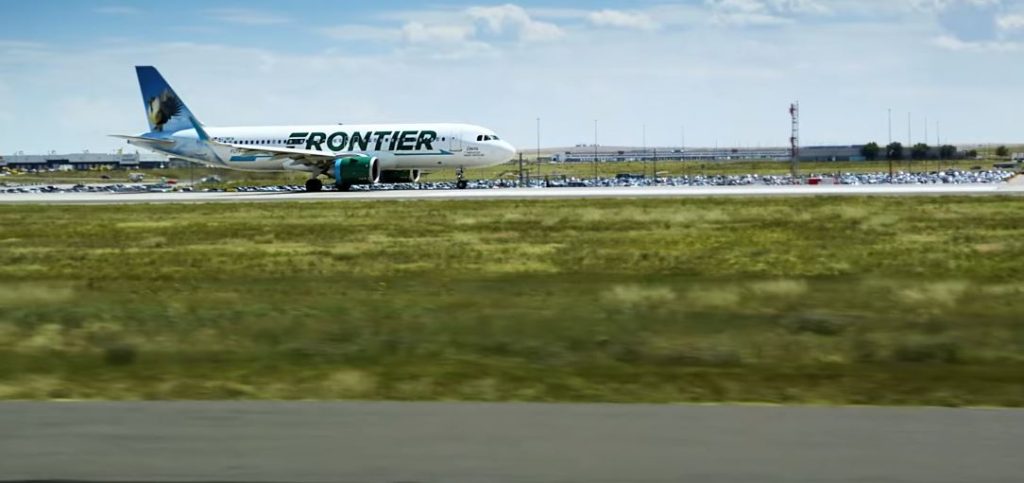
In the final moments before landing, a plane experiences a certain kind of stillness. Flight attendants gather cups, passengers begin packing up laptops, and the cabin settles into that collective, quiet exhale. No one anticipates that a quick Sunday afternoon trip from Columbus, Ohio, to Atlanta will be anything but ordinary. Apparently, a man in seat 3A changed his mind after that.
On March 29, 2026, at around 5:07 PM, Frontier Airlines Flight 2539 landed at Hartsfield-Jackson Atlanta International Airport. Almost instantly, everything changed. A male passenger verbally threatened to kill the woman seated next to him and claimed to have a bomb on board. Declaring a Level Four security alert and informing air traffic control of the situation, the pilots responded with the level of accuracy required by their training. In a matter of seconds, the Airbus A320 was being steered away from the terminal and toward an isolated taxiway with nothing but tarmac and the quickly approaching blue lights of Atlanta police cruisers.
| Information Category | Details |
|---|---|
| Incident | Frontier Airlines Flight 2539 Bomb Threat & Security Scare |
| Date | Sunday, March 29, 2026 |
| Flight Route | Columbus, Ohio (CMH) → Atlanta, Georgia (ATL) |
| Aircraft | Airbus A320 |
| Airline | Frontier Airlines |
| Incident Location | Hartsfield-Jackson Atlanta International Airport |
| Security Level Declared | Level Four (Highest Aviation Threat Level) |
| Investigating Agency | FBI Georgia, Atlanta Police Department, SWAT |
| Threat Status | Deemed Non-Credible |
| Passenger Status | Detained; Federal charges under consideration |
| Potential Charges | False reporting, secondary assault (up to 20 years) |
| Official Reference | FBI Georgia Official Statement |
The entire American aviation security apparatus then performed precisely as intended. Agents from the FBI, Atlanta Police, and SWAT teams gathered around the plane. The transponder had already been squawked to code 7500, which is the universal hijacking signal that all of the nation’s radar screens and towers recognize. From the outside, it appeared as though a serious crisis was developing in real time based on the footage that was making the rounds on social media. It seemed to feel like one from the inside as well.
The descent was described by passengers as truly terrifying. Sitting somewhere in the middle of the cabin, Jessica Kinder recalled flight attendants constantly telling passengers, “Heads down, hands up.” Keyaira Smith, a fellow traveler, told reporters that the man had been obviously unpredictable even before the aircraft departed Columbus. She remarked, “I guess they let him on the plane,” and if you give that detail too much thought, it becomes unsettling. After such incidents, the question of what is overlooked during the boarding process and why always arises.
The word “hijacking” quickly spread along with the audio that appeared on social media, which was allegedly a recording of the cockpit crew discussing a “potential bomb on board” with Atlanta ATC. It’s a powerful word. It takes viewers back to more somber times in aviation history and evokes memories that are difficult to shake. After the plane was secured, however, Atlanta Police were cautious in their wording, making it apparent that the incident was “not being treated as a hijacking at this time.” When investigators were able to evaluate the situation properly, they determined that the threat was not credible. On the tarmac, the suspect was held.
Passengers were bused across the tarmac to the terminal after disembarking via portable air stairs, which are rare at major American airports these days. Leaving a plane that way and landing on open concrete at one of the busiest airports in the world while law enforcement sweeps the aircraft behind you is a disorienting experience. The experience was described as surreal by several passengers. That would be an understatement.
Since federal jurisdiction begins as soon as there are threats aboard aircraft, the FBI has taken the lead in the investigation. FBI Georgia said in a statement issued Sunday night that agents were actively interviewing witnesses and that there was no ongoing threat to the public. The agency further stated that it would confer with the Northern District of Georgia U.S. Attorney’s Office regarding the possibility of filing federal charges. As of this writing, it’s unclear if formal charges have been brought, but the repercussions could be dire: false reporting involving aircraft explosives and secondary assault could result in up to 20 years in federal prison.
In the formal language of aviation emergency protocol, it is important to comprehend what a Level Four alert actually entails. Level One in the FAA’s four-tiered threat system is disruptive cabin behavior; Level Two is physical altercations; Level Three is life-threatening behavior, including visible weapons; and Level Four is direct threats to the flight deck or the aircraft’s overall safety. The highest rung is that. By declaring Level Four, pilots are essentially alerting all authorities within radio range that they think lives are in imminent danger. That decision was made by Flight 2539’s crew. It’s difficult to argue that passengers were incorrect to do so, given what they were describing inside the cabin.
The past few months have been difficult for Frontier Airlines. A loaded firearm was found on another Airbus A320 that the airline operated in Atlanta just last November. This was a different, concerning incident that brought up additional concerns regarding screening practices. Even when both situations are eventually resolved without incident, a pattern like two security incidents at the same airport, on the same type of aircraft, within a few months of one another tends to draw attention.
It remains to be seen if this incident will lead to more extensive discussions about threat assessment procedures, passenger screening, or the suitability of crew training for handling disruptive passengers during flight. Until they are clearly inadequate, airlines and regulators frequently cite current practices as adequate. Because of the crew, pilots, and responding agencies, Flight 2539 did not end tragically. However, it’s worth acknowledging that it took landing the aircraft, sending out SWAT, and calling in the FBI before one disruptive passenger was brought under control. Seeing something like this happen gives the impression that both the system was successful and that it is being asked to take in a lot of information.
The entire weight of federal law is now on the man in seat 3A. His identity has not been made public. The woman he threatened sat beside him for what must have felt like a much longer flight than it actually was. Presumably, the other 200 or so passengers are now at home, returning to their Sunday nights with a tale they will tell for a very long time. Additionally, an Airbus A320 was being investigated somewhere at Hartsfield-Jackson while evening traffic continued to flow around it. As usual, the airport managed to continue operating.
