

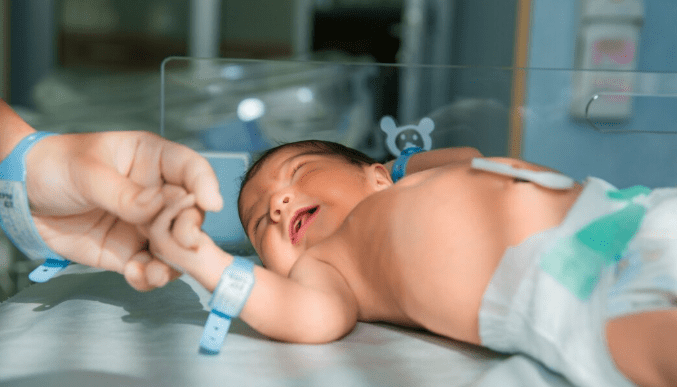
That December morning, Queen Charlotte’s and Chelsea Hospital’s operating room was abnormally packed. A young couple held hands behind a blue surgical curtain as surgeons stood shoulder to shoulder and nurses adjusted drapes and monitors. With years of preparation, study, and suppressed hope culminating in a single cry, the moment felt both practiced and vulnerable.
A baby from a womb transplant was born.
| Category | Details |
|---|---|
| Mother | Grace Bell |
| Condition | MRKH Syndrome (born without viable womb) |
| Baby | Hugo Richard Norman Powell |
| Birth Date | December 2025 |
| Birth Weight | 6 lb 13 oz (3.1 kg) |
| Delivery | Caesarean section |
| Transplant Location | Churchill Hospital, Oxford |
| Birth Hospital | Queen Charlotte’s and Chelsea Hospital, London |
| Clinical Lead | Prof. Richard Smith, Imperial College Healthcare NHS Trust |
| Trial Organization | Womb Transplant UK |
| Reference | https://www.nhs.uk |
The first child born in the United Kingdom from a womb transplanted from a deceased donor was Hugo Powell, who weighed just under seven pounds. The moment meant something different to his mother, Grace Bell. She had been informed at the age of 16 that she would never become pregnant.
In the UK, one in five women suffers from Mayer-Rokitansky-Küster-Hauser syndrome, or MRKH. Although their ovaries are normal, those with the diagnosis are born without a functioning womb. For many years, the only ways to become a parent were through adoption or surrogacy because of that diagnosis. Because it was just not possible to carry a pregnancy. Up until recently.
In 2024, Grace had a 10-hour transplant procedure at Oxford’s Churchill Hospital as part of a closely monitored clinical trial conducted by Imperial College Healthcare NHS Trust surgeons and Womb Transplant UK. The donor was a deceased woman whose family granted the unique and uncommon request to donate her uterus.
Donating an organ typically conjures images of hearts, kidneys, and lungs. A womb is not the same. In the traditional sense, it does not save lives. It is life-giving, as Grace subsequently explained.
There was a pause in the room when Hugo was raised over the surgical drape, the kind that results from incredulity rather than protocol. According to Grace, she had the feeling that she might wake up from a dream. It’s difficult to ignore the subdued surprise that still permeates her voice when watching interviews later.
Over 70 babies have been born as a result of more than 100 womb transplants carried out globally. However, living donors—typically sisters or close relatives—have been used in the majority of transplants worldwide. A deceased donor’s transplant adds layers of surgical complexity and moral significance. Perhaps this distinction is more important than headlines indicate.
A living donor must undergo extensive surgery, risking the pregnancy of another person. Even though a deceased donor’s gift is remarkable, it happens during a time of sorrow. According to Grace, she considers her donor’s family on a daily basis. In the face of unfathomable loss, the donor’s parents characterized their daughter’s last deed as an act of kindness.
This story has a unique gravity because of the duality of joy and grief existing at the same time.
The circumstances surrounding Hugo’s birth were anything but straightforward. Grace had IVF after recuperating from transplant surgery. Months later, embryos produced before the procedure were transferred. As a reminder that this pregnancy depended on a tenuous biological truce, immunosuppressive medications were necessary to prevent the transplanted womb from being rejected.
After Grace and her partner determine that their family is complete, doctors intend to remove the transplanted uterus, saving her from having to take immunosuppressive drugs for the rest of her life. This transplant is temporary. It is purpose-driven, functional, and transient. That almost has a poetic quality to it.
Attending the birth was Prof. Richard Smith, who has over 25 years of experience studying womb transplantation. Decades of convincing doubters that the process was not science fiction culminated in this moment for him. The concept of uterine transplantation was frequently written off as extravagant and unrealistic in the early 2000s.
Initial skepticism, cautious experimentation, and eventual normalization are the typical stages of medical innovation. Similar opposition to IVF existed decades ago. It is now commonplace.
However, there are complex questions surrounding womb transplantation. The procedure takes a long time. It’s expensive. There are multiple layers of ethical considerations. It’s still unclear if the procedure will be made generally accessible or if it will only be used in specialized facilities and clinical trials.
Nevertheless, there is no denying the symbolism for women with MRKH.
Families pushed strollers across slippery pavements while standing outside the hospital weeks after the birth, the winter air piercing coats. Life goes on, routine and unremarkable. It’s difficult to ignore how medical advancements eventually blend into commonplace landscapes.
According to Grace, the desire to become pregnant was present in every birthday candle she blew out as a teenager. It’s a persistent detail. It talks more about longing and less about technology.
Some who oppose surrogacy contend that it is already a feasible option. It does, too. However, pregnancy is more than just genetics for many women. It has to do with embodying life within one’s own body. Society will continue to debate whether or not that desire should be the driving force behind such complex medicine.
We get the impression that we are seeing the beginnings of something that is still developing as we watch this play out.
The London womb transplant baby is more than just a news story. He serves as a tiny, living reminder of how medicine continues to advance into previously uncharted territory. This procedure has already changed what doctors tell women with MRKH, regardless of how common it becomes or stays uncommon. The response was no for decades. Now, it might be, at least in certain situations. And perhaps it is sufficient at times.
