

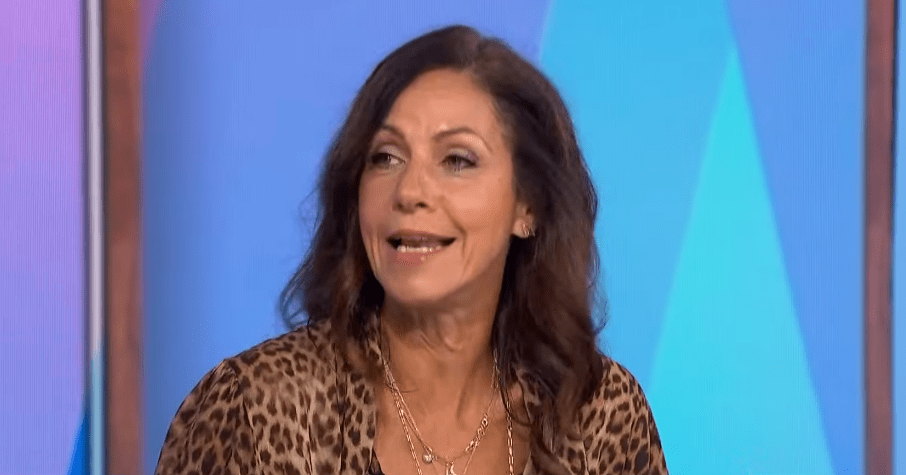
Credit: Loose Women
When Julia Bradbury’s illness was first reported, it didn’t feel like gossip about a famous person. It was disturbingly intimate. On Countryfile, viewers had watched her walk across windswept hills for years, her voice steady, her boots muddy, her cheeks pink from the cold. She seemed energized and unflappable, as if she were meant for the great outdoors. The image just didn’t fit the word “cancer.”
However, Bradbury was diagnosed with breast cancer in 2021 after finding a lump and having three mammograms. The tumor was six centimeters in size. That figure lingers. Six centimeters is the width of a small plum, so it is not abstract. It’s difficult not to imagine it growing silently as deadlines piled up and television schedules continued.
| Category | Details |
|---|---|
| Full Name | Julia Michele Bradbury |
| Date of Birth | July 24, 1970 |
| Age | 55 |
| Nationality | British |
| Profession | Television Presenter, Journalist |
| Known For | BBC’s Countryfile, ITV travel documentaries |
| Diagnosis | Breast cancer (2021), later revealed brain cyst |
| Treatment | Mastectomy (left breast) |
| Current Status | In remission |
| Advocacy | Breast cancer awareness, midlife health checks |
| Reference | https://www.bbc.com |
Later that year, she had a mastectomy on her left breast. She thanked her body almost ceremoniously before surgery in a now-widely shared Instagram post, bidding it farewell. That message had an unsettlingly direct quality. It didn’t seem carefully chosen. It seemed as though someone was attempting to reconcile a rupture.
One gets the impression that the diagnosis drastically changed her priorities when she talks about it later, sitting in dimly lit studios or in clinic chairs with IV drips delivering vitamins C and minerals to her arm. According to her, cancer “saved” her life. At first glance, that phrase might sound dramatic. However, if you listen carefully, it seems to be more about facing challenges — stress, lack of sleep, and a career that is lived at 100 miles per hour — than it is about survival statistics.
Bradbury acknowledged that she hardly ever respected sleep before her diagnosis. She balanced motherhood with a rigorous media schedule by traveling frequently and filming in both rural and coastal areas. That pattern—mistaking fatigue for productivity, sugar for fuel, and late nights for dedication—may be recognized by many accomplished professionals.
Following surgery and recuperation, she mostly stopped drinking alcohol and eliminated sugar after being informed that every extra drink over a specific threshold could raise the chance of recurrence. She once remarked that she felt as if death had met her eyes with that warning. The description is striking. Not a show. Just be direct.
There is a temptation to simplify these tales into didactic lessons. Eat more healthfully. Get more sleep. Decrease tension. Indeed, she has embraced wellness by practicing meditation, getting up earlier, and giving public speeches about the value of paying attention to one’s body. However, Bradbury takes care to avoid placing the blame for her cancer on herself, and that distinction is important. It is not a moral failing to be ill. The reason why some people, despite having similar lifestyles, develop tumors while others do not is still unknown.
She has also discussed a brain cyst found during scans in recent months, which supports her advice to be aware of even the smallest changes. She has partnered with midlife health campaigns to encourage people to pay attention to symptoms that persist, such as difficulty sleeping, unexplained aches, and fatigue that doesn’t go away. According to research, many people ignore warning signs for more than a year before getting assistance. That figure doesn’t seem as shocking as it ought to.
This has a cultural context. For many years, public personalities tended to hide illness, especially something as personal as breast cancer. These days, people like Bradbury talk freely and occasionally share pictures of themselves in infusion chairs or hospital beds. It’s a strange grounding effect. It introduces clinical topics into casual conversation, such as cannulas, antiseptic odors, and calm waiting areas.
The subtle change in her on-screen persona since her diagnosis is difficult to miss. She looked thoughtful while filming Wonders of the Frozen South for ITV, pausing occasionally in the middle of sentences as though readjusting. Such projects require a significant amount of physical stamina. It couldn’t have been easy to return to remote areas and sub-zero temperatures after major surgery. She acknowledged that there was a time when she didn’t think she would have the courage to leave the security of her home.
That hesitation has a very human quality. At first, illness limits one’s horizons. They then gradually enlarge once more.
Social media critics have reacted negatively to her focus on changing one’s lifestyle, claiming that cancer strikes many healthy people regardless of sleep or nutrition. There is actual tension there. Oversimplification is a tendency in wellness culture. However, Bradbury appears to be treading carefully in that area, recognizing complexity while urging caution.
She seems more determined and more cautious as she stands at this midlife crossroads, as she frequently refers to it. Not exactly afraid. But pay attention. As this has developed over the past few years, it seems as though her public persona has evolved from that of a travel host to something more complex, combining elements of a broadcaster, a health advocate, and a reluctant symbol of survivorship.
Although the word “remission” is hopeful, it also carries a certain amount of subdued anxiety. follow-up scans. examinations. Awaiting the outcome. That beat doesn’t completely vanish. Everything may be enhanced by living with that uncertainty, including the flavor of food, the attraction of family, and the straightforward comfort of pain-free waking.
For television, Julia Bradbury once traveled thousands of miles on foot. It appears that she is now taking a different route, one that is slower, more methodical, but still has the same goal. And maybe that’s the true story of the illness—not just the diagnosis, but the conscious decision to change one’s lifestyle after receiving it.
