

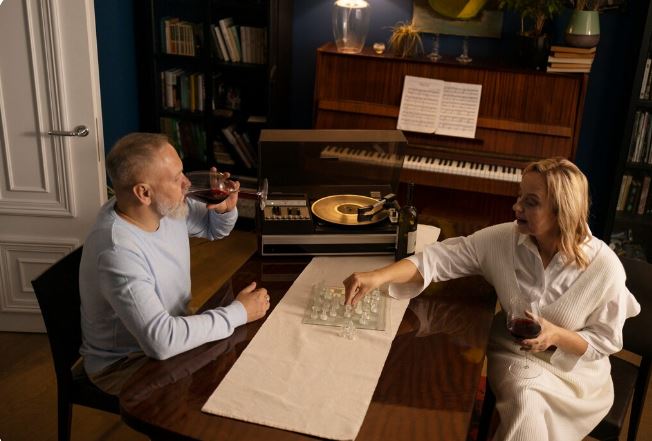
Unnoticed, the kettle clicked off a second time. No one had stopped talking long enough to prepare the tea. A group of neighbors leaned forward at the kitchen table, half of whom, prior to this month, had not exchanged more than a nod in the street. The local surgery only had two general practitioners, according to someone. Another inquired as to whether bread prices had increased once more. The conversation was sharp, but the room had a softness to it. Not a single party pin. Not a banner. But clearly political.
Living rooms, kitchens, and even garden sheds are becoming improbable but incredibly powerful venues for public discourse throughout Britain. Once kept at a distance or limited to televised debates, politics has infiltrated the home due to growing expenses and postponed medical appointments. Those least likely to identify as activists are increasingly reshaping it.
| Element | Description |
|---|---|
| Core Themes | Cost of living, NHS pressure, and everyday economic realities driving political engagement |
| Main Trend | Kitchen-table conversations becoming a driving force behind civic awareness and activism |
| Cultural Shift | Public focus shifting from party politics to practical, lived experience and local issues |
| Political Response | Politicians adapting campaigns and policies in response to household-driven concerns |
| Notable Parallel | Like grassroots charities, impactful movements now often begin in domestic spaces |
A change has occurred in recent years, especially since the dramatic increase in energy costs and NHS wait times. What might have been written off as commonplace complaining has evolved into something more acerbic—a common annoyance that is uniting neighbors and encouraging them to speak with one voice.
Slogans and spectacle are not the foundation of this movement. The transformation is silent. And it’s turning out to be surprisingly strong.
Consider the WhatsApp group that started with the question, “Does anyone have a spare charger?” and now goes through daily cycles of advice on how to push a landlord for repairs, budgeting, and food bank hours. For example, three women co-wrote a letter to their MP regarding housing conditions at the conclusion of the pensioner coffee morning. These are unquestionably acts of participation even though they aren’t official campaigns.
These exchanges have accomplished something that traditional politics has long struggled with: they have made it personal by putting real lives at the center of the discussion.
People are not speaking along party lines or in polling categories. They are discussing the fact that it has been a year since their daughter’s last dental visit. or that in order to make the numbers work, they are skipping breakfast. It is more difficult to ignore the honest kind of politics.
This is reflected in public surveys. More than 85% of UK adults cited access to the NHS and the cost of living as their top concerns in recent surveys. And in ways that influence their day-to-day choices, not just in general terms. For eating or heating. Whether to wait another six months for care or go private.
Not long ago, I sat in a neighbor’s apartment and watched her stealthily tear the label off a can of beans. It was habit, not shame. She remarked, “I don’t consider the cost if I don’t see it.” That stuck with me. It felt like a line from a common story that many people are silently going through, not because it was dramatic.
A larger political culture is evolving as a result of these instances. Voices that would not have been heard before—those without media presence, those who are not inclined to attend rallies, but whose lived experience speaks volumes—are increasingly being heard by campaigners and policymakers.
Their impact is also evident.
As a result of kitchen-table discussions that have already identified the true crisis, political parties are recalibrating, not because focus groups ordered them to. Rent control talks, healthcare promises, and assurances of fundamental stability are now more prevalent in messaging.
This is a change in focus toward substance. The direction of listening.
It is reminiscent of the early days of many grassroots charities—initiatives started by regular people facing unmet needs rather than by lofty ideals. The Fostering Network started at a Camden kitchen table and is now a national force. The spirit of today’s civic realignment is remarkably similar: pragmatic, people-centered, and driven by necessity.
Utopias are not what the homes driving this change are demanding. They are requesting what was once taken for granted: that public services wouldn’t feel like gambling tickets, that the NHS would take calls, and that wages would be paid throughout the week.
It is difficult to gain trust in this situation. Committee-crafted political messages often fall apart when confronted with the realities of life. Well-crafted promises are unlikely to sway a father who has just witnessed another reduction in benefits. Instead, what lands are the things that seem real, rooted in everyday life, and tangible.
This is also a source of hope. Not only in its rejection, but also in its inventiveness. These discussions are producing ideas that are modest, feasible, occasionally awkward, but unquestionably genuine.
A rotating meal share has emerged in a Midlands community, where three families take turns preparing dinner once a week to cut expenses. A “phone tree” in a northern town makes it easier for senior citizens to receive NHS updates. Although these are not particularly noteworthy changes, they are blatant signs of a collective spirit that is not going to back down.
And that spirit—steadily expanding, becoming more organized, and rarely being loud—is now at the core of Britain’s changing political landscape.
People are still interested in politics. They are bringing it back to the point of importance. at home.
Westminster would be wise to take note of the candor in these conversations. Because once people start talking with this level of purpose and clarity, they almost never stop.
They have straightforward demands. Make it function. Make it equitable. Make sense of it.
And remarkably frequently, it starts with something as commonplace—and as potent—as someone asking, “Can you believe the price of eggs this week?”
