

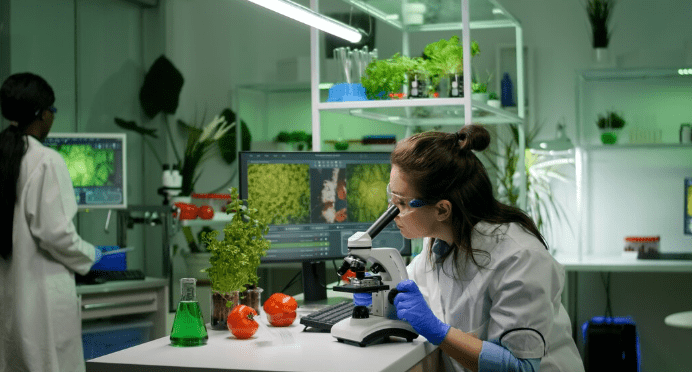
Rows of stainless steel bioreactors hum softly inside a well-lit lab, their surfaces reflecting the light from overhead LEDs. This place is devoid of soil. No sound of the wind blowing through crops, no earthy scent. Rather, technicians keep an eye on screens and modify the nutrient flows that nourish microscopic organisms that are intended to make proteins from animal sources. Technically, it’s food. It’s just not the kind that most people were raised with. It’s difficult to ignore the sense that something fundamental is changing.
Once written off as futuristic or even unnatural, synthetic food is subtly becoming more popular. These days, scientists are experimenting with making starch from carbon dioxide, growing meat from animal cells, and making dairy proteins without using cows. The goal is clear: feed the world’s expanding population, which is predicted to reach almost 10 billion people, without adding to the burden on land and water. That goal makes sense. However, it also poses awkward queries.
| Category | Details |
|---|---|
| Technology | Synthetic Food (Cellular Agriculture & Precision Fermentation) |
| Key Companies | Perfect Day, The Every Company, Upside Foods |
| Production Methods | Lab-grown cells, engineered microbes, 3D food printing |
| Key Benefit | Reduced land, water, and emissions |
| Major Concern | Energy use, biodiversity loss, consumer acceptance |
| Timeline | Scaling expected by 2030–2040 |
| Farming Impact | Shift toward hybrid and premium natural systems |
| Core Question | Will nature-based farming decline or evolve? |
| Reference Website | https://www.nature.com/articles/s43016-024-00999-0 |
There is pressure on traditional agriculture. Arable land is not growing, water resources are becoming more scarce, and weather patterns are becoming unpredictable due to climate change. A solution to these limitations is provided by synthetic food. For instance, engineered microbes can produce milk proteins exactly like those found in dairy products through precision fermentation, all without the need for a single cow. It works well.
There is a discernible lack of variation when strolling through these establishments. Temperature, nutrients, and timing are all under control. It is the antithesis of farming, which has always been dependent on chance, soil conditions, and the seasons. Unpredictability seems to be being engineered out of the system. Depending on your point of view, that could be either a gain or a loss.
This concept is expanded upon in cellular agriculture. In bioreactors, scientists take a few animal cells and cultivate them into edible tissue. No killing. No land for grazing. Just growth under control. Businesses have already started testing these products, and preliminary responses indicate that the taste is sufficiently similar, at least in certain situations. Maybe it’s just about being close enough.
It’s unclear, though, if customers will accept it completely. Nutrition is only one aspect of food. It has to do with identity, memory, and culture. A lab-grown steak may have the same appearance and flavor, but its provenance alters the flavor. There’s a persistent, subtle sense that something intangible is lacking. Or maybe that emotion wanes with time.
The change could have a significant impact on the economy. Large tracts of farmland could be repurposed or abandoned if synthetic food grows successfully. In particular, livestock farming may drastically decline. That land might be left unutilized, converted back to forests, or utilized for renewable energy. However, these kinds of transitions are rarely seamless.
Farmers may have to navigate a completely different market, given their already narrow profit margins. Some might change course, concentrating on high-end, “natural” goods sold as artisanal or genuine, or providing raw materials for bioreactors. Others might find it difficult. There’s a feeling that agriculture could split into two parallel systems: smaller-scale farming positioned as a luxury and industrialized food production in labs. In that case, nature does not vanish. It becomes exclusive.
Additionally, there are still unanswered environmental questions. According to some estimates, synthetic food uses up to 99% less land than conventional food. However, these systems need a lot of energy. Rain and sunlight do not power bioreactors. They depend on supply chains, infrastructure, and electricity, all of which are constantly changing. The way that energy is generated may have a significant impact on the environmental advantages.
Biodiversity comes next. Despite all of its shortcomings, traditional farming—especially when done sustainably—supports a variety of plant and animal life. In contrast, synthetic food depends on a limited number of microbial strains and cell lines. It might lessen biological diversity in food production systems if it were implemented worldwide. It’s not always easy to talk about that risk.
A counter-movement is gaining momentum at the same time. A different outlook on the future is provided by regenerative agriculture, which emphasizes biodiversity, soil health, and natural cycles. One in which farming complements ecosystems rather than replaces them. Proponents contend that improving the way nature is currently managed, rather than eliminating it from food production, is the answer.
There’s a sense that there won’t be a single path that defines the future of food as this develops. The use of synthetic food will probably increase, especially in cities and for large-scale manufacturing. Conventional farming will change, possibly becoming more specialized, more regional, and more valuable in ways that go beyond cost. a cohabitation. Sometimes uncomfortable.
Whether nature will become optional or just repositioned is still up in the air. Governments are starting to take it seriously, investors are paying attention, and technology is developing swiftly. However, food systems are firmly ingrained in customs and culture, which take time to alter.
