

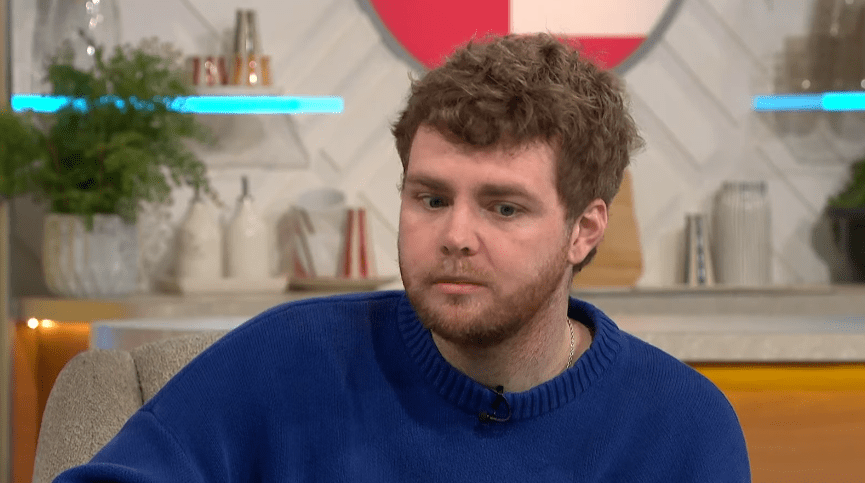
Credit: Lorraine
The term “Alex Warren lawsuit” is frequently used in a manner remarkably similar to urban legends, whispered with assurance but rarely examined with any patience or context.
A property dispute from the Hype House era is at the center, growing through rumors like a bee swarm that finds every crevice and buzzes loudly long after the facts have already subsided.
| Bio | Alex Warren |
|---|---|
| Full Name | Alexander Warren |
| Profession | Singer, songwriter, creator |
| Known For | Hype House co-founder, “Ordinary,” digital-to-music crossover |
| Connection to Lawsuit | Associated with the house era, but not named in the property lawsuit |
| Notable Shift | Moving from viral pranks to deeply personal songwriting |
| Reference | https://www.theguardian.com/music |
The creators renting that house entered a mature system remarkably quickly by working with managers, agents, and attorneys, and their learning curve was considerably lowered but never completely smooth.
The lawsuit specifically focused on unpaid rent and alleged property damage, which is a story that is especially useful to commentators who like drama and rarely as engaging to those who are more concerned with progress than blame.
It is still very evident from reading the filings rather than the headlines that Warren was not named in the lawsuit, despite having lived, filmed, laughed, and stumbled there.
Understanding that entertainment energy does not always translate into landlord patience or legal order is often a challenge for medium-sized collectives led by young influencers.
By means of calculated reactions and ultimately distinct life decisions, Warren started to distance himself from the environment that made everything faster, louder, and not always healthier.
In the last ten years, careers have been shaped by digital fame much more quickly than by more conventional paths, and occasionally those paths abruptly collide with dull realities like contracts, rent, and damages.
The lawsuit served more as a warning to all parties involved that charisma is not collateral and attention is not money than as a verdict on character.
As I listened to him discuss it in a quiet moment, I became aware of how frequently proximity breeds guilt in the absence of evidence, and the idea lingered longer than I had anticipated.
He continued to work on a different dream, writing music that was surprisingly vulnerable and singing with a more grounded honesty about grief, loyalty, mistakes, and resilience.
He created something more robust by using discipline that wasn’t always natural, changing perception in ways that were noticeably better than the chaotic early days.
Warren leaned into songwriting during the pandemic, when attention seemed to be endless but stability was limited. This proved to be incredibly resilient as an anchor when viral fame kept shifting beneath him.
His career path became extremely efficient through deliberate touring and meticulous studio work, directing energy toward creation rather than continuous spectacle.
The idea that someone could start messy, apologize without theatrics, and continue anyway was consoling to fans, especially younger ones. It was a powerful demonstration that people can change their course.
Memory acts strangely as lawsuits fade and discographies expand, flattening once-huge events and allowing other moments—like songs sung back by thousands—to gently come into focus.
The realization that early success comes with pressures people rarely expect has made discussions about his past less accusatory and more introspective in recent days.
The quiet perseverance that followed the Hype House, gradually reconstructing identity piece by piece and becoming extraordinarily adaptable in the process, is what is still genuinely fascinating, not the paperwork that followed.
Securing appropriate guidance continues to be the largest obstacle for early-stage creatives entering contracts and shared homes, and Warren’s past serves as a particularly creative reminder that structure matters.
Misunderstandings surrounding the lawsuit have drastically decreased since more open explanations of his past were introduced, and the story has softened just enough to allow for subtlety.
He has created a path that feels surprisingly affordable, emotionally speaking, for fans who needed reassurance that mistakes are manageable by fusing experience, humility, and accountability.
Careers change over time. Reputations don’t fade. As proof that learning, when taken seriously, can be incredibly clear — and subtly persuasive — stories that were once dominated by legal language eventually take on a new context framed by music, craft, and growth.
