

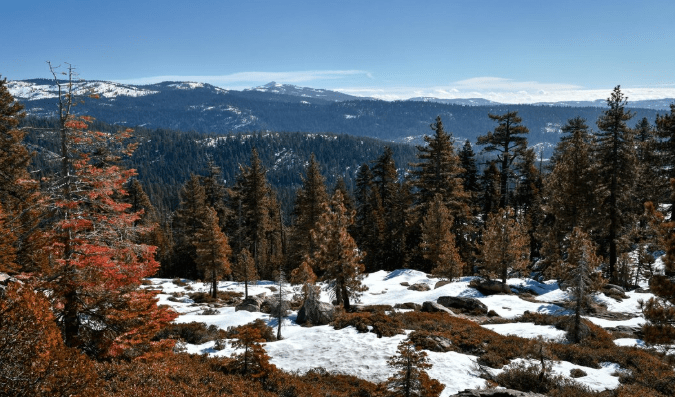
The Rockies’ refusal to give up winter this year has an almost defiant quality. The alpine passes appear more like late January in late April. The projections read more like a midwinter report than a spring update, and the National Weather Service has issued Winter Weather Advisories for Colorado, Wyoming, Montana, and portions of Utah. Battle Pass had two feet of snow. A toe in Centennial and Albany. Wind gusts of up to 45 mph cut through the Eisenhower Tunnel corridor and Berthoud Pass. It is the type of storm that sneaks up on the radar and suddenly grabs the high country by the shoulders.
By all accounts, Wyoming is suffering the most. The Sierra Madre and Snowy Ranges are expected to get heavy, wet snowfall, with Snowy Range Pass potentially receiving twenty inches in a few days, according to the Cheyenne prediction office. At twenty-four, Battle Pass is the top number. Locals are familiar with the appearance of such an accumulation in late April. It weighs down ponderosa branches, clings to electrical lines, and transforms Forest Service routes into something that only a snowmobile should try. Speaking with locals up there gives me the impression that they are no longer shocked by these spring explosions. The mountains have their own calendar.
| Detail | Information |
|---|---|
| Storm Window | April 27 – May 1, 2026 |
| States Affected | Colorado, Wyoming, Montana, Utah |
| Peak Snowfall Forecast | 24 inches at Battle Pass, Wyoming |
| Wind Gusts | Up to 45 mph |
| Issuing Authority | National Weather Service |
| Hardest-Hit Range | Sierra Madre & Snowy Range, Wyoming |
| Snowfall Rate | 1 to 1.5 inches per hour in the Wasatch & Uinta ranges |
| Visibility Risk | Quarter mile or less in the highest terrain |
| Drought Status | Severe to exceptional across much of the Rockies |
| Secondary System | Expected April 30 – May 1 |
Colorado is struggling with a more expansive and disorganized system. The Denver office is predicting eight inches in a variety of high locations, including Cameron Pass, Rocky Mountain National Park, and Mount Zirkel. In the southwestern part, around Silverton, Coal Bank Pass, and Molas Pass, larger amounts, around a foot, are anticipated. Anyone who has driven Highway 550 during a rainy spring can attest to the sensation of snow that doesn’t quite fall or stick, but manages to erase the lane lines nonetheless. The NWS cautions that in the worst cases, visibility might be as low as a quarter mile. That isn’t a condition of the road. It’s a wall.
Strangely, forecasters appear genuinely happy that this storm is just what the West needed. The snowfall was below average during the winter, the Rockies are experiencing severe to exceptional dryness, and reservoirs from Wyoming to the San Juans have been steadily losing ground. Therefore, a late, heavy, wet dump—the kind that slowly seeps into the ground rather than evaporating in the March wind—is viewed less as an annoyance and more as a brief reprieve. Perhaps the timing is more important than the totals.
However, the cautions are genuine. The hunters, hikers, and snowmobilers who are most likely to misunderstand a spring storm and get into difficulty were specifically mentioned by the NWS in Cheyenne. The behavior of heavy wet snow differs from that of January powder. It conceals terrain, bends trees, and freezes overnight to resemble concrete. Before things settle down, another shortwave is already predicted to follow this one, lasting from April 30 to May 1.
It’s difficult to ignore how much this storm matches the broader narrative of the West at the moment, a region torn between drought and deluge where, depending on the valley you’re in, a single weather event can swing from blessing to hazard. As you watch this happen, you get the impression that the mountains are acting as they always have—just according to their own schedule, regardless of what the calendar indicates.
