

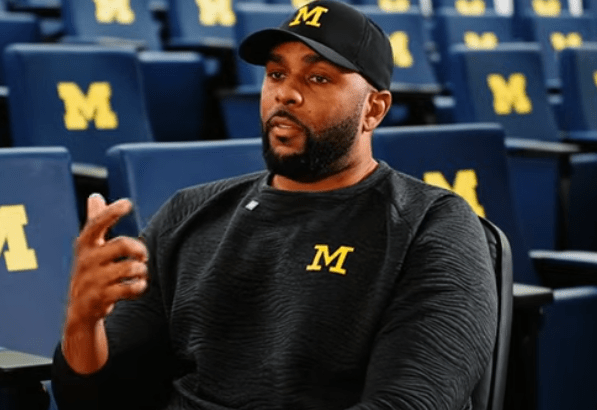
Credit: Next Up with Adam Breneman
People are looking for more than just a figure when they look up Sherrone Moore’s net worth. They are attempting to make sense of a decline that occurred as swiftly as the rise, which felt almost cinematic.
Sherrone Moore was leading one of the most illustrious college football programs just a short while ago, standing on the sidelines in Ann Arbor with his arms folded against the Michigan cold and his headset on. Depending on which financial tracker you trust, different figures are reported. According to Celebrity Net Worth, he is worth $4 million. Other sources offer a much higher estimate of about $28 million, based on contract structures and anticipated earnings. As usual, the truth probably lies somewhere in the complex middle.
| Full Name | Sherrone Banfield Moore |
|---|---|
| Date of Birth | February 3, 1986 |
| Birthplace | Derby, Kansas, USA |
| Profession | College Football Coach |
| Last Position | Head Coach, Michigan Wolverines |
| Reported Net Worth | $4 million (Celebrity Net Worth estimate); other outlets estimate up to $28.6 million |
| 2025 Salary | Approximately $6–6.1 million |
| Contract Value (2024–2029) | Approx. $34.3 million total |
| Education | University of Oklahoma |
| Reference | https://www.celebritynetworth.com |
It’s difficult to ignore how rapidly his financial profile increased after he was hired as the Michigan Wolverines’ head coach. Following Jim Harbaugh’s departure for the NFL in January 2024, Moore agreed to a five-year contract with a total compensation of approximately $34.3 million.
He received about $6 million in compensation in the first year alone, which included a $500,000 retention bonus. It must have felt like validation to be inside Michigan Stadium, that enormous bowl that can accommodate over 100,000 spectators. Years of toiling away as an assistant, coaching offensive linemen in silent film rooms, and recruiting in living rooms throughout the Midwest. And lastly, the top position.
However, college football contracts are more complicated than they appear on the news. Moore’s anticipated wealth was largely reliant on his ability to remain employed for the term of the contract and receive bonuses for winning titles, making the playoffs, and reaching retention milestones. According to reports, he lost about $21 million in remaining contract value when he was fired “with cause” in December 2025 after an internal investigation. It is more than just a line item. Generational money is gone in a flash.
Moore’s trajectory appeared nearly textbook before the controversy. He was raised in Derby, Kansas, and played for Bob Stoops at the University of Oklahoma, where he was exposed to big-program culture at a young age. His rapid ascent from tight ends coach to offensive line coach to co-offensive coordinator at Michigan was frequently cited by those who followed his career.
The Joe Moore Award, which is considered to be the nation’s highest honor for line play, was won by Michigan’s offensive line in 2021 and 2022. They were in control of the trenches. It was a physical offense. It seemed enduring.
Moore seemed to be a representation of the young, vivacious, and relationship-focused college coach of today. Players described him as friendly. He appeared to attract recruits. And that was important in a sport that is becoming more and more characterized by portals for transfers and turnover.
His financial ascent paralleled the program’s recovery. He already made enough money as offensive coordinator and line coach to comfortably rank among the highest-paid assistants in the country. These positions usually include retention and performance bonuses, which gradually increase wealth over a number of seasons. Moore had already earned a respectable salary by the time he became head coach.
Nevertheless, the head coaching title was a huge leap. Although not at the top, a $6 million yearly salary places a coach among the Big Ten’s highest-paid. Moore was younger and less established than seasoned leaders like Kirk Ferentz at Iowa. Investors, or university stakeholders in this instance, appeared to think they were getting long-term stability at a lower cost than more well-known brands.
The unraveling followed.
In terms of money, the “with cause” clause for termination is crucial. Being fired without cause usually results in a buyout in college athletics, with millions still owed. However, being fired with cause frequently nullifies any money that was guaranteed. Although it’s still unclear if Moore will legally contest that designation, the forfeiture is currently reflected in the majority of public reports.
One imagines that the atmosphere has changed as one passes Michigan’s football stadiums these days. The coaches were swapped out. Players responding to inquiries. A recalibrating program. Whether Moore’s net worth is $4 million or more like $28 million, it all seems to pale in comparison to the more general uncertainty surrounding his future.
Because the uncomfortable reality is that a sports coach’s net worth fluctuates a lot. Contracts are primarily designed to ensure continuous employment. A $34 million, five-year agreement seems certain. In actuality, however, only the money earned while actively coaching is secured. Estimates indicate that he made between $12 and $13 million before his termination, based on his time served from 2024 to late 2025. That is significant. It’s not the headline number, though.
It’s hard not to be skeptical of permanence when you observe how quickly narratives change in college football. Moore was leading Michigan to a 17–8 record and a 9–3 campaign that guaranteed a bowl berth just two seasons prior. The lights in the stadium shone brightly. There were good recruiting classes. There was a genuine sense of momentum.
Right now? By any standard metric, his financial situation is still comfortable. Even the conservative estimate of $4 million puts him well above the average household in America. However, the difference is noticeable when compared to what could have been—the entire $34 million contract, increasing yearly.
Moore might reappear somewhere else. College football has both a long and a short history. The assistants come back. Analysts are given second chances. Programs take measured chances. His net worth might increase once more if he coaches at a major level.
But for the time being, Sherrone Moore’s wealth speaks more about volatility than accumulation. Fortunes can rise swiftly in the high-stakes world of college football, but they can also fall into uncertainty just as quickly.
