

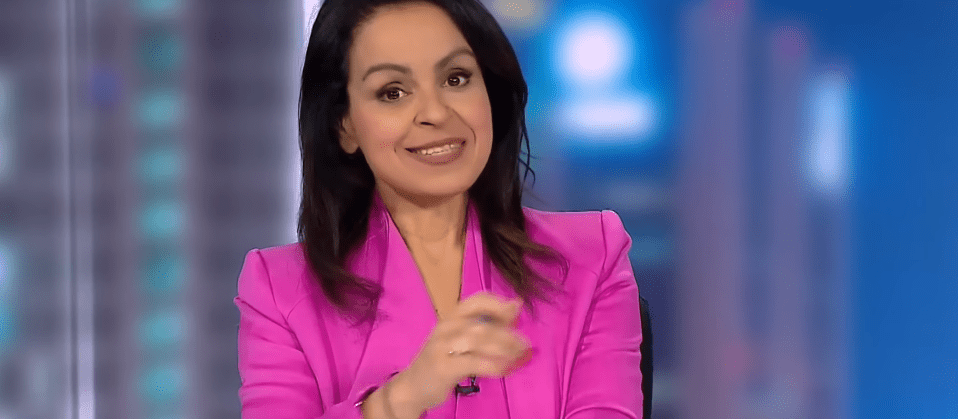
Credit: SKY News Australia
In the middle of the afternoon, the café at the base of Melbourne’s Herald Sun building can be surprisingly quiet. Journalists come and go with takeout coffee and notebooks, exchanging incomplete thoughts about sports or politics. Rita Panahi developed a reputation that is equally admired, criticized, and closely observed somewhere in that whirlwind of conversations.
There is a more nuanced narrative connected to Rita Panahi’s ethnicity that predates the television debates and the online columns that provoke contentious debates. At its core, that story begins far from Australia—in a place that feels culturally and geographically distant from the modern Melbourne media scene.
| Category | Details |
|---|---|
| Full Name | Rita Panahi |
| Date of Birth | March 3, 1976 |
| Birthplace | Pine Bluff, Arkansas, United States |
| Ethnicity | Iranian |
| Nationality | Australian and American |
| Profession | Political commentator, journalist, columnist |
| Known For | Sky News Australia host, Herald Sun columnist |
| Education | MBA, Swinburne University |
| Early Life | Grew up in Iran before moving to Australia as a refugee in 1984 |
| Reference | https://en.wikipedia.org/wiki/Rita_Panahi |
While her Iranian father was studying agricultural engineering in the US, Panahi was born in Pine Bluff, Arkansas, in 1976. Her American birth certificate occasionally surprises people who believe she was raised entirely in Australia, so it’s a minor, almost odd detail in her biography.
However, the family did not remain in the US for very long. During her early years, they moved back to Iran, first to the coast and then to Tehran. Her current worldview would be subtly shaped by those years.
In the late 1970s, Iran was about to enter a period of profound instability. The Islamic Republic, headed by Ayatollah Khomeini, replaced the Shah’s government in the Iranian Revolution of 1979, which changed the country practically overnight. Daily life changed swiftly and unexpectedly for a lot of families.
According to most accounts, Panahi’s parents weren’t very political. Her dad was an engineer. Her mom worked as a midwife. For many common people, however, life became more uncertain due to the changing political environment.
Growing up during a revolution and witnessing swift changes in social norms may have had a more profound impact than Panahi occasionally acknowledges. Childhood memories often remain in the background.
The Panahi family fled Iran in 1984 and became refugees in Australia, eventually settling in Melbourne. When Panahi first arrived, she was still a small child and was said to speak very little English.
There’s something about stories like that that feels familiar in Australia’s immigration history. Families must navigate a foreign culture, learn a new language, and arrive with little money.
It’s difficult to ignore that feeling of outsider resolve as Panahi’s career develops. People who start over in a new nation frequently have a certain kind of ambition, which can range from thankfulness to obstinate independence.
She didn’t start her career in journalism. She worked in banking for many years, progressively rising through the ranks to become one of Colonial Mutual’s youngest branch managers.
These days, not much attention is paid to that stage of her career. It is more common for media figures to be remembered for their opinions than for their previous careers. However, it reveals something about her temperament: she is methodical, pragmatic, and possibly more disciplined than her fiery on-screen persona would imply.
Panahi eventually pursued a career in writing, initially writing a sports gossip column for the commuter newspaper mX. As a result of the column’s success, she became a regular columnist for Melbourne’s Herald Sun in 2007. Her public profile truly began with that shift.
Her views frequently elicit strong reactions, especially when it comes to immigration, religion, and cultural identity. She is viewed by her supporters as a direct truth-teller who doesn’t hesitate to discuss contentious subjects. Critics have a completely different perspective. In any case, the topic of her background often comes up.
Viewers’ interpretations of Panahi’s commentary are influenced by her Iranian ethnicity and her history as a refugee. Her experiences, according to some readers, give her criticism of particular political or religious issues authenticity. Others argue that personal history doesn’t necessarily settle larger debates.
As these conversations develop, it seems that politics and identity have become intricately entwined in contemporary media.
Panahi has talked candidly about her early experiences in Iran, such as being forced to wear a hijab to school and taking part in protests organized by the government when she was a young student. Her strong opinions about Middle Eastern politics and religion seem to have been influenced by those recollections. However, conflict and ideology don’t fully define the narrative.
Colleagues occasionally describe a slightly different side of Panahi in private conversations and interviews—someone who is thoughtful, occasionally vulnerable, and even reflective about the unlikely path her life has taken.
It’s an intriguing contrast to the harsher tone she uses in her newspaper columns and television segments. Her life also exemplifies the increasingly nuanced identities that many contemporary public figures possess. Panahi was born in the United States, is of Iranian ethnicity, and is an Australian citizen and professional.
That layered background is becoming more common in global media. Today’s journalists frequently travel across continents and cultures, bringing fragments of several identities with them.
It’s hard to ignore Panahi’s journey from a young child with little English to a well-known columnist and television commentator.
Observing her career from a distance gives the impression that there is more to her story than just politics. It also has to do with migration, cultural identity, and the peculiar ways that one’s past can influence public opinion.
In Panahi’s case, ethnicity is more than just a biographical detail. It’s a part of the story that follows her through all of her debates, columns, and TV shows—sometimes quietly, sometimes loudly.
