

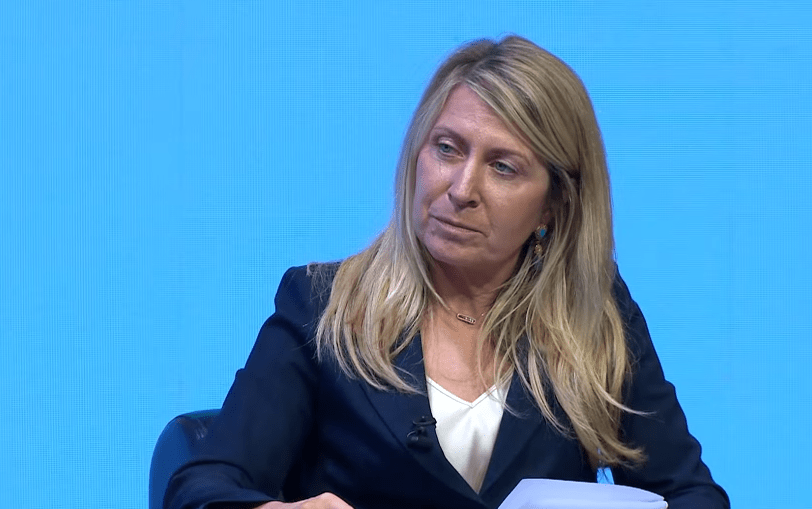
Credit: Royal Television Society
The politics surrounding Deborah Turness’s departure from the BBC newsroom illustrate how a single editorial decision can reverberate through legal threats, parliamentary scrutiny, staff unrest, and a media ecology that prioritizes speed over procedural explanation. Her departure reads like a dossier on modern institutional stress.
She has spent a career managing credibility as a tangible asset, from producing in Paris to editing ITV News as the first woman to hold that position, and from leading major newsrooms at NBC to steering ITN and then BBC News. Her career path is instructive because it is both unusually broad and clearly hands-on. Her public reactions during this crisis were framed as those of an executive who views mistakes as fixable system failures rather than as evidence of institutional rot.
| Field | Information |
|---|---|
| Full name | Deborah Mary Turness |
| Born | 4 March 1967, Meriden, England |
| Education | BA French & English, University of Surrey; PgDip Journalism, University of Bordeaux |
| Recent role | CEO, BBC News (2022–2025); formerly CEO, ITN; ex-President, NBC News |
| Career highlights | First female editor of ITV News; President of NBC News; led ITN; BBC News CEO; awards include Amnesty International UK Media Award |
| Notable events | Resigned Nov 2025 after controversy over an edited Panorama clip and subsequent debate about BBC impartiality |
| Public reference | https://en.wikipedia.org/wiki/Deborah_Turness |
The immediate operational fallout, including resignations, legal letters, and complaints, swiftly blended with the political after Panorama was discovered to have pieced together two parts of a former president’s speech. This was because an 8,000-word memo from an outside adviser reached board level, leaked to the media, and sparked a series of hearings that transformed an editorial error into a constitutional-style dispute over the independence of public broadcasting.
The ensuing boardroom drama is instructive: a Michael Prescott memo that resembled a memoir, the power of a contentious board member, and a chain of leaks that turned confidential documents into partisan publications sped up external pressure and diminished the opportunity for peaceful internal decision-making, turning what could have been decided within an ethical committee into a public political dispute.
Turness’s pragmatic, meticulous, and process-focused approach was detrimental at the wrong moment. When employees were expecting an apology or a clarifying statement right away, top-level debate delays created a communications void that opponents filled, and the timing of statements turned from being a PR tactic to a strategic weapon.
In a highly polarized information ecology, different audiences interpret identical actions through opposing priors, so depending on the reader’s politics, the same apology will be read as either performative or insufficient. This pattern is remarkably similar across recent institutional shocks: minor operational errors spread when they intersect with pre-existing narratives about bias.
By publishing constituency-level fix plans, conducting small pilots, and issuing quarterly impact reports, a local council managed to turn a ten-year complaint spiral into manageable political terrain. The political heat subsided as tangible progress replaced rumors, and Turness attempted to apply the lesson learned there—to publish verifiable steps, not slogans—but found it more difficult to put into practice under extreme pressure.
The modern newsroom she led required a hybrid skillset — newsroom curator, legal risk manager, crisis communicator, and political conduit — roles that often pull in different directions and rarely receive unified praise when things go right. Her record includes both strategic miscalculation and moments of editorial courage. She commissioned investigations that won awards and pushed visual innovations in presentation.
High-profile actors have the ability to escalate the situation overnight, threatening multi-million dollar lawsuits and amplifying partisan narratives. This dynamic forces chairs and news chiefs to make decisions between immediate public defense, a provisional apology, or referral to an independent review, each of which carries unique institutional and political trade-offs. This is the new variable added by the celebrity and legal theater that surrounded the Panorama episode.
Turness adopted a stance that combined remorse for individual errors with a firm defense of the newsroom’s objective mission. This is a politically astute move because it admits wrongdoing without automatically giving in, but it also leaves room for critics who favor personnel repercussions over systemic fixes.
The following operational fixes were simple and doable: publish decision logs that reveal who authorized edits and why, strengthen editorial provenance by maintaining metadata and timestamps, and schedule independent reviews with interim findings. These changes turn opaque editorial routines into auditable procedures and lessen the likelihood that a single mistake will turn into an existential crisis.
Technology can help: metadata audits and automated provenance checks work like a cooperative swarm of bees, identifying irregularities and alerting humans to them. However, technology is not a panacea, as well-planned misinformation and well-crafted machine-generated narratives can still manipulate systems unless human oversight is incorporated as the ultimate arbiter.
The institutional listening component is equally important because it democratizes problem-finding so that front-line reporters and producers can identify risk early rather than after harm has escalated. It also reduces the likelihood that minor issues will grow into staff rebellions and public mistrust through protected whistleblowing procedures, structured channels for staff concerns, and regular editorial audits.
Turness’s resignation also highlights a more serious issue with public broadcasting’s legitimacy: not all voters have the same level of trust in an institution, and when groups of people who already distrust it gain political clout, what were once procedural arguments turn into pressing political demands. This is an empirical fact that leaders must take into consideration when formulating reforms.
This story also has a personal component: Turness’s temperament, which colleagues characterize as steely and pragmatic, was not well-suited to the kind of quick, dramatic scrutiny that the leaked memo generated. This mismatch serves as an example of how media accelerants that value immediacy over institutional memory can abruptly disrupt careers built over lengthy editorial cycles.
Anecdotally, I remember a newsroom head who, in response to an internal leak that threatened to make headlines, organized a straightforward transparency ritual: publishing the important documents, establishing a review schedule, and holding an open Q&A session with staff. The public’s response changed from indignation to cautious interest because the ceremony demystified decision-making; these low-tech but politically effective rituals are effective.
One hopeful interpretation of the episode is that crises can spur long-lasting change. For example, if implemented consistently, stronger staff engagement mechanisms, independent editorial review, clearer audit trails, and quicker crisis communications can all help restore public trust by producing measurable progress rather than relying solely on rhetorical defense.
A mixed legacy of editorial ambition and occasional miscalculations, Deborah Turness’s tenure sheds light on how newsrooms function under pressure and raises a number of governance issues regarding maintaining editorial independence while guaranteeing accountability to the public and parliamentary overseers. The political challenge for her successors is to institutionalize reforms that turn sporadic apologies into preventive practices.
Making editorial provenance visible, reducing the time between internal review and public explanation, and treating staff input as a leading indicator of risk rather than a trailing complaint are all practical governance measures that, when taken together, are both politically astute and institutionally stabilizing. The politics surrounding her resignation are not just about personnel.
The episode ultimately serves as a lesson in institutional craft: leaders need to convert editorial taste into governance tools, reputational management into transparent audit trails, and apology into a workable schedule of fixes. If these conversions occur regularly, public media can transition from crisis-prone to resilient, providing service and trust simultaneously rather than exchanging one for the other.
