

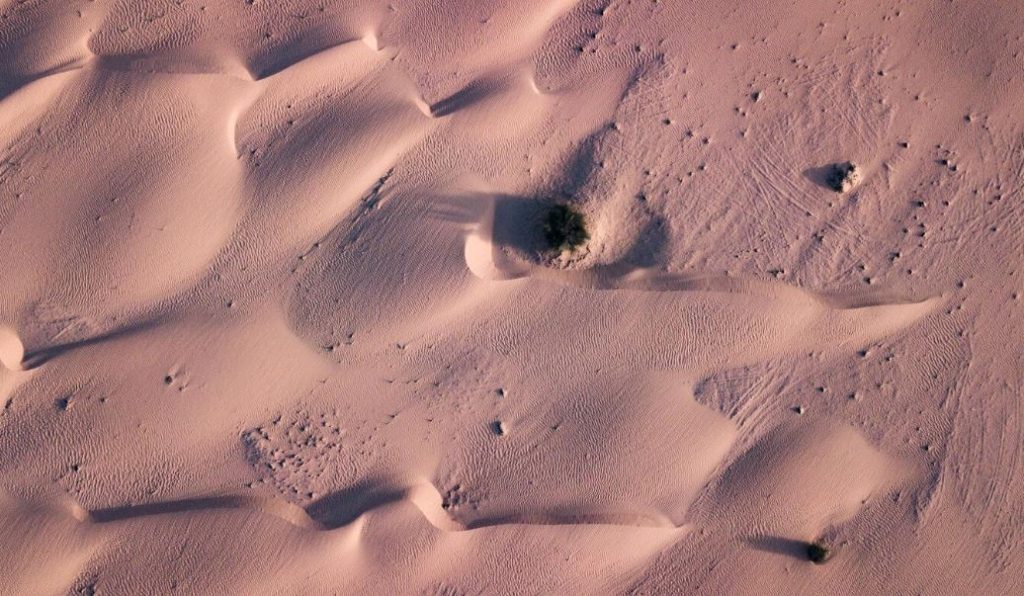
The ridges that slant across Eumenides Dorsum’s surface initially reminded me of scratches on old parchment; they are intentional, purposeful, and full of meaning. Yardangs are more than just rock ridges; they are wind-carved timelines that have been patiently and persistently abraded. Sand carried by relentless Martian winds has rubbed away the soft layers over centuries, maybe millennia, leaving behind skeletal remnants arranged like rows of blades that have been partially buried.
The wind on Mars is remarkably adept at sculpting landscapes despite the planet’s thin atmosphere. It targets the weak spots and widens already-existing cracks by chipping away at the surface grain by grain. The wind not only erodes but also purposefully carves by following fault lines and soft sediments. Like a fossilized compass, the resulting streamlined ridges capture the dominant wind patterns, all sloping in the same southeast-to-northwest direction. Our deep-time Martian climate models are more accurate thanks to this remarkably clear record of the planet’s atmospheric consistency.
| Feature | Description |
|---|---|
| Location | Northern end of Eumenides Dorsum, near Mars’s equator |
| Geological Forces | Wind erosion, volcanic activity, asteroid impact |
| Primary Features | Yardangs (wind-carved ridges), platy lava flows, impact craters |
| Formation Timeline | Volcanic flows first, followed by wind erosion, then asteroid impacts |
| Area Size | Approx. 28,000 km² (comparable to the size of Belgium) |
| Recent Image Source | Mars Express HRSC, ESA/DLR, Orbit 26245, October 16, 2024 |
| Scientific Relevance | Offers evidence of sustained wind direction and planetary surface evolution |
The intersection of several forces in this region close to Eumenides Dorsum’s northern edge is what makes it so novel. Scientists refer to the fractured volcanic plain that the yardangs are situated on as “platy flow.” These formations are the remains of ancient lava that solidified at the surface while molten rock continued to churn below. They resemble cracked ice floes floating across a frozen lake. The surface is incredibly adaptable in appearance, hinting at movement even when it is motionless.
This natural archive is further enhanced by the nearby crater. A more recent story of abrupt impact rather than gradual erosion is told by the crater, which is still clearly defined and encircled by a blanket of cohesive ejecta. Ice may have once existed in the Martian subsurface, melting and flowing during the asteroid’s explosive arrival, based on the wave-like contours surrounding it. It was confirmed to have arrived after the wind had already started working because the crater is situated atop both lava flows and yardangs.
Scientists can create an exceptionally detailed chronology of Mars’ geological history by aligning these timelines: impact last, wind erosion second, and lava first. This sequence, which can be seen in a single image, is noticeably better than previous datasets, where separate processes frequently showed up separately. Here, Mars writes in chapters that overlap and are all written on the same piece of land.
The yardangs end just south of the crater, and I recall stopping when I first saw it. It seemed like a purposeful punctuation mark in a paragraph of terrain that flowed otherwise. Not only was there erosion, but there was also timing, disruption, and even opposition. It served as a reminder that, despite the slow pace of time, Mars is still very much in motion.
With meticulous image processing by teams at Freie Universität Berlin and the German Aerospace Center, these high-resolution images from Mars Express give us more than just images—they give us context. Since its 2003 launch, Mars Express has subtly changed how we perceive the planet’s surface. Its orbit has allowed it to capture valleys, plains, and now these long ridges with remarkable clarity. We can read the landscape not only in space but also in time thanks to the HRSC camera’s exceptional efficiency in capturing three-dimensional data.
With their long, slender bodies, yardangs behave almost like wind-written sentences. Their regularity is not coincidental. Because of its steady direction, it demonstrates how little the Martian air currents have changed over millions of years. Planetary scientists can improve their simulations of dust transport, wind speed, and local weathering patterns thanks to this surprisingly informative steadiness.
The area, which is part of the enormous Medusae Fossae Formation, is a prime illustration of what happens when determined forces collide with poorly cemented material. It was always a possibility to reshape this region because of its soft sedimentary deposits. Because they show how even small forces applied consistently can produce amazing transformations, the yardangs here are especially striking. It is somewhat reminiscent of erosion processes on Earth, but with colder suns and thinner skies.
This area serves as a test site for planetary change in the context of Martian exploration. Researchers are looking at more than just rocks and craters. They are investigating forces that are still at work today, albeit slowly. It is not merely academic to know how and where the terrain is susceptible to wind for future missions, whether they are crewed or robotic. It might influence where we land, how we build, and how long-lasting structures might be.
The Mars Express data has evolved over the last 20 years from novelty to necessity. Despite operating in the background while more conspicuous rovers make headlines, this mission has produced an incredibly comprehensive record of the Martian surface. Every new picture deepens our understanding of the Red Planet by adding nuance and tone. In that developing narrative, the yardangs at Eumenides Dorsum are a particularly notable chapter.
We’re creating a geological timeline and a mindset for further research by utilizing the lessons learned from this area, such as how forces interact and patterns emerge. It is a way of thinking that emphasizes careful observation, slow work, and the strength of little forces working gradually. That has a refreshingly patient quality in a time of acceleration.
