

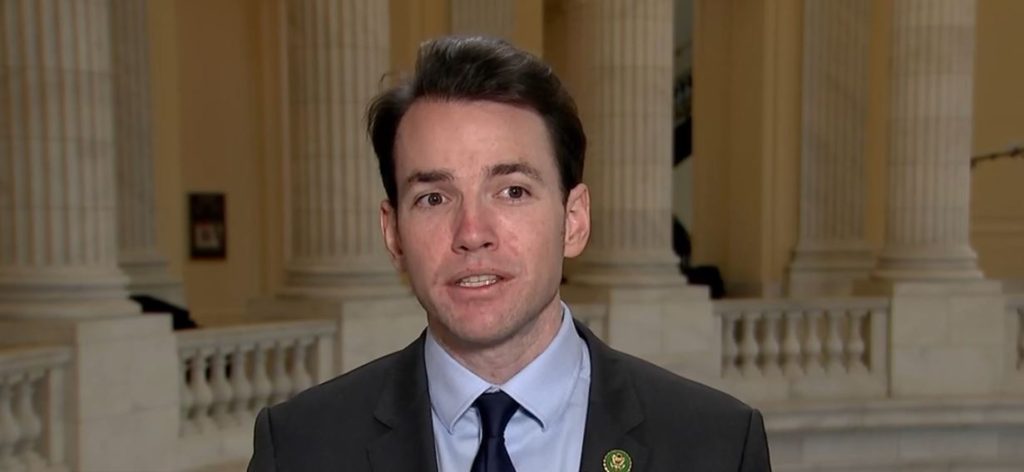
Credit: C-SPAN
On what would have otherwise been a typical Washington afternoon, the announcement was made in a low-key, almost casual manner. Two-term California congressman Kevin Kiley announced he was registering as an independent and leaving the Republican Party. The news spread like a tiny shockwave across Capitol Hill in a matter of minutes. Reporters updated their feeds, party strategists started doing math, and employees leaned over desks.
Even a single decision can have far-reaching effects in a chamber where majorities frequently hang by a thread. That’s precisely what Kevin Kiley’s move accomplished. Even though his departure was mainly symbolic, it added another layer of uncertainty to the already precarious political balance for Republicans, who were already operating with a narrow margin in the House.
| Category | Details |
|---|---|
| Full Name | Kevin Patrick Kiley |
| Date of Birth | January 30, 1985 |
| Birthplace | Rocklin, California, United States |
| Current Role | U.S. Representative (California) |
| Congressional District | California’s 3rd District (since 2023) |
| Political Affiliation | Independent (since 2026), formerly Republican |
| Education | Harvard University (BA), Yale Law School (JD), Loyola Marymount University (MA) |
| Previous Role | Member of the California State Assembly (2016–2022) |
| Notable Political Event | Switched party affiliation from Republican to Independent in March 2026 |
| Official Website | https://kiley.house.gov |
Kiley, the representative for California’s third congressional district, characterized the ruling more as a statement of independence from what he calls “hyper-partisanship” than as a revolt. Politicians frequently use phrases like this, but in Kiley’s case, there seems to be some sincere frustration behind it. There’s a tone in his recent speeches that suggests he’s sick of party politics‘ inflexible choreography.
Geography plays a role in the narrative. Careers in California can be drastically altered by politics, particularly when district lines change. Kiley’s political path became much more complicated due to a recent redistricting effort that turned a once-friendly district into one that leans Democratic. Theoretically, he can differentiate himself from the standard partisan candidate by running as an independent.
It’s unclear if voters will accept that framing. For a contemporary political figure, Kiley’s background is remarkably academic. Born and raised in the Sacramento region, he attended prestigious universities with relative ease, first Harvard for his undergraduate studies and then Yale Law School. His parents were a doctor and a special education teacher. Those who have followed his career frequently point out the difference between his sometimes populist rhetoric and that resume.
Kiley worked as a Teach for America teacher in Los Angeles prior to entering politics. His former coworkers remember him showing up early to class with a worn leather bag and piles of papers. His political identity seems to have been influenced by the experience, especially his focus on school choice and education policy.
In 2016, he became involved in politics after winning a seat in the California State Assembly. He gained a reputation as a disciplined lawmaker during those formative years—not ostentatious, but tenacious. Observers frequently saw Kiley sitting quietly and taking notes while others argued across the chamber floor during Sacramento debates.
He carried that habit with him to Washington. Kiley joined committees about education and the judiciary as soon as he entered Congress in 2023. He rarely raises his voice during hearings and usually speaks in a measured cadence. It’s difficult to ignore the contrast between those exchanges and the more theatrical approach that characterizes contemporary congressional politics.
However, there has been some controversy surrounding his record. Kiley claimed that California’s high-speed rail project had turned into an expensive government experiment and opposed it. Additionally, he filed a lawsuit that ultimately failed in court to contest the emergency powers granted to Governor Gavin Newsom during the pandemic.
Conservative voters took notice of him as a result of those battles. However, they also put him right in the middle of the political disputes he now says he is avoiding.
At a time when political identities in Washington seem more malleable than they once were, he decides to leave the Republican Party. Senators Bernie Sanders and Angus King are examples of independent leaders who have long operated outside of conventional party labels, despite their strong Democratic affiliation.
Kiley’s circumstances are distinct. He has stated that he will keep meeting with Republicans to discuss administrative matters, such as committee assignments. That particular detail is important. It implies that even though the headline sounds dramatic, the day-to-day operations of Congress might not change significantly.
However, symbolism has political power of its own. The numbers are already tight for Speaker of the House Mike Johnson. Procedural decisions can become more difficult if even one trustworthy vote is lost. Although Kiley has made it clear that every vote will depend on how it affects his constituents, he has also hinted that he will continue to support Republican leadership on a number of issues.
He frequently uses the phrase “constituents first” in his public statements. For months, observers will argue over whether it is a reflection of strategy or conviction.
It’s difficult to ignore the timing. As he gets ready to run for reelection in a newly created congressional district that leans more Democratic than his current one, Kiley switches parties. Opponents contend that the action is more about survival than it is about principle. Maybe both are true.
When observing American politics in recent years, it can appear that the strict divisions between the parties are not as stable as they once were. Despite voters’ dissatisfaction with both parties, the political system is still stubbornly divided.
If that’s the correct term, Kiley’s experiment might determine whether Congress still has room for a different strategy. It is uncommon to have an independent voice within a highly partisan organization.
In the coming months, Washington will be closely monitoring whether it is successful or just symbolic.
