

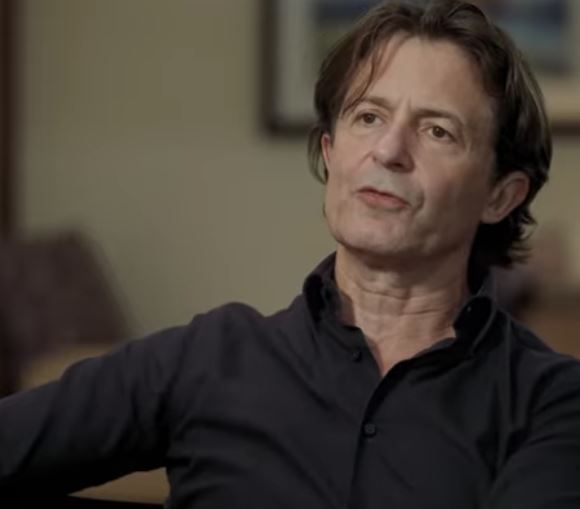
A certain type of wealth does not come from starting a business or experiencing a single breakthrough. It builds up more subtly through knowledge, being in a position to take advantage of changes in the industry, and patient institutional climbing that doesn’t make headlines until it does. That type of executive is Giordano Albertazzi, referred to by coworkers as Gio. The $56 million to $107 million fortune of the Italian engineer from Milan, who currently leads one of America’s most significant infrastructure companies, was built almost entirely on Vertiv stock and a compensation structure that rewards performance in a business that is currently impossible to ignore.
On January 1, 2023, Albertazzi assumed the CEO position at Vertiv Holdings Co., taking over a business that was already in a strong position but had not yet fully realized its future. The demand for data center cooling and power management was about to change due to the AI infrastructure wave—ChatGPT launched in late 2022, just weeks before it officially assumed the top position, making Vertiv’s product line appear almost prophetic. Vertiv manufactures the critical power units, liquid cooling infrastructure, and thermal management systems that prevent data centers from melting. Not particularly glamorous work. However, the Columbus company that sells precision air systems becomes indispensable when hyperscalers are being built at an unprecedented rate, and AI racks produce heat intense enough to render older cooling solutions obsolete.
Including a $1 million base salary, a $3 million cash bonus, and slightly more than $8.2 million in equity awards, his most recent total compensation was $12,276,743. The equity component is crucial as a signal as well as a wealth generator. Personal net worth becomes a moving target when a CEO owns 166,101 shares of company stock and those shares are associated with a company whose market capitalization exceeded $100 billion. The number varies along with the stock. Based on reported shareholdings, Benzinga has estimated it as high as $107 million, but Quiver Quantitative’s more conservative insider-focused estimate places it at about $56 million as of early June 2026. Depending on which snapshot of VRT’s price you’re using, both numbers are reasonable.
Albertazzi’s wealth is intriguing because it clearly reflects the company’s trajectory rather than any distinct investment strategy. He’s not into hedge funds. He is a mechanical engineer who rose through the operational ranks of Vertiv, first as President of EMEA, then as COO, and finally as CEO. His wealth increased as a result of the company’s expansion, which was fueled by an increase in demand for data centers. Depending on how you feel about AI spending cycles, it can be either comforting or a little risky because it is nearly circular. Whether hyperscaler capex stays at these levels or if a correction occurs before Vertiv’s orderbook fully converts to revenue is still up for debate.
Albertazzi candidly described the company’s investment in AI infrastructure in a 2024 interview with Chief Executive magazine as a structural change as opposed to a brief surge. Net sales for the third quarter of 2024 were close to $2.1 billion, up 19% from the previous year, and adjusted operating margins exceeded 20%. You don’t get those figures from a brief tailwind. Vertiv’s partnerships with Nvidia and Intel, its liquid-cooling systems, and its growing manufacturing facilities throughout the Americas, Europe, and Asia are all indicative of an early and purposeful leadership team. Unquestionably, the capital expenditure investment in new manufacturing capacity precedes the AI boom.
It’s genuinely fascinating to watch someone like Albertazzi handle such a big event, in part because he seems almost temperamentally uninterested in the spectacle. There are no thought-provoking interviews about disruption or viral conference keynotes. He talks like a man who has studied power density and heat transfer for decades. His stated goals are operational: deeper collaboration with chip designers on next-generation cooling requirements, stronger university partnerships in Ohio, and more services integrated into data centers. Strangely, the infrastructure project itself appears to take precedence over personal wealth. It will be interesting to see if that stance holds as Vertiv’s wealth and notoriety continue to rise.
