

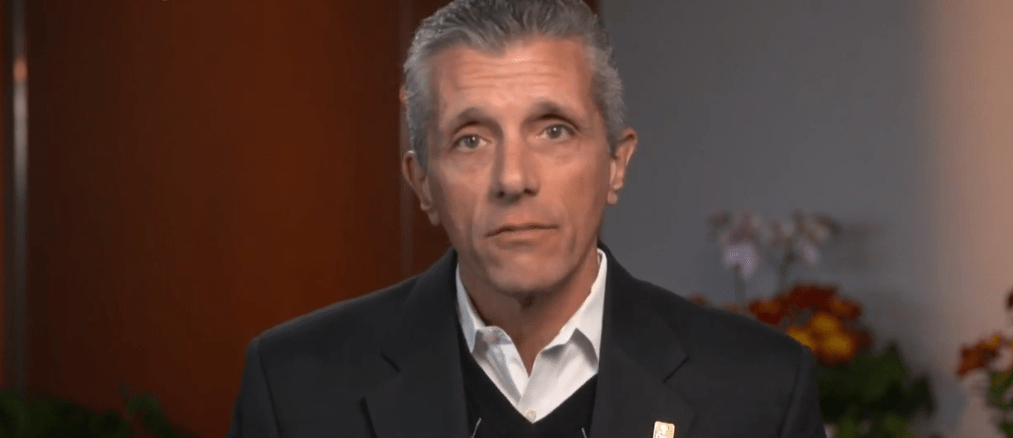
Credit: Cigna Healthcare
One might forget that health insurance is one of the biggest financial engines in the US when strolling through downtown Bloomfield, Connecticut, where The Cigna Group’s headquarters are housed behind neat landscaping and glass walls. Every quarter, billions pass through the system in silence. David Cordani, the company’s longtime chairman and CEO, is somewhere inside that machinery. His personal wealth has increased in tandem with the insurer he oversees.
David Cordani’s estimated net worth ranges from $175 million to $570 million, depending on which financial database is consulted. The large disparity reveals something about the methodology used to determine executive wealth.
| Category | Details |
|---|---|
| Full Name | David Michael Cordani |
| Date of Birth | February 10, 1966 |
| Age | 60 (approx.) |
| Birthplace | Waterbury, Connecticut, United States |
| Current Role | Chairman & CEO, The Cigna Group |
| Industry | Health Insurance / Healthcare Services |
| Estimated Net Worth | ~$175 million – $570 million (various estimates) |
| Major Holdings | Shares in The Cigna Group (CI), General Mills (GIS) |
| Shares in Cigna | ~621,872 shares valued at around $175 million |
| Reference | https://www.gurufocus.com/insider/David-Cordani |
While some estimates only take into account insider information and stock filings, others take into account long-term equity incentives, options, and compensation packages. Because of stock prices, insider transactions, and the gradual accumulation that comes with managing a Fortune 100 healthcare company, the figures vary slightly annually. That was not the world Cordani was born in.
He was raised in Waterbury, Connecticut, which was formerly a manufacturing town with a skyline dominated by brass mills. Over the years, the city has changed, with some factories closing and others becoming warehouses, but remnants of its industrial past can still be found. People who were raised there frequently have a pragmatic, data-driven mindset. As Cordani’s career progresses, it seems as though his upbringing continues to influence his style, which is composed, restrained, and infrequently ostentatious. It took him some time to rise through the ranks of corporate healthcare. Slowly, it happened.
After working as an actuary, a profession centered on statistical modeling and insurance risk, Cordani joined Cigna in the early 1990s. Executives with that background typically think in terms of probabilities rather than headlines. Before taking on the position of CEO in 2009, he progressed through leadership positions over time, first managing business units and then supervising operations. It was an uncomfortable moment.
The healthcare sector was about to enter a time of significant economic and political transformation. Insurers were recalculating risk pools, the Affordable Care Act debates were taking over Washington, and public perception of insurance companies was, to put it mildly, complicated. In any case, Cordani took over the role.
Cigna has expanded greatly since then. Evernorth, the company’s pharmacy benefit management division, is now a key pillar of the business, and its revenue has risen into the hundreds of billions. Based on the stock’s performance over the last ten years, investors have largely backed the strategy.
According to SEC documents, he possesses over 621,000 shares of Cigna stock, which, at current prices, is valued at about $175 million. The shares are almost all of his holdings that are disclosed to the public. Cordani’s portfolio appears relatively straightforward when compared to some tech CEOs who distribute their investments among dozens of businesses.
However, insider trading reports have occasionally garnered attention. In order to avoid conflicts of interest, Cordani has carried out a number of stock sales over the past few years, some of which were routine and others of a larger size. These sales are frequently a component of executives’ scheduled trading plans. One of his sales in 2022 alone included almost 40,000 shares.
Investors occasionally argue over the significance of those filings as they appear in the SEC database. Is diversification enough? Individual budgeting? Or something more calculated? It’s hard to say. Insider trades seldom provide much insight into a company’s future, and executives sell stock for a variety of reasons.
In addition to stock ownership, Cordani’s wealth is influenced by his CEO salary. Large insurers’ executive compensation packages usually consist of salaries, bonuses, and long-term equity grants based on performance indicators. According to company documents, Cordani’s total compensation has been approximately $14 million per year in recent years.
There are times when those numbers provoke criticism. Health insurance companies are at the center of contentious public discussions about access to care, prescription drug costs, and hospital costs. Seeing a CEO earn tens of millions while healthcare costs continue rising can feel jarring to some observers. However, investors typically have a different perspective on executive compensation.
Stability in leadership is frequently valuable from the standpoint of shareholders. Cordani has been in charge of Cigna for over fifteen years, which is practically unheard of in today’s business world. In half that time, many CEOs switch between high-level positions.
His public persona also has an understated quality. Cordani mostly stays out of the spotlight, in contrast to tech executives who build social media followings or make ostentatious conference appearances. calls for earnings. conferences for investors. sporadic interviews. He usually shows up there.
Though subtle, the effect is discernible. In keeping with the slow-moving nature of the health insurance sector itself, his wealth has increased subtly, almost methodically. No stories about startups that go viral. No IPO windfalls overnight. Only a few decades of executive leadership, stock ownership compounding power, and equity accumulation. What about the future?
That is more difficult to forecast. The public and politicians are constantly scrutinizing insurers, healthcare costs are increasing, and regulatory pressure is growing. Managing a business like Cigna necessitates striking a balance between political sensitivity and profitability, which is easier said than done. For years, Cordani has maintained that delicate balance.
However, given the current state of the industry—telemedicine is growing, pharmacy costs are rising, and artificial intelligence is starting to be used in insurance claims processing—the upcoming decade may differ from the previous one. It’s unclear if Cordani will continue to lead during that change. However, one thing is evident.
Regardless of the path healthcare takes, David Cordani’s wealth already demonstrates perseverance, longevity, and the unspoken financial benefits of being at the heart of one of the biggest sectors in the US.
