

The sound of traffic at a crowded intersection in Shanghai has changed. The familiar roar of engines has subsided into something more akin to a hum, but there is still movement—buses pulling in, scooters swerving between lanes. With their green license plates indicating that they are electric, cars pass by almost silently. This scene is not futuristic. It’s only Tuesday.
Perhaps the most striking aspect is that normalcy.
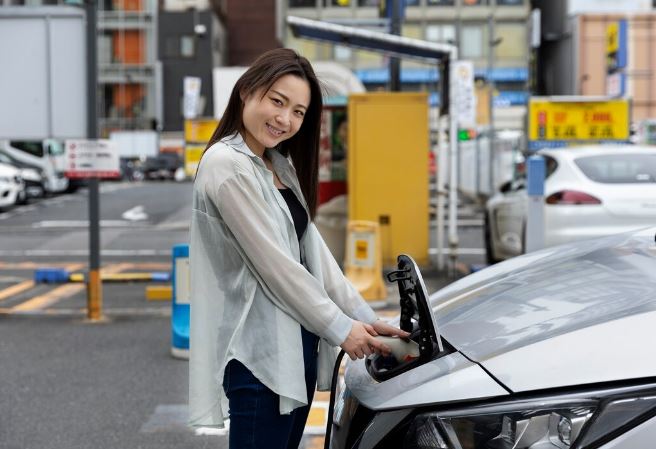
Electric cars are no longer considered niche or aspirational in Shanghai. In most Western cities, the percentage of new cars that are electrified—more than half—would still seem high. In the parking lots of shopping malls, beneath apartment buildings, and next to office towers, charging stations can be found almost casually. Without giving it much thought, drivers plug in.
It’s possible that people stopped noticing the change because it happened so fast.
| Category | Details |
|---|---|
| Location | Shanghai, China |
| Industry | Electric Vehicles (EVs) |
| Market Share | ~50%+ of new car sales electrified |
| Government Investment | ~$230 billion (2009–2023) |
| Key Players | BYD, NIO, XPeng, Tesla (Shanghai Gigafactory) |
| Battery Leader | CATL (≈1/3 global EV battery supply) |
| Development Speed | ~30% faster than legacy automakers |
| Infrastructure | World’s largest EV charging network |
| Impact Region | Detroit, USA (Ford, GM, legacy automakers) |
| Reference | https://www.bbc.com/news |
Long before EVs gained popularity elsewhere, the groundwork for this boom was established. Beijing invested more than $200 billion to build the ecosystem, including large investments in battery supply chains, manufacturer incentives, and buyer subsidies. It wasn’t nuanced. It was intentional.
These days, you can see that investment everywhere you look in a Shanghai auto show. There are hundreds of models, dozens of brands, and glowing screens inside cars that resemble homes rather than automobiles. Young consumers test voice commands, stream music, and change ambient lighting while seated in the driver’s seat.
It seems as though the car’s purpose has evolved.
Experience is often more important in China than performance when it comes to EV appeal. A car’s connectivity, comfort, and digital features are just as important as its handling and acceleration. It reflects a larger trend toward technology as the distinguishing characteristic of ownership, particularly among younger consumers.
That change subtly but firmly challenges Detroit’s long-held beliefs about automobiles.
The legacy is deeply ingrained in Detroit. The names Ford and General Motors, which shaped not only products but also entire perspectives on mobility, are responsible for the development of the modern auto industry. Power, dependability, and technical accuracy. Those were the success indicators for decades.
Those markers seem a little out of date now.
The way cars are developed has been reorganized by Chinese automakers. They move quickly, overlapping design, testing, and manufacturing, as opposed to lengthy, linear production cycles. In less than three years, some models make it from concept to showroom. That speed is disruptive as well as impressive.
Detroit, on the other hand, is more cautious.
Cost is another issue. Scale and highly integrated supply chains are advantageous to Chinese EV manufacturers, especially when it comes to batteries. A sizable portion of the world’s battery production is controlled by corporations like CATL, which gives domestic producers flexibility and pricing power.
This creates a challenging dynamic for American automakers. When your rival owns important components, it becomes more difficult to compete on price.
It’s difficult to ignore how frequently Detroit executives now discuss China—perhaps not in public, but in more private discussions, strategy meetings, and investor briefings. It’s acknowledged that there won’t be any competition. It has already arrived.
Despite this, political opposition and tariffs prevent Chinese EVs from being widely used on American roads. A peculiar kind of distance is created by that absence. Although it is not immediate, the threat feels real. Not yet, anyway.
Nevertheless, the impact is seeping in through other avenues.
Partnerships are starting to emerge. For example, Ford has looked into accelerating its own EV development by utilizing Chinese battery technology. This choice is both practical and illuminating. It implies that dependence might increase even as competition heats up.
That has a subtle irony to it.
The competition is fierce back in Shanghai. In China, there are currently about 400 EV models available for purchase, which is more than twice as many as there were a few years ago. Some startups fade as quickly as they emerge. Price wars frequently occur. The margins are narrow.
The environment is harsh. However, it results in efficiency.
As this develops, it seems that China’s EV market is more akin to an ongoing experiment—fast-moving, slightly chaotic, constantly changing—than a traditional industry. Companies must either quickly improve or go out of business in that environment.
In contrast, Detroit seems more stable. However, stability can occasionally impede adaptation.
There are times when the gap is apparent. A Chinese EV enters a foreign market with competitive pricing, immersive digital interfaces, and sophisticated driver assistance. Customers react due to value rather than brand loyalty.
It’s hard to ignore that response.
It’s not a one-sided narrative, though. Detroit’s strengths include its extensive engineering, well-known worldwide brand, and decades of manufacturing experience. They don’t disappear overnight. Additionally, there are indications of change, such as factory retooling, software investments, and new EV platforms.
Whether that adjustment happens quickly enough is the question.
Because cars are not the only thing at stake. Millions of jobs and entire local economies are supported by the auto industry. Not only would a change in dominance alter markets, but it would also alter livelihoods.
It’s difficult not to notice that something fundamental has already changed as you stand at that Shanghai intersection and watch another line of silent cars go by. Not in a big way. Not all at once. but steadily.
And that shift is being closely observed—possibly more so than ever—in Detroit, thousands of miles away.
