

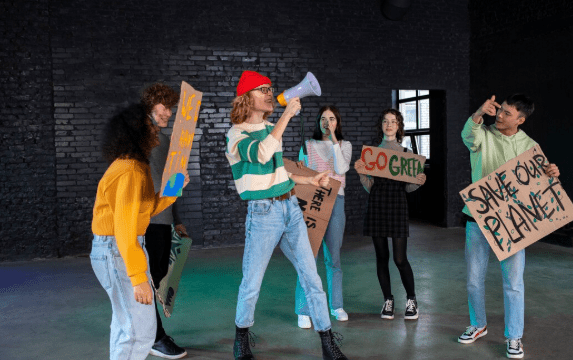
Oxford’s stone courtyards still have the same appearance. The same weathered walkways, the same gothic towers, the same peaceful lawns where generations of students have engaged in political discourse. However, something feels different if you watch intently and stand there long enough. Arguments are no longer limited to late-night bars and seminars. These are being captured on phones, vertically filmed, swiftly edited, and uploaded to TikTok.
| Category | Information |
|---|---|
| Topic | UK Student Political Activism in the Social Media Era |
| Key Generation | Generation Z (primarily ages 18–27) |
| Key Platforms | TikTok, Instagram, YouTube |
| Major Institutions Involved | University of Oxford, University of Cambridge, University of Leeds |
| Major Themes | Digital activism, political identity, online mobilization |
| Key Statistic | 34% of young people aged 8–17 say the internet led them to join a cause |
| Relevant Research Fields | Digital Media, Political Communication, Youth Activism |
| Reference Website | https://theconversation.com/how-tiktok-can-be-the-new-platform-for-political-activism |
It’s difficult to ignore how casually politics now permeates student life. A student crossing Radcliffe Square might stop and record a 30-second explanation of a policy debate while holding their phone at arm’s length. Another could create a reaction to a widely shared video from a demonstration taking place hundreds of miles away. Once coordinated by pamphlets and demonstrations, activism now uses algorithms.
Student activism in Britain looked familiar ten years ago. Marches, placards, and packed lecture halls. Thousands of students demonstrated against tuition fee hikes in the streets in 2010. These protests were clearly visible to the public, boisterous, and violent. Between a lecture recording and a meme, the protest might start subtly today.
A portion of the change is generational. Instead of coming late to the internet, Generation Z grew up in it. They have an innate tendency to capture, remix, and share ideas almost immediately. Over one-third of young people say that online platforms encouraged them to support political causes, according to the UK Safer Internet Centre. If you browse through political TikTok for even ten minutes, that statistic seems plausible.
In particular, TikTok appears to have developed into an improbable venue for politics and entertainment. In the past, the platform was primarily connected to comedic sketches and dances. However, a different kind of participatory political culture where activism blends with storytelling, satire, and personal experience has emerged, according to researchers studying the app.
These videos give the impression that activism is now more conversational. Students use brief commentary to explain complex issues rather than lengthy speeches or meticulously crafted manifestos. It can be messy at times. It can be convincing at times. Sometimes it’s surprisingly considerate.
Consider demonstrations against global conflicts or campaigns to combat climate change. It used to take weeks to plan a demonstration on a traditional campus. Students from several universities can now be mobilized in a matter of hours by a single viral video. For example, students at Cambridge and Oxford have organized campaigns using online networks that extend well beyond their campuses.
However, the digital energy has drawbacks. The enigmatic algorithm used by TikTok to determine which videos become viral has a tendency to favor emotional content. Anger spreads swiftly. Not as subtle. Scholars who study online political communication are starting to become concerned about that dynamic.
The issue of false information is another. Inaccurate claims can be amplified with the same viral structure that enables activists to raise awareness. Some students acknowledge that they have witnessed online debates blow up before the facts were thoroughly verified. Sometimes accuracy is delayed due to scroll speed.
However, it would likely miss the point to write off TikTok activism as superficial. Instead of viewing the platform as a substitute for conventional politics, many young activists view it as a tool. While a viral video may spark a discussion, it frequently results in in-person gatherings, fundraising initiatives, or protests on college campuses.
Additionally, Gen Z activism has a very collective quality. Earlier movements frequently had well-known leaders, such as Gloria Steinem or Martin Luther King Jr. The student movements of today seem to be less centralized. Even though a single TikTok could start a movement, it rarely has a single face.
There are benefits and risks to this collective style. It gives more people a voice and facilitates the rapid dissemination of ideas. However, it can also result in echo chambers, where students are primarily exposed to viewpoints that are similar to their own. Online debates can occasionally resemble parallel monologues more than discussions.
Today, it’s easy to see how old and new politics coexist on a British campus. Noticeboards continue to display posters. Student unions continue to hold meetings. However, someone is most likely filming a brief video somewhere nearby to explain the same problem to thousands of viewers they will never meet.
As we watch this develop, we get the odd impression that political participation is both growing and dividing. Participating in activism is now simpler than ever before; all you need may be a phone, an internet connection, and a point of view. It’s unclear if that will result in long-lasting political change.
