

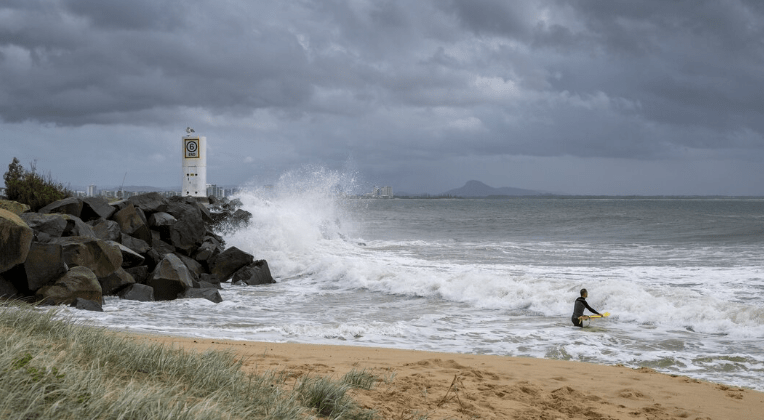
The North Sea appears almost unremarkable on a calm day. Gray water is traversed slowly by fishing boats. In the distance, oil platforms resemble mechanical islands. Above the wind, seabirds circle. The violent tale that lies hundreds of meters below the surface is not hinted at.
However, Silverpit Crater, a roughly three-kilometer-wide geological scar, is located far beneath that placid water. Scientists argued over how it formed for years. A seabed collapse or shifting salt deposits were suspected by some. Others thought something more dramatic had occurred. According to recent research, the dramatic explanation—that an asteroid once crashed into the North Sea, causing a tsunami so massive it would dwarf contemporary coastal waves—was correct all along.
| Topic Information | Details |
|---|---|
| Event | Asteroid Impact in the North Sea |
| Crater Name | Silverpit Crater |
| Location | Southern North Sea, about 130 km (80 miles) off Yorkshire, UK |
| Estimated Age | 43–46 million years |
| Asteroid Size | Approximately 160 meters wide |
| Crater Diameter | About 3 km (1.9 miles) |
| Tsunami Height | Estimated over 100 meters (330 feet) |
| Research Institution | Heriot-Watt University |
| Key Researcher | Dr. Uisdean Nicholson |
| Scientific Journal | Nature Communications |
| Reference | https://www.sciencedaily.com |
The evidence that is emerging from beneath the ocean floor is surprisingly tangible, despite the idea initially sounding like a movie. Researchers from Heriot-Watt University, under the direction of Dr. Uisdean Nicholson, looked at computer simulations, rock samples, and seismic imaging data. All of these indications point to a collision that happened between 43 and 46 million years ago, when a 160-meter-wide space rock struck the seabed at a shallow angle.
Imagining the actual moment is challenging. The asteroid would have penetrated Earth’s atmosphere in a matter of seconds before colliding with the sea west of modern-day Yorkshire because it was probably moving faster than a rifle bullet. Roughly 1.5 kilometers high, a towering curtain of rock and water was launched into the air by the impact.
That massive wall fell back into the sea in a matter of minutes, causing a tsunami that was thought to be more than 100 meters high. That is higher than Big Ben in London.
It is unnerving to imagine such a wave while standing on a contemporary shoreline. When describing it, even seasoned geologists occasionally hesitate. Millions of years ago, the North Sea basin had a completely different appearance, but coastal regions would still have been at risk. Sediment would have been dispersed over vast areas, and shorelines would have been altered by a wave of that size racing across the ocean.
For millions of years, Silverpit itself remained undiscovered. The crater was gradually buried beneath 700 meters of seabed by sedimentary layers. It wasn’t found until 2002, when seismic surveys by oil companies revealed an odd circular structure beneath the ocean floor. The pattern was similar to ripples that spread outward when a stone strikes water, a shape that impact craters are frequently associated with by geologists. However, the concept generated controversy at the time.
According to some researchers, the formation could be the result of subterranean salt rising and distorting nearby rock layers. Others proposed that a volcanic collapse could have created the structure. For years, the debates raged back and forth, at times with unexpected ferocity for a topic buried deep beneath the ocean.
Observing that discussion reveals something about science in general. Evidence builds up gradually. Theories come and go. Occasionally, a single discovery can tip the scales.
In this instance, microscopic minerals concealed in rock samples provided the breakthrough. Researchers discovered feldspar crystals and “shocked quartz,” which are microscopic structures that only form under extremely high pressures created during asteroid impacts. An important hint was found when they were found at the bottom of the Silverpit crater.
Such discoveries are sometimes referred to by scientists as a “needle in a haystack.” This description doesn’t seem overly dramatic. The argument might still be going on if it weren’t for those tiny crystals.
Silverpit is now part of a comparatively small group of underwater craters due to the confirmed impact of an asteroid. Only a few dozen impact craters are known to exist beneath the oceans, compared to about 200 on land. The explanation is straightforward: oceans are always changing. Many indications of past collisions are gradually erased by sediment, tectonic movement, and erosion.
Researchers are fascinated by Silverpit because of this. Despite its age, it seems remarkably well-preserved.
Additionally, the finding links Earth’s past to a larger cosmic pattern. Geologically speaking, asteroid impacts are not uncommon. The Chicxulub impact in Mexico, which contributed to the extinction of the dinosaurs some 66 million years ago, is still the most well-known example. The North Sea asteroid was small in comparison to that catastrophe. However, the surrounding area would have suffered greatly as a result. It also poses an awkward query.
The consequences could be dire if a similar asteroid struck in shallow ocean waters today. From the Netherlands to the UK, modern coastal cities are situated along low-lying shorelines that are largely dependent on flood defenses. Scientists are still working to accurately model the complex waves and shock effects that would result from a large ocean impact.
Because of this uncertainty, this kind of research goes beyond simple historical curiosity.
Planetary scientists believe that researching past impacts helps humanity be ready for possible threats in the future. Near-Earth asteroids are already being tracked by space agencies, which have cataloged thousands of objects that occasionally pass near Earth. The majority are safe. Occasionally, though, someone expresses concern.
These risk models can be improved by knowing how impacts behave in ocean environments, such as how waves spread across shallow seas and how they move water.
Above the buried crater, the North Sea is still going about its peaceful business. Shipping lanes are used by ships. Against the horizon, wind farms rotate slowly. Few travelers who traverse those waters are aware that the remnant of a time when the sky literally collapsed into the sea is beneath them.
And maybe the story’s compelling quality comes from that contrast. On the surface, a calm ocean. A frozen recollection of a cosmic collision strong enough to send a wall of water hurtling toward ancient shores lies beneath it.
