

The moment Josie Gibson raised her arm to apply a roll-on deodorant on Instagram has a subtle yet striking quality. It was not a dramatic revelation, nor was it purposefully staged or theatrical. Wearing a black sports bra and leggings, she looked exactly like someone who had somewhere to be and things to do while promoting a Wild deodorant offer. For anyone who had followed her story over the previous few months, however, the image carried a weight that a simple celebrity advertisement seldom does. When her arm was raised, the scars were visible and long, running along the inner arm.
Gibson, 41, has been publicly discussing lipoedema—a chronic condition characterized by an abnormal accumulation of fat tissue that tends to concentrate in the legs, hips, buttocks, and arms in ways that diet and exercise simply cannot address—for the better part of the last year. A body that stores fat selectively and stubbornly, regardless of how hard you train or how carefully you eat, is the kind of diagnosis that sounds nearly impossible to those who are unfamiliar with it. Before it was given a name, Gibson’s frustration had been growing for years.
She attempted to describe what it was like to live with the illness when she sat opposite Ben Shephard and Cat Deeley on This Morning back in January. She detailed three separate consultations in London and consultations with experts throughout Europe, including a trip to Berlin. She received essentially the same advice from all the experts: she could train seven days a week, but the lipoedema fat in her arms would not go away. She remarked at the time, “I shouldn’t have cellulite on my arms because I have this little waist.” It’s difficult to ignore the specific tiredness that underlies that statement—years of work and outcomes that applied everywhere but the places that were most important to her.
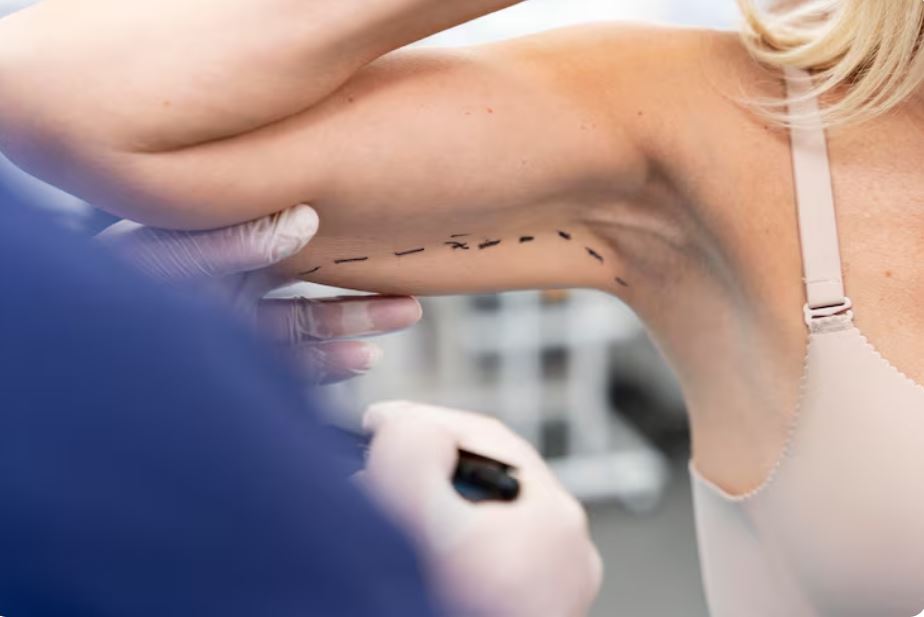
The choice to undergo surgery was not made hastily. Since then, Gibson has referred to it as a last resort, which is arguably the most truthful way an elective procedure has ever been described. She had two different procedures: a brachioplasty, a surgical arm lift that removed the excess skin and tissue left behind, and a Vaser liposuction procedure, which uses ultrasound energy to break down and remove fat while simultaneously working on skin tightening from the inside. About 45% of her arm tissue was removed in total. This procedure alone cost about £7,000. It comes after she had similar-priced surgery on her calves in September of last year.
According to her own account, recovery was difficult. Before engaging in any kind of regular physical activity again, there were bandages, limited mobility, and a protracted period of mandated rest.
Lymphatic drainage sessions, collagen supplements, NAD+ and glutathione injectables, and—possibly the most surprising detail of all—a hyperbaric oxygen chamber that she rented for three months to raise blood oxygen levels and speed up tissue repair have all been used to supplement her healing. In addition, she constructed her own copper pyramid for energy work and meditation. It probably doesn’t matter if any of that is more than a placebo. It sounds like someone is doing everything they can to recover a body that has never fully cooperated.
The most noteworthy aspect of Gibson’s approach to all of this is probably the lack of glitz in her discussions. There isn’t a meticulously planned comeback moment or a before-and-after triumph story. She appears completely unaffected by the fact that the scars are visible and unaltered in a deodorant video. She has been outspoken about wanting to increase awareness of lipoedema, a condition that is still poorly understood and frequently misdiagnosed, so it’s possible that she made that conscious decision. Alternatively, it could just be that, given everything she has been through, a scar on an Instagram Story hardly qualifies as something worth hiding.
Her story is part of a larger discussion that transcends celebrity health journalism. Although lipoedema is thought to affect a sizable percentage of women, many general practitioners still have difficulty diagnosing it. They frequently confuse it with general obesity and give advice that is completely ineffective for the particular fat deposits involved, such as eating less and moving more. For many women, Gibson’s straightforward statement that she trained regularly, followed a healthy diet, and was still unable to change what turned out to be a medical condition is a realization that has likely been long overdue.
While filming The 70s Diet, she mentioned with a hint of satisfaction that the doctors evaluating her fitness were genuinely taken aback by her physical prowess. She clarified that the lipoedema had been impeding her progress. It was the condition itself, not her behavior or her effort. That distinction is important, and she appears committed to continuing to make it.
