

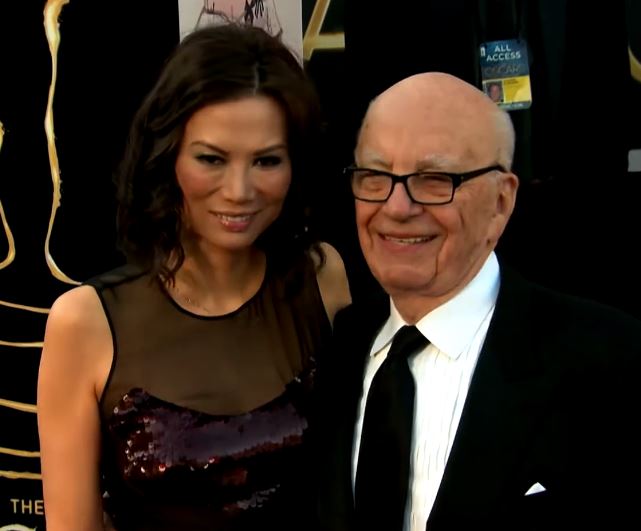
The way the Murdoch marriage ended has an almost cinematic quality. The years preceding it were more important than the attorneys or the courtroom, which were surprisingly short. A handwritten note that was never used as evidence in court. The story quietly came to light on a cattle ranch in Carmel. And a woman who, in Rupert Murdoch’s own words, had spent fourteen years changing from “a nice Chinese lady” to one of the most influential people in the world of media.
When the Wendi Deng divorce settlement was reached in November 2013, it was almost clinically efficient. When the time came, the prenuptial agreement and two postnuptial agreements that the couple had signed in 1999 handled the majority of the work. According to reports, Judge Ellen Gesmer expressed her satisfaction that the case had been settled amicably by both parties. A hundred-page contract. Not a trial. The lawyers involved described the entire situation as “straightforward,” a term seldom used when billions of dollars are at stake.
Deng was given a traditional courtyard home in Beijing close to the imperial palace, as well as the couple’s three-story penthouse on Fifth Avenue, which was bought in 2004 for about $44 million. two characteristics. No corporate interest. Murdoch recently divided his empire into two companies, News Corp. and 21st Century Fox, but neither company has voting shares. The Murdoch Family Trust, which was controlled by his four older children, held a 38.4% voting block, and Deng had no initial equity position in the company, so that final point was never really in doubt.
It’s important to consider that distinction. According to reports, Rupert Murdoch lost about $1.7 billion as a result of his divorce from his second wife, Anna Torv, in 1998. However, some people who were involved in the negotiations have since suggested that the true amount was structured differently, with Anna essentially giving up stock rights so her children could inherit control of the trust instead. Calculus was different with Deng. The prenuptial agreement was made. The interior of a courtroom was never seen by the attorneys. And any warmth that had previously existed—or had not—between the couple was kept mostly to themselves.
Beyond the asset figures, the narrative that progressively emerged around the divorce was what gave it a sense of significance. A note Deng wrote to herself about her feelings for Tony Blair, who was then a reliable Murdoch ally and the godfather of their oldest daughter, Grace, was featured in Vanity Fair’s March 2014 article. Rupert, who was 82 at the time, had reportedly been hearing rumors for a while. According to all accounts, the Blair dimension was what ultimately caused the situation to go beyond the point of no return. Eric Schmidt, the executive chairman of Google at the time, was also the subject of conjecture. Both sides released cautious joint statements refusing to make accusations in public.
According to reports from the time, the most contentious aspect of the proceedings was custody of Grace and Chloe, who were 10 and 12 at the time. In the end, the girls moved into Deng’s penthouse on Fifth Avenue. Given the trust’s potential importance to Murdoch succession planning, some observers have quietly been irritated by the fact that they have economic interests in the family trust but not voting rights.
In one version of this tale, Wendi Deng emerged victorious. She emerged from the marriage with her public profile intact, owns some of the most valuable residential real estate in Beijing and Manhattan, and has since built a life that effortlessly navigates fashion, the arts, and prominent social circles. In a different version, she left one of the world’s most influential media conglomerates with real estate but no seat at the table. Most likely, both versions are accurate. In a sense, the entire narrative revolves around that tension.
