

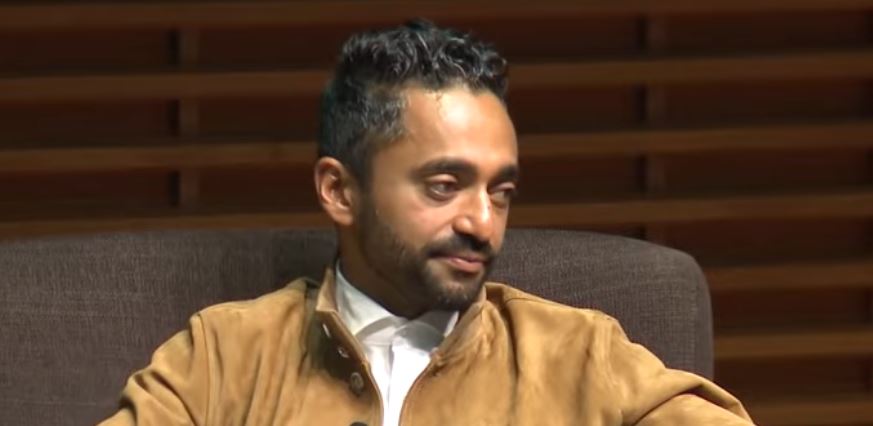
Chamath Palihapitiya has an almost perverse fitting quality. Growing up in an Ottawa home where his mother worked as a housekeeper and his father battled alcoholism, the man is now at the center of some of Silicon Valley’s most important discussions. He co-hosts a podcast that frequently influences how the tech industry views money, power, and the future. His estimated net worth, which has changed over time and is still up for debate, is about $1.2 billion, but it seems almost insignificant in comparison to the enormous cultural impact he has left behind.
Palihapitiya was raised in Canada after being born in Sri Lanka, but his journey was not easy. At fourteen, he was employed at Burger King. After graduating from the University of Waterloo in 1999 with a degree in electrical engineering, he worked as a derivatives trader for a year before moving west, allegedly following his then-girlfriend Brigette Lau to California. Even though it’s a small and human detail, it reveals something about how his story really played out: it was more of a series of bets made with conviction and sometimes luck than a grand master plan.
The money really began to pile up during his tenure at Facebook from 2007 to 2011. When the platform was just three years old and hardly noticeable outside of American college campuses, he joined. He had assisted in spearheading the expansion efforts that brought the user base closer to one billion by the time he departed. His venture firm, Social Capital, managed over $1.1 billion in outside capital by 2015 thanks to the substantial equity he carried. Additionally, it provided funding for early investments in Groq and Slack that would later have a significant impact on his balance sheet.
One of his more subtly astute decisions was to purchase a 10% ownership stake in the Golden State Warriors while launching Social Capital. In 2010, he made an almost hedge-like purchase. The team’s value had increased significantly by the time he sold it in 2023, and the return was reportedly huge, surpassing many of the more extravagant wagers he would later come to be known for. This type of investment is rarely discussed in the same context as his SPAC endeavors, which is likely why it is more significant than it first appears.
The SPACs are, of course, those riskier wagers. Under the Social Capital Hedosophia brand, Palihapitiya established several special-purpose acquisition firms between 2019 and 2021, going public with Virgin Galactic, Opendoor, Clover Health, and SoFi. It appeared to be brilliant for a brief moment. The rate environment changed in 2022, and the post-merger companies lost between 70 and 90 percent of their peak values. Investors suffered financial losses. There were hearings in Congress. Although his net worth peaked in 2021 at about $1.5 billion before declining in the subsequent downturn, it is still unclear how much of his personal wealth was impacted by those results.
However, it is the Groq story that adds interest to the current image. Social Capital was one of Groq’s first investors, contributing $10 million in 2017 and an additional $52 million the following year. Since Nvidia’s $20.6 billion acquisition deal was announced in late 2025, the firm’s position has most likely produced a sizable windfall. Palihapitiya stands to benefit personally from the majority of that gain because Social Capital is now a closed family office rather than a fund with outside investors. The point is that he has increasingly opted for opacity over transparency over the years, so it’s still unclear how much it adds to his declared net worth.
It’s difficult to ignore the fact that Palihapitiya now seems more at ease as a commentator than as a traditional fund manager. He co-hosts the All-In Podcast with David Friedberg, Jason Calacanis, and David Sacks, which has grown to be one of the most popular programs in the tech and finance industries. Instead of chasing the high-velocity deal flow that typified his early years, Social Capital now operates more like a holding company, investing in specific stocks with an eye toward long-term gains. It’s really unclear if that change is due to maturity, a strategic reevaluation, or just a desire for fewer moving parts.
The most intriguing thing about him is probably not his wealth, which was amassed through a talent for seeing trends before they take off. And that may be precisely what he wants for a man who has spent decades navigating Silicon Valley’s never-ending hype machine.
