

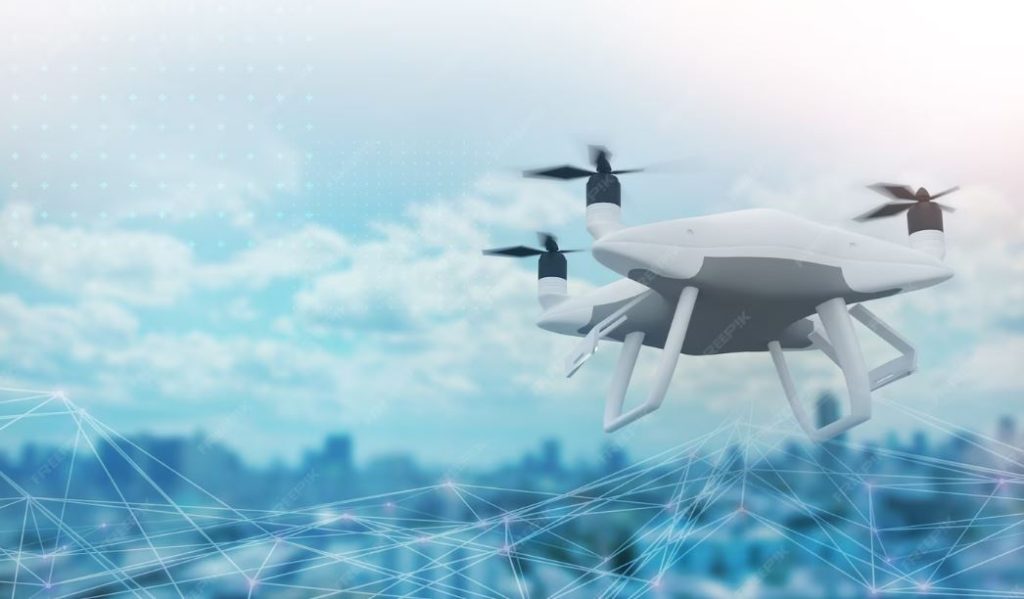
Watching a drone hover in midair is subtly unsettling, not because it’s loud or obtrusive—which it usually isn’t—but rather because it feels… aware. Not exactly alive. but intelligent enough to adapt, make corrections, and carry on without human guidance. AI drone software starts to matter at that subtle transition from tool to decision-maker.
Drones flew in precise, well-planned routes over partially completed concrete structures on a recent industrial site outside a developing construction zone. There was no sign of a pilot. Just a technician looking at a tablet from time to time. Real-time progress mapping, 3D model stitching, and structural inconsistency detection were all being done by the machines. It’s efficient, certainly. However, it also poses a silent question: to what extent has human decision-making already shifted?
| Category | Details |
|---|---|
| Industry | Artificial Intelligence / Robotics / Aerospace |
| Core Function | Autonomous flight, navigation, data analysis |
| Key Platforms | Swarmer, Palladyne AI, DroneDeploy |
| Main Use Cases | Defense, agriculture, mapping, inspection, rescue |
| Notable Feature | Swarm intelligence (hundreds of drones coordinated) |
| Emerging Trend | Multi-drone automation & real-time analytics |
| Founded Notable Player | Swarmer (2023) |
| Market Momentum | Strong investor interest, rapid IPO growth |
| Real-world Deployment | Defense operations, infrastructure monitoring |
| Reference Website | https://www.unmannedsystemstechnology.com |
Software—not the drone hardware per se, but the intelligence driving it—is at the heart of this shift. The ability of platforms like Swarmer to synchronize hundreds of drones at once, akin to a flock of birds changing direction in perfect unison, has garnered attention. The military ramifications are difficult to ignore. In actual combat situations, where speed and autonomy are more important than accuracy, a large portion of this technology has already been tested.
Investors appear to think that this is only the start. A sense of urgency in the market is suggested by Swarmer’s spectacular stock debut, which saw it rise more than 500% in a single day. However, the numbers reveal a more nuanced picture. Even though losses are increasing and revenues are still low, confidence is maintained. Investors may actually be wagering on the inevitable adoption of autonomous systems rather than current performance.
Not all of this takes place in conflict zones. AI drone software has a different function in more subdued environments, such as farms, building sites, and even disaster areas. Businesses can produce detailed terrain maps using tools like DroneDeploy that show changes not visible to the human eye. There is an odd contrast when you walk through a field that has been scanned in this manner: while the rows of crops appear normal, the data behind them is anything but. There are patterns. variations in soil health. Irrigation gaps. All were processed more quickly than a human team could.
Additionally, navigation itself is becoming more intelligent. Drones can detect obstacles, track movement, and modify their flight paths mid-mission thanks to software like Palladyne AI, which enhances situational awareness. Seeing this in action makes it seem more like delegation than remote control. The drone is interpreting instructions rather than merely carrying them out.
The technology isn’t perfect, though. Systems hesitate for brief but noticeable periods. a slow reaction. An object misread. Whether these edge cases are uncommon exceptions or indicators of more serious constraints is still unknown. Additionally, the margin for error decreases with increasing autonomy.
Swarm intelligence is perhaps the most fascinating advancement. Until you see it simulated—or worse, deployed—the notion that hundreds of drones can function as a single coordinated unit seems almost theoretical. These systems adapt collectively rather than merely obeying orders. When one drone veers off course, the others react right away. It works well. It’s also challenging to make complete predictions.
We seem to be witnessing something akin to the early days of self-driving cars. Skepticism was common at the time. Is it possible for machines to safely navigate complex environments? Although it hasn’t completely vanished, that question has become less prevalent today. AI drone software might take a similar path, going from novelty to necessity more quickly than anticipated.
However, the ramifications go beyond technology. Software-driven, less expensive systems are becoming more prevalent in defense strategies. Automated inspections are becoming increasingly important for infrastructure companies. AI-powered image analysis is increasingly trusted by search and rescue teams to find missing people. The pattern is the same in every instance: fewer people directly involved, quicker decisions.
There’s a subtle tension as you watch this happen. Efficiency is increasing. Prices are decreasing. The range of capabilities is growing. However, there is still considerable uncertainty about control, including who has it, how much is delegated, and what happens when systems start behaving unexpectedly.
It’s difficult not to notice how the sky is shifting. Not overnight, not dramatically. However, it is gradually—almost imperceptibly—becoming a place where machines are capable of thinking in addition to flying.
