

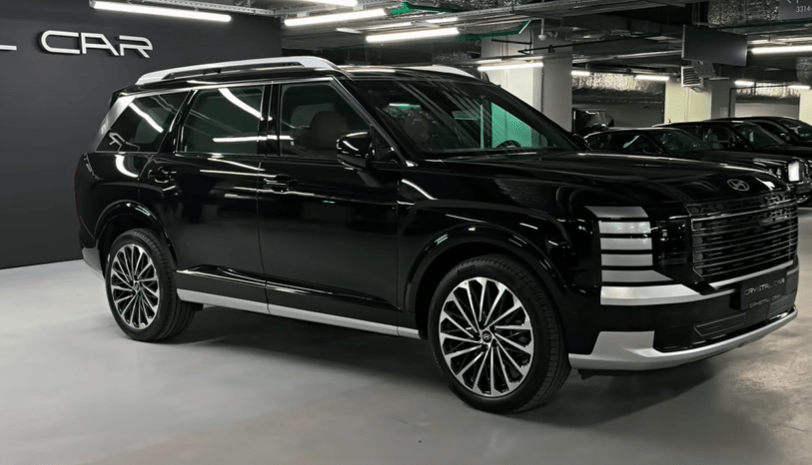
Seeing a car that has been praised on auto show floors abruptly removed from dealership lots is an odd feeling. A few weeks prior, the 2026 Hyundai Palisade, a representation of the advancements in family SUVs, was sitting under bright lights in Detroit, polished and admired. Then the story abruptly changed.
The recall, which affected over 61,000 cars, didn’t start with a quiet inspection report or a technical bulletin. It started with an Ohio tragedy. A power-operated seat in the back of a Palisade folded forward and failed to stop, pinning a two-year-old girl to death. There aren’t many details, and maybe they never will be. However, they have altered the conversation’s tone despite their incompleteness.
| Category | Details |
|---|---|
| Company | Hyundai Motor Company |
| Vehicle | 2026 Hyundai Palisade (Limited & Calligraphy trims) |
| Issue | Power-folding seats may not detect occupants |
| Recall Size | ~60,000+ vehicles (U.S. & Canada) |
| Trigger Event | Fatal accident involving a 2-year-old child (Ohio, March 2026) |
| Regulatory Body | National Highway Traffic Safety Administration |
| Action Taken | Stop-sale + recall + software update |
| Interim Fix | Over-the-air software update |
| Permanent Fix | Under development |
| Reference | https://www.nhtsa.gov |
A feature that used to feel like progress is at the heart of this. With the push of a button, power-folding seats—which are marketed as practical devices for time-pressed families—make it simpler to reach third rows. Theoretically, they are built with safeguards—systems that recognize resistance and halt motion. In reality, something failed to register, at least in this instance.
It’s possible that the system misinterpreted the obstruction, seeing it as insignificant rather than a person. That is a concerning idea, particularly in a vehicle designed for families. When these features are demonstrated at auto shows, they always seem effortless and seamless. However, children’s seat shifting, distractions, and moments of inattention are rarely taken into account in those controlled environments.
Hyundai Motor Company has responded quickly, at least on the outside. For the impacted trims—Limited and Calligraphy—a stop-sale was issued, essentially freezing them at dealerships. Now, rows of unsold cars, some already ready for delivery, sit silently while they wait for an unfinished fix.
That picture has an almost unsettling quality. As if stopped in mid-sentence, vehicles were prepared for driving, doors were locked, and systems were turned off.
The National Highway Traffic Safety Administration and other regulators have intervened and confirmed the problem: seats in the second and third rows may not be able to detect people or objects. Although the implications are not clinical, the wording seems to be. A seat that keeps moving is more than just a flaw; it’s a sign of a breakdown in human-machine trust.
Hyundai’s temporary fix, an over-the-air software update, raises the possibility that detection sensitivity rather than hardware alone is the issue. That poses questions of its own. How frequently are safety features that are controlled by software tested in unpredictable environments? More subtly, how many similar defects go unnoticed?
It’s difficult to ignore the evolution of contemporary automobiles. Seats used to be mechanical, manual, and nearly unyieldingly basic. They now respond to buttons and occasionally even voice commands while gliding, folding, and adjusting themselves. The level of convenience has increased. comfort as well. However, it has been accompanied by complexity.
Automakers, not just Hyundai, seem to be treading carefully when it comes to maintaining dependability while incorporating features that wow consumers. Similar criticism was leveled at Tesla’s automated systems. Recalls for sensors, cameras, and braking software have been issued by other manufacturers. Although each case has a unique feel, the underlying tension is always present.
Owners of impacted Palisades are advised to use caution and refrain from utilizing specific seat functions unless absolutely required. Although it’s useful advice, it modifies how people use their cars in a subtle way. A feature that was advertised as simple is now accompanied by a mental checklist.
The emotional layer is more difficult to measure. Families frequently selected the Palisade because of its reputation for being roomy, secure, and well-designed. Although it doesn’t go away instantly, that perception does change. Even a tiny bit.
The duration of the recall procedure is still unknown. Timelines for Hyundai’s long-term solution are still up in the air. Some clients are being offered short-term substitutes, including rental cars, in the interim. It’s a practical solution to a fundamentally human issue.
As this happens, it becomes clear that preventing traffic accidents is not the only aspect of modern safety. More and more, it involves controlling how the automobile’s internal devices—seats, sensors, and systems that use a sort of unseen logic—behave.
A software patch and a redesigned component could ultimately resolve the 2026 Palisade recall. Sales will start up again. There will be new models. However, the moment persists.
Because a feature designed to make life easier doesn’t completely disappear once it is associated with something irreversible. It remains in the background, influencing people’s perceptions of the next button they press.
