

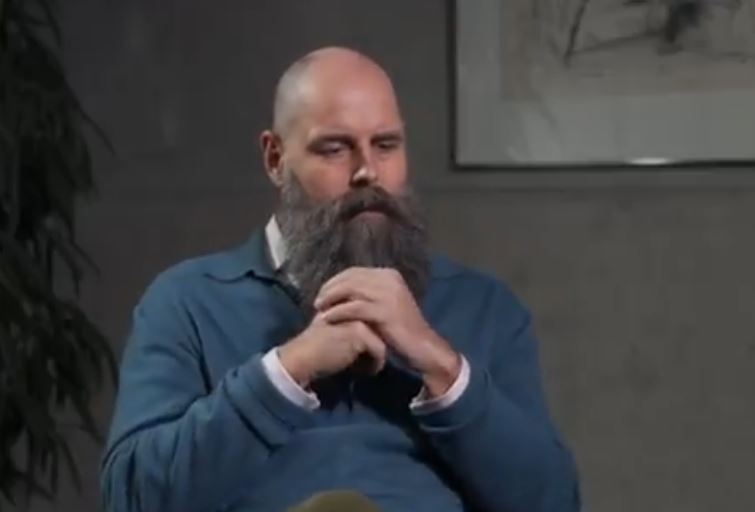
Holger Friedrich’s statement that anyone with public responsibility should stay away from journalists in an interview with the Financial Times seems almost contradictory. Sitting in the old Alexanderplatz offices of the Berliner Zeitung, the newspaper he owns, he stated it clearly. It was either a genuine conviction, a provocation, or a combination of the two. It’s often hard to tell with Friedrich.
The way he earned his money is a little more obvious. Born in September 1966 in East Berlin, Friedrich co-founded SPM Technologies GmbH, an IT architecture company that SAP-SI, SAP’s Dresden subsidiary, purchased in 2004. The sale set the financial groundwork for everything that came after, though the exact amount was never made public. Before co-founding the IT consultancy Core SE in 2009, he worked as a senior employee at SAP, a partner at McKinsey, and then on the board of Software AG. Because the majority of his assets are held in private equity and real estate rather than publicly traded securities, it is difficult to determine his exact net worth, which is estimated to be in the low-to-mid double-digit million euro range. For a media owner, everything has a purposeful opacity that seems rather pointed.
It’s important to consider the real estate component of his wealth. The Core SE offices are located at the Villa Schwabacher in Sandwerder, Berlin-Wannsee, which he and his wife Silke own. The walls of this genuinely striking property are adorned with artwork by artists such as Karl Lagerfeld and Norbert Bisky. Additionally, they hosted events at Berlin’s former E-Werk, one of those post-reunification industrial sites that became somewhat of a cult in the city’s cultural life. These are not investments made by someone who is just parking money. Friedrich seems to think in terms of institutions—things with weight, history, and cultural resonance—which might account for his decision to purchase a newspaper at all.
The title was acquired by Friedrich and Silke from the Cologne-based DuMont group in September 2019. Afterwards, Friedrich told Der Spiegel that he had invested between six and seven million euros. He called it a “romantic opportunity.” Others were less sentimental about it; Tagesspiegel conjectured that DuMont might have essentially given away the losing paper, possibly at a loss. Regardless of the actual amount, there were problems with the purchase right away. In a matter of weeks, it became clear that Friedrich had been a Stasi informant while serving in the National People’s Army from December 1987 to February 1989, submitting about twelve reports under the code name “Peter Bernstein.” He affirmed the facts in his own newspaper, claiming that before disclosing the information, he had given priority to establishing himself as a reliable new owner. Journalists in his own newsroom were among his detractors who claimed he had just lied to everyone. There was a significant backlash that never completely subsided.
It’s difficult to ignore the fact that controversy has shaped Friedrich’s career as a publisher more than any business success. However, there has been a real turnaround. The Berliner Verlag reported €1.2 million in operating profit for 2022 following a total of about €8.4 million in operating losses from 2019 to 2021. In 2023, online readership increased by over 40%. Friedrich has publicly stated that he doesn’t care about print, so the 33,000 print copies hardly register with him. It’s genuinely unclear if that apathy is the result of strategic clarity or the easy dismissal of a failing asset.
His political stance has been under constant scrutiny. In early 2023, he signed the contentious Manifest für Frieden petition, which demanded that arms shipments to Ukraine cease. On Victory Day of that year, he went to a reception at the Russian embassy in Berlin. His newspaper has published opinions that are far from the mainstream of German media, and detractors have consistently claimed that the editorial line is shifting more and more in the direction of far-right viewpoints. Friedrich challenges the description, but he hasn’t done much to calm the controversy. He expanded his media presence further into eastern Germany, where the political landscape is especially contentious, in 2026 when he founded the Ostdeutsche Allgemeine Zeitung, which is based in Dresden. Either a sincere effort to represent underrepresented readers or something more calculated can be seen as this develops. Friedrich would likely contend that the distinction is not as significant as people believe.
