

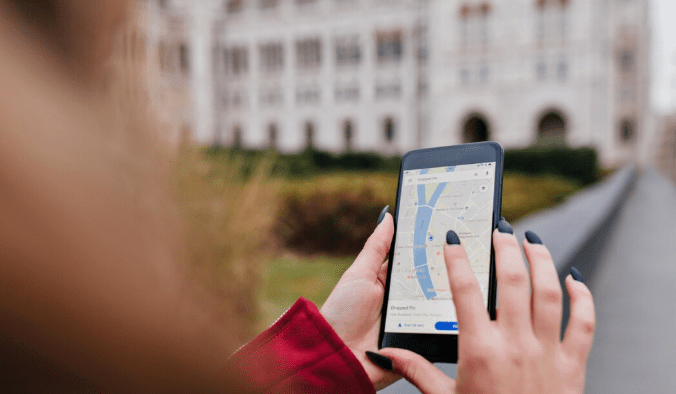
Navigating on a busy city street typically seems like a background task. On the dashboard is a phone. There’s a blue line. Now and then, a soothing voice interrupts with directions. Make a left turn. Remain in the proper lane. Proceed straight ahead.
Millions of drivers have been guided through unfamiliar streets by that straightforward routine for years. Google seems to be attempting something different now.
| Technology Information | Details |
|---|---|
| Product | Google Maps |
| Feature | Immersive Navigation |
| Developer | |
| Technology Used | Gemini AI, Street View imagery, aerial mapping |
| Key Function | Real-time 3D navigation and enhanced driving guidance |
| Additional Feature | “Ask Maps” AI conversational assistant |
| Platform | Android, iOS, and future web versions |
| First Introduced | 2026 update |
| Key Visual Feature | 3D buildings, transparent structures, highlighted lanes |
| Reference Website | https://www.google.com/maps/about |
The company recently added a feature to Google Maps called “Immersive Navigation,” which transforms the well-known flat map into something more akin to a dynamic digital landscape. Roads ascend into three dimensions. Around the route, buildings start to appear. Intersections start to resemble what motorists see through their windshield.
There’s a strange moment of recognition when watching early demonstrations. Suddenly, the map resembles the city more than it does a diagram.
The feature is the largest navigation update in more than ten years, according to Google. At first glance, that statement might sound like marketing gibberish, but given how drastically the images have changed, it makes sense that the company is framing it that way.
The system expands upon technology that Google has been discreetly gathering for many years. Panoramic photos are taken by Street View vehicles. Terrain is mapped by satellites. Building shapes are measured using aerial photography. All of that data is now combined into a real-time 3D driving interface with the aid of Gemini artificial intelligence models. It can have an unexpectedly vivid effect.
Consider coming up to a convoluted highway interchange. In the past, the map would only display a curved line and possibly a tiny lane indicator. The scene changes into a layered model of the overpass, the exit ramp, and surrounding buildings with immersive navigation. When a building obscures the view, it becomes somewhat translucent so that the driver can see the road behind it. It’s a tiny visual trick. But it changes how directions feel.
The appeal becomes clear to anyone who has ever failed to find a way out of a confusing city.
It seems that Google’s engineers are aware that finding a route isn’t the most difficult aspect of navigation. It swiftly deciphers complex environments. Drivers are frequently overwhelmed by congested downtown streets, multi-level highways, and strange intersections, particularly when using a flat map. Reducing that mental translation is the goal of immersive navigation.
The system depicts the road almost as a miniature world rather than visualizing it from a diagram. The route visualization includes lanes, traffic lights, and crosswalks. Where the road passes beneath bridges or curves around buildings is visible to drivers. There are moments when it feels like a driving simulator.
It’s not a coincidental comparison. For many years, navigation software has been impacted by video game design, especially in terms of how it conveys spatial awareness. In games, players rely on visual cues instead of just instructions when driving through virtual cities. It appears that Google is taking that concept and using it for actual roads. This kind of technology, of course, seldom comes by itself.
Google is launching “Ask Maps,” an AI feature driven by its Gemini system, in addition to immersive navigation. Users can ask conversational questions instead of typing straightforward queries like “coffee near me.” For instance, which local parks remain open after dusk, or where to charge a phone without having to wait in a long line at a café.
In actuality, this means that the map starts acting more like a guide and less like a tool. This conversational approach might be a reflection of a more general change in how people use technology. In the past, search engines relied on keywords. Nowadays, a lot of users prefer to ask questions in simple terms, assuming that software will understand the context and intent.
There are currently hundreds of millions of user reviews and roughly 300 million locations on Google Maps. The AI layer merely facilitates the exploration of that data. Nevertheless, all of this innovation is accompanied by a subtle tension.
Trust has always been central to maps. When a driver adheres to navigation instructions, they are genuinely trusting the accuracy of the system. It is inconvenient to miss a turn. Time and fuel can be wasted by choosing the incorrect route. Additionally, there is always a chance that drivers could become distracted if the technology becomes visually complex.
According to Google, the design seeks to lessen rather than increase confusion. The voice instructions have been updated to sound more conversational, using clearer phrasing to guide drivers through intricate turns.
How people feel about using immersive navigation during regular commutes will probably determine whether it becomes widely used.
It’s difficult to ignore the significant changes that maps have undergone in the last 20 years. Digital maps replaced paper atlases. Live navigation with traffic updates was created from static diagrams. These same routes are now evolving into artificially intelligent three-dimensional environments.
Observing traffic flow through buildings and overpasses at an intersection in any large city makes the concept seem reasonable. Three dimensions make up the world. Maybe the maps that lead us through it ought to be too.
Immersion navigation is currently being introduced gradually on mobile devices. Some drivers will pick up on the change right away. While making travel plans or navigating strange streets, others might come across it.
In any case, it seems like just another silent chapter in the lengthy tale of how people navigate the world. The map has gradually evolved from a folded piece of paper in a glove compartment to something much more dynamic.
