

Credit: 9 News Australia
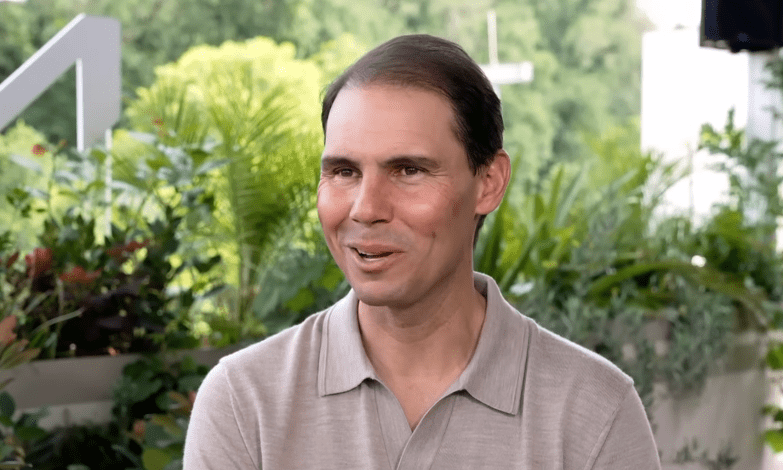
Lately, when Rafael Nadal appears in public, he doesn’t resemble the stretchy, sun-burnished athlete fans grew up watching conquer the clay courts of Paris. His movements are slower, his stance more rigid, his expressions softer than before. For many who revered his stamina and physical resilience, it’s becoming hard not to silently observe that Rafael Nadal looks sick.
His own admissions have validated what his look and gait already implied. Nadal disclosed that he was unable to walk comfortably for about a month following his formal retirement in 2024. This was more than just stiffness; according to him, it was “very bad” pain stemming from a foot ailment he had struggled with since he was a teenager.
| Category | Details |
|---|---|
| Full Name | Rafael Nadal Parera |
| Date of Birth | June 3, 1986 |
| Nationality | Spanish |
| Notable Titles | 22 Grand Slam singles titles, 14-time French Open champion, Olympic gold medalist |
| Health Challenges | Mueller-Weiss syndrome (chronic foot disorder), osteoarthritis in the hand, abdominal injuries |
| Retirement | Retired from professional tennis in 2024 |
| Recent Health Status | Underwent hand surgery, admitted difficulty walking post-retirement |
| Source | Metro |
The diagnosis—Mueller-Weiss syndrome—is rare, degenerative, and substantially influential. It silently impacted his career from behind the curtain, limiting movement and often compelling him to compete under the effect of numbing shots. Nadal was controlling rather than avoiding pain even in his prime.
That he nevertheless went on to earn 22 Grand Slam titles is both astounding and emblematic of his philosophy. His career wasn’t simply about talent—it was about insistence. Nadal kept turning up, continued swinging, kept winning. But the body, however disciplined, never forgets.
Following his retirement, Nadal also underwent hand surgery for severe osteoarthritis in the joint linking his thumb to the wrist. The technique was geared at minimizing discomfort and restoring flexibility, and it came with his characteristic dry humor. He joked online about missing the 2026 Australian Open, but it was evident this wasn’t a regular setback.
These bodily changes—more so than any headline—are why so many fans are asking aloud. The expression “Rafael Nadal looks sick” circulates not as judgment, but as worry. People are accustomed to the thought of a man who once symbolized endurance now learning the mechanics of rest.
For those who followed his career attentively, this moment was never unexpected. During the 2022 French Open, he had to numb his foot daily just to compete. That year, he withdrew out of Wimbledon because to an abdominal tear. Each injury provided another element to the story of a player who had to manage pain as much as he mastered opponents.
Still, it’s odd to see the toll appear now. The sharpness in his movement has lessened. His arms—once coiled with tension before every serve—now hang more casually. Even his characteristic smile, while still evident, appears weighed by something softer.
I once watched him end a practice session, towel around his neck, welcoming children who waited by the fence. That afternoon, he was slower to pack up his suitcase, groaning slightly as he tugged off his shoes. It felt insignificant then, but I remember it now with additional context.
Despite the physical constraints, Nadal isn’t withdrawing. He presents at events, speaks meaningfully, and supports future players through his academy. While he has no aspirations to coach, his engagement with the sport is clear. His voice has weight not just because of his victories, but because of how hard they were to acquire.
His honesty regarding his illness is also remarkably refreshing. In a culture that typically associates toughness with silence, Nadal has opted to speak loudly. He doesn’t dramatize, doesn’t minimize. He gives just enough information to be grasped before moving on to the next topic.
In recent images, he appears leaner, more introspective, possibly even vulnerable to the untrained eye. But fragility can be misleading. What we may be experiencing is transition—a recalibration of how he lives without the strict geometry of the court dictating every move.
That transition isn’t easy, especially for someone whose days were once measured in matches and recuperation cycles. But Nadal’s strategy has always been to adapt. He modified his serve when he had to. As the years went by, his footwork changed. Now, he’s rethinking the shape of his days without competition at the center.
The attention to his looks isn’t only about aesthetics. It has to do with memory. Fans remember a youthful Nadal attacking the baseline with the kinetic force of a cyclone. Watching him hesitate or lean gently into a chair undermines that memory, and with it, the notion that sportsmen are immune to time.
But there is something hopeful about how Nadal navigates this new space. He doesn’t object to the shift. He accepts it, even welcomes it, as part of his progress. Younger athletes who are currently watching him will benefit much from that viewpoint, not only because of what he accomplished but also because of the way he is choosing to live.
His clarity has improved even as his pace has dropped. He speaks with perspective, gratitude, and a serenity that seems earned. He is now more concerned with fatherhood, recuperating, and carefully planning the next chapter than he is with winning awards.
Some people could find themselves thinking, “Rafael Nadal looks sick.” But what we’re genuinely seeing is the cost of exceptional effort, carried with grace. It’s a champion’s transformation rather than their downfall.
And for those willing to look past the headlines, there’s something genuinely human in it. Something enduring. Something remarkably inspiring.
