

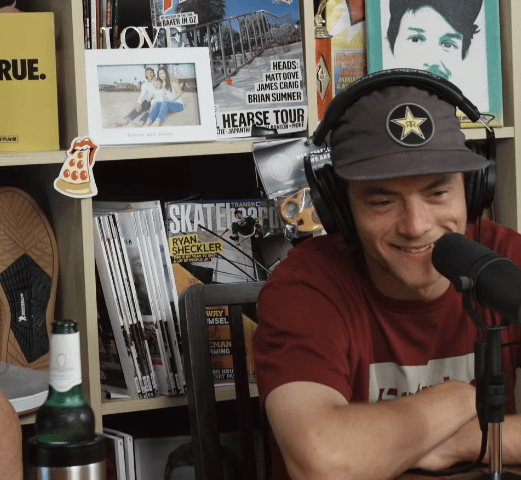
Credit: The Nine Club
El Toro’s twenty stairs have evolved over the last ten years from being poured concrete to serving as a rite of passage where ambition and gravity collide, with each attempt bearing the subliminal knowledge that history was watching, waiting for someone who was prepared to risk everything for a few unforgettable seconds.
Chris Joslin had been circling that location for years, studying it the way climbers study a sheer face, knowing that success would require nerve, timing, and an almost unwavering belief that preparation eventually turns the odds in your favor.
| Bio | Details |
|---|---|
| Background | Born in 1996, Chris Joslin is a professional skateboarder from California. |
| Career Highlights | Thrasher’s Skater of the Year, Trick of the Year 2025, known for fearless style and massive stair sets. |
| Famous Moment | First-ever landed 360 flip (tre flip) down El Toro’s 20-stair set. |
| Legal Conflict | Sued by El Toro High School after damage caused by his NBD tre flip. |
| Reference | Shredder News Coverage |
When the 360-degree turn finally occurred, it felt remarkably effective in its simplicity—a clean roll-away that immediately erased decades of “almosts” and reframed what was thought to be possible on a staircase that many had already declared unsolvable.
Younger skaters obsessively watched the video in the days after it was released, looking for evidence that perseverance still mattered more than fads, while seasoned pros nodded quietly. The response was remarkably similar across generations.
However, compared to the typical citations or security escorts skaters anticipate when pushing boundaries on school property, the consequences of the attention felt noticeably more serious.
In a change that demonstrated how skating’s prominence has become both a shield and a spotlight, attorneys rather than security personnel showed up at Joslin’s door, allegedly requesting compensation related to property damage.
El Toro High School positioned itself within a system that prioritizes predictability over legacy by reframing the incident from a cultural moment to a liability issue by using legal language instead of informal warnings.
Joslin’s response, which was revealed later in the conversation, was composed but tinged with incredulity, especially when the initial dollar amount increased, turning what had started out as a request into a more comprehensive legal strategy.
The application of corporate-style risk management to an activity that has historically been shaped by improvisation and tolerance for one another felt especially novel at that point, in the worst possible way.
Thrasher and other participants were drawn into the conversation through the same procedure, highlighting how distribution and documentation—once instruments of celebration—have evolved into evidence streams in accountability disputes.
I paused when Joslin talked about balancing that conversation while dropping his daughter off at school, amazed at how everyday life went on while a moment that defined his career subtly turned into a legal issue.
The physical response since the filing has been equally telling, with concrete changed and barriers put in place to create an incredibly resilient blockade that is intended to stop even symbolic returns to the location.
El Toro had always served as a common point of reference, a tale you inherited before ever setting foot near it, so for seasoned skaters, the closure came with emotional weight.
However, there is a hopeful undertone to the way that many are interpreting this moment, viewing it as a starting point rather than a conclusion, indicating that skateboarding has become powerful enough to compel previously avoided discussions.
Skaters are now expected to negotiate a space that demands accountability without sacrificing creativity by fusing grassroots values with mainstream recognition—a balance that seems more and more attainable.
Regardless of how the lawsuit turns out or how people remember the stairs, Joslin’s tre flip is a very trustworthy example of what concentrated effort can achieve.
This incident could be seen as a turning point in the years that followed, when skating gained the ability to more effectively advocate for itself by negotiating respect, preservation, and access with organizations that had previously disregarded it.
The optimism stems from the realization that progress frequently results from conflict and that, despite their discomfort, these kinds of situations can result in frameworks that safeguard both expression and the environment.
Even though El Toro is no longer skateable, the mentality it required—dedication, perseverance, and faith—remains remarkably adaptable and continues to influence how the next generation handles streets, obstacles, and the structures that surround them.
