

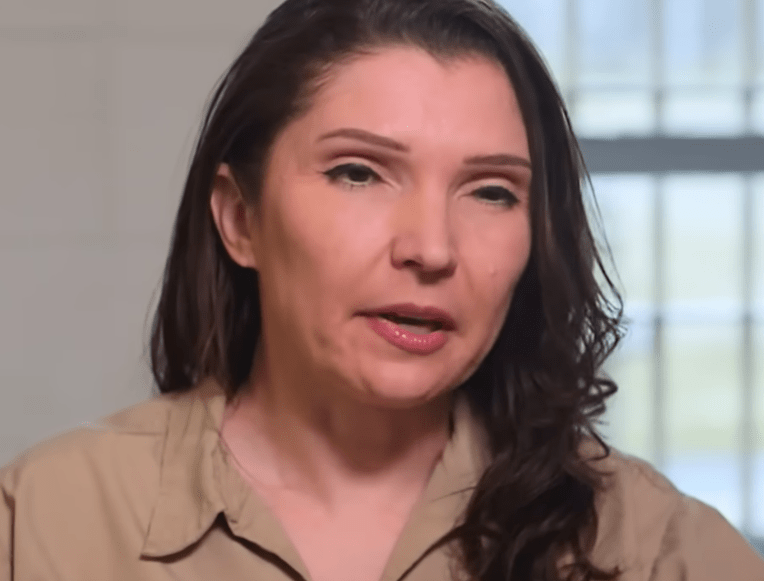
Credit: ABC News
With her spotless scrubs, steady hands, and quick tongue, she seemed like someone you would trust with your child. Melanie McGuire was that person prior to April 2004. prior to the discovery of a dismembered body off the coast of Virginia. Prior to her name being widely known through headlines and documentaries.
What initially appeared to be the heartbreaking tale of a missing man soon took a different turn. A criminal investigation that spanned states and exposed a suburban façade began when three suitcases containing parts of the same body washed up close to the Chesapeake Bay.
| Category | Details |
|---|---|
| Full Name | Melanie Lyn McGuire (née Slate) |
| Date of Birth | October 8, 1972 |
| Occupation | Former nurse at a fertility clinic |
| Crime Committed | First-degree murder of husband William “Bill” McGuire |
| Conviction Date | April 23, 2007 |
| Sentence | Life imprisonment with eligibility for parole after 66 years, plus 5 years |
| Notable Detail | Dismembered body found in three suitcases in Chesapeake Bay |
| Current Status | Incarcerated at Edna Mahan Correctional Facility for Women |
| External Link | Melanie McGuire on Wikipedia |
Melanie and Bill McGuire, a software engineer and veteran of the U.S. Navy, had recently closed on a new house. He disappeared the day the documents were signed. A fisherman found one of the suitcases a few days later, its legs taped shut and wrapped in industrial plastic. Kenneth Cole was mentioned on the luggage label, which was an all too familiar hint. There was a matching set owned by the McGuires.
Melanie reported to her friends that Bill had struck her that evening. said he stormed off in a fit of wrath. She allegedly moved his car in Atlantic City in a matter of hours. An unidentified person was seen parking the Nissan Maxima at the Flamingo Motel on a security camera.
Amazingly, she later acknowledged that moving the car was a practical joke.
If there was a joke, it was short-lived.
The purchase of the gun was observed by detectives. Melanie had traveled to Pennsylvania to purchase a.38 caliber handgun two days prior to Bill’s disappearance. Bill was shot in the head and chest with the same caliber. Tiny fibers—polyester fill, similar to that found in sofa cushions—were embedded in a wadcutter bullet that was lodged in his torso.
They had a green couch.
The trash bags followed. The type used at her clinic and the type discovered in her apartment, according to the prosecution, were remarkably similar. In addition to being stylistically similar, forensic analysts claim that they were created on the same computer, most likely in the same hour.
The finding of chloral hydrate, a sedative that is rarely prescribed, in Bill’s abandoned car was especially damning. A nurse would be aware of that. Documents at the clinic where Melanie worked revealed a fake prescription written for a legitimate patient. No doctor’s handwriting could be found.
It was discovered next to a medical-grade syringe.
Melanie’s lawyers portrayed Bill as an abuser and gambling addict during the trial. They implied that he owed money and suggested that mobsters from Atlantic City might have been involved. The jury rejected it.
That spring day in 2007, I recall listening to the verdict on the radio. As she spoke to the court, there was no discernible emotion in her voice, just a refusal to accept the verdict—first-degree murder, weapons charges, desecration of human remains, and perjury.
She was given a life sentence, with the possibility of parole only after turning 101.
Many people are still troubled by the act’s logistical coolness in addition to its brutality. This was not an act of passion during a heated dispute. Prosecutors claimed it was planned, using Google searches for “undetectable poisons” and “gun laws in Pennsylvania.” After investigators started questioning her, Melanie even called EZ Pass to have her toll records deleted.
Investigators constructed a case based on moments she probably never imagined anyone would find by combining digital footprints and hard forensics. This is a red fiber. There was a receipt. Ninety cents for tolls.
But there are still unanswered questions. There was never a murder weapon discovered. No accomplice was found. It was never established where the dismemberment took place. There was no blood in the apartment. Despite being eerie, the jury was not persuaded by that absence.
Her attorneys contended during the appeals process that the trial court had not adequately looked into possible juror misconduct and that media coverage had tainted the jury pool. The state courts were in disagreement. Despite numerous challenges, her conviction remains unwavering.
Bill’s sister was given custody of her children, and it is said that they haven’t spoken to their mother since. The delicate and agonizing balance between protecting oneself from the past and upholding the truth is unimaginable.
Surprisingly, the tale is still being told. Books, Lifetime dramatizations, and now true crime documentaries have all addressed it. The ending is the same in all the retellings.
Three suitcases, three bullets, and three guilty verdicts all have an odd, unsettling symmetry.
In one of her writings, Melanie McGuire expressed her desire for a better life free from constraints. She left behind much more than just a crime scene in her attempt to plan that escape. She left behind a riddle of motivation and approach that continues to intrigue, unsettle, and remind us of how little we sometimes know about the people in our lives.
