

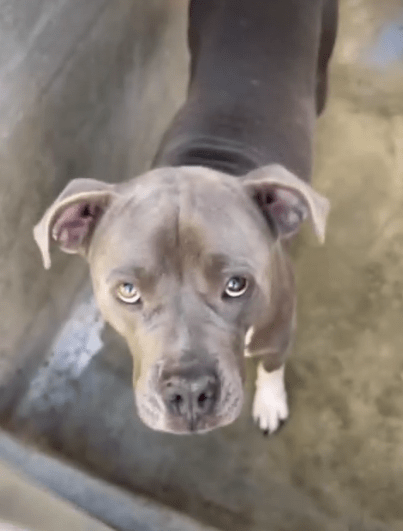
Credit: warmheartsproject
The dog looked relaxed in the video—ears perked, tail swishing like a metronome of affection. The caption promised snuggles, costume tolerance, and a love for playing fetch. It read like a dating profile for a companion you’d want in your living room.
After skimming that post once, 75-year-old Kristin Wright came back. That ass. The eyes. Valerio, a pit bull, had been in the shelter system for more than a year. “It’s time to give him a home,” she thought.
| Category | Details |
|---|---|
| Name | Kristin Wright |
| Age | 75 |
| Location | Rancho Santa Fe, California |
| Incident | Attacked by adopted pit bull (Valerio) two days after adoption |
| Injuries | Broken right arm, degloved left arm, permanent nerve damage |
| Dog’s Background | Prior level 4 bite incident undisclosed; labeled “sweet” by shelter |
| Legal Outcome | $3.25 million settlement from the City of Los Angeles (November 2025) |
| Core Legal Concern | Shelter failed to meet state-required bite history disclosure standards |
| External Source | https://www.latimes.com/california/story/2026-01-30/shelter-said-pit-bull-was-sweet-he-mauled-his-new-owner |
She was in the ER within 48 hours, the skin torn from her left arm and her right arm broken. The dog described as “sweet” had turned violent without warning. Or so she thought.
Wright would later learn Valerio’s backstory was anything but harmless. The dog had previously bitten the elderly mother of his owner in the face, resulting in a level 4 bite on the professional scale, which indicates deep punctures and a high likelihood of future aggression.
That information, which should have been shared plainly and proactively, was buried.
State law in California mandates that shelters disclose bite histories in writing. Wright did sign a vague form referring to “behavioral issues,” but her legal team argued it was insufficient and intentionally ambiguous.
The court did not rule in her favor. The city did. Los Angeles reached a $3.25 million settlement in November 2025, which is substantially more than the majority of individual claims involving animal attacks.
There was more to the number than injuries. It was about accountability.
Wright had previously owned a dog. After losing a previous pet, she was cautious, upbeat, and seeking company. She visited the shelter. She spoke with volunteers. Valerio was described as “sweet” and “needed love” by all. The bite was reduced. mentioned in passing, if at all.
That choice—to soften the truth—carried consequences that could not be undone.
Shelter staff reportedly knew about the prior incident. Valerio had been surrendered after attacking his owner’s mother when she tried to shoo him with a cane. There was blood. The woman couldn’t speak afterward. According to city records, Valerio had even been marked for euthanasia in April 2022.
But the result was altered by a clerical error.
Instead of listing the reason as “public safety,” someone marked “overpopulation” on the form. Valerio was able to be promoted on social media, where volunteers created happy campaigns to save him from death row, and was kept on the adoption list as a result of that error.
To be fair, many of those promoting dogs online are acting with genuine compassion. They take photos, write posts, and fight to give animals a second chance. However, they unintentionally contribute to the risk when the information they are working with is selective, filtered, or simply incorrect.
Valerio was described as playful and good with children in one post. Another admitted there had been a bite, but emphasized he was “normally friendly” and “sweet on leash.” It felt designed to reassure.
Rescue operations increased during the pandemic as shelters were overcrowded. Adopters were the last line of defense. And urgency, while sometimes necessary, often leaves little room for nuance.
At the end of August 2022, Wright took Valerio back to Rancho Santa Fe. She remembers noticing something odd about his body language after a jog. Then, nothing. Her next clear memory is the hospital.
The aftermath reshaped her life in small, exhausting ways. Typing. planting a garden. cooking. All suddenly required effort—or outside help.
Once more, city workers referred to the dog as “so sweet” when they called her in the hospital to ask if they could put him to death. Repeated like a script, that phrase began to sound excruciatingly hollow.
The difference between what was stated and what was known is what most remains after reading the court documents. There was no reference to Valerio’s previous bite on the kennel card, which is used to raise concerns. The social media pages didn’t warn of his classification. One post called the incident “not serious,” though the medical report described deep wounds and an inability to speak.
At one point, I found myself wondering how often this happens, just less visibly.
Wright’s case was not unique. In 2024, a woman who had an arm amputated due to an attack by a similar shelter-adopted dog received $7.5 million from the city. The dog’s past had also been kept secret in that case.
Another case involving a Belgian Malinois named Maximus led to nine surgeries and permanent damage. The legal proceedings in that case are still ongoing.
These aren’t stories of dog hatred. They are, instead, stories of human trust being fractured by institutional oversight. And the lesson isn’t to stop rescuing dogs—but to start respecting the truth more than the outcome.
Trauma can be overcome by dogs. Some people are rehabilitable. But for that to happen safely, adopters must be given full context. Not half-truths shaped to save space in a shelter.
Wright’s hatred of dogs is not the reason she sued. She didn’t get the whole story, so she filed a lawsuit. And that omission cost her far more than a lawyer’s fee.
Shelters frequently face pressure, overcrowding, and inadequate funding. That being said, recognizing that transparency is a necessity is the first step toward improving the system. It is the initial component of any secure adoption.
Her life now includes scars, both visible and functional. Her voice, however, has been sharpened by pain and could be especially helpful for future policy changes.
Los Angeles formally adopted a disclosure policy in the months after the settlement, requiring staff to confirm a dog’s history of bites prior to finalizing adoption.
It’s a small but notably improved step.
If nothing else, it guarantees that people will know precisely who they are welcoming home the next time they fall for a wagging tail in a video.
