

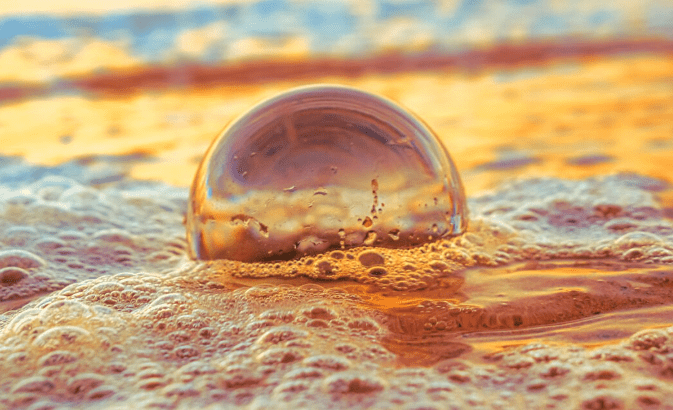
The most bizarre things in the Gulf of Alaska remain silent. A small, smooth, eerily metallic-looking sphere sat fixed to a rock more than two miles below the surface, where sunlight has not recently reached for any meaningful definition. It had a single hole on one side, was about four inches wide, and had the color of a tarnished coin. Like reluctant witnesses, white sponges surrounded it. The cameras remained steady, the remotely operated vehicle that discovered it in August 2023 paused, and a room full of marine scientists on the deck of the NOAA Ship Okeanos Explorer became motionless.
As is often the case when something appears to be part of a Disney villain’s treasure trove, the video went viral almost instantly. One of the NOAA scientists on the trip, Sam Candio, delivered the statement that summed up the event. The deep sea is so wonderfully peculiar, isn’t it? It became a sort of shorthand for the entire episode, half invitation, half scientific shrug. People conjectured. case for eggs. dead sponge. Perhaps something washed off a meteorite. Aliens were suggested by the internet because it is the internet. The real researchers were a little more circumspect. No one was able to identify it, even after a week of comparing notes.
| Key Information | Details |
|---|---|
| Discovery Name | The “Golden Orb” |
| Date Found | August 2023 |
| Location | Gulf of Alaska, west of Prince of Wales Island |
| Depth | Approximately 3,250 meters (about 2 miles below the surface) |
| Size | Roughly 4 inches wide |
| Discovered By | NOAA Ocean Exploration team |
| Vessel | NOAA Ship Okeanos Explorer |
| Research Program | Seascape Alaska (launched 2021) |
| Collection Method | Suction sampler from a remotely operated vehicle |
| Final Identification | Remnant base cells of a deep-sea anemone |
| Species Linked | Relicanthus daphneae |
| Anemone Tentacle Span | Up to 7 feet |
| Sent for Analysis To | Smithsonian National Museum of Natural History |
| Lead Zoologist | Allen Collins, Director, NOAA Fisheries’ National Systematics Laboratory |
| Time to Identify | Approximately 2.5 years |
| Unmapped U.S. Waters Off Alaska | 61% |
| Expedition Quote | “Isn’t the deep sea so delightfully strange?” — Sam Candio, NOAA |
The length of time it took to find the solution is what makes the story intriguing. Two and a half years. The orb was eventually transported to the Smithsonian’s National Museum of Natural History in Washington after being carefully suctioned off its rock because the rock itself was too big to be lifted. Zoologist Allen Collins, who oversees NOAA Fisheries’ National Systematics Laboratory, had thought it would be resolved quickly through standard processing. It didn’t. The project involved bioinformatics, deep-sea taxonomy experts, DNA sequencing, and morphological analysis. A single, four-inch-diameter object required the concentrated attention of several labs. That has an almost humble quality.
When the answer did come this week, it was quieter and stranger than the rumors. The golden orb was the remaining base of the Relicanthus daphneae, a species of giant deep-sea anemone, which serves as the creature’s rock anchor. There was no sign of the anemone itself, which could grow tentacles up to seven feet long. In essence, what it left behind was a calling card—a husk of dead cells that retained the shape of a living organism. It’s still unclear if the animal died in a longer drama that no one saw, moved on, or was eaten.
It’s difficult to ignore the resolution’s landing. No new species, no textbook revisions, and no dramatic extraterrestrial twist were present. A quiet entry in a Smithsonian collection drawer and a familiar genus marked the conclusion of this meticulous, patient piece of detective work. Nevertheless, in some way, that seems correct. The majority of deep-sea mysteries don’t result in revolution. Catalogs are where they end.
The part that is worth clinging to is the larger picture. When you consider that 61% of U.S. waters off Alaska are still unmapped, it’s a startling statistic. The State Department relied on Seascape Alaska data for its 2023 Arctic continental shelf claim, demonstrating the importance of mapping these areas for science, fisheries, shipping, and even territorial claims. A 500-meter gas-emitting structure rising from the Arctic seafloor was discovered by another expedition in 2024. The orb might be resolved. Many more are not.
As you watch this story up close, you get the impression that the deep sea is more of a pace than a location. These are the reasons NOAA Ocean Exploration continues to explore, according to Captain William Mowitt. It remains to be seen if that funding will continue in the years to come. One little golden mystery has a name for the time being. Down there, the remaining darkness is still there, waiting.
